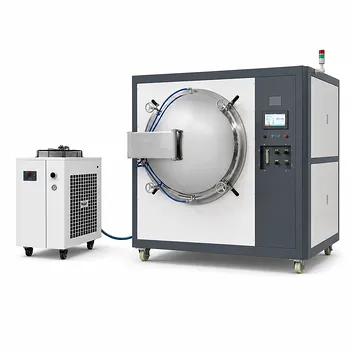
Vacuum hot-pressing acts as the critical manufacturing bridge for Y3+:CaF2 ceramics, transforming loose powder into optically transparent solids through the simultaneous application of uniaxial pressure (30 MPa) and high temperatures (850°C to 1000°C). This process relies on a strictly controlled vacuum environment to prevent the oxidation of both the sensitive fluoride ceramic powder and the graphite mold, ensuring the material remains chemically pure and structurally sound.
Core Takeaway The furnace achieves optical transparency by synergizing mechanical pressure with thermal energy to accelerate grain boundary diffusion and mass transport. This eliminates light-scattering pores and drives the material to near-theoretical density at temperatures low enough to prevent abnormal grain growth.
The Critical Role of the Vacuum Environment
Prevention of Oxidation
The primary function of the vacuum is protection. At the elevated temperatures required for sintering, both the Y3+:CaF2 powder and the graphite mold used to shape it are highly susceptible to oxidation.
Preserving Optical Purity
By removing oxygen from the chamber, the furnace prevents the formation of oxide impurities. These impurities would otherwise act as scattering centers, significantly degrading the optical transmittance of the final ceramic component.
Synergistic Effects of Heat and Pressure
Accelerating Mass Transport
While heat alone can sinter materials, the addition of 30 MPa of uniaxial pressure drastically accelerates the process. This external force acts as a catalyst for grain boundary diffusion, moving material more efficiently than thermal energy could achieve on its own.
Mechanisms of Densification
The combination of heat and pressure triggers multiple physical mechanisms simultaneously. These include particle rearrangement, sliding, and plastic deformation, which collectively close the gaps between particles much faster than pressureless sintering.
Lowering Sintering Temperatures
Because the mechanical pressure adds energy to the system, the ceramic reaches high density at relatively lower temperatures (850°C–1000°C). This is crucial because lower temperatures inhibit abnormal grain growth, preserving the fine microstructure necessary for superior mechanical and optical properties.
Achieving Optical Transparency
Complete Pore Elimination
Optical transparency in ceramics is strictly defined by the absence of pores. The vacuum hot-pressing furnace utilizes programmed pressurization to squeeze out residual gas pores located at the grain boundaries.
Approaching Theoretical Density
The process drives the material to achieve a high relative density, approaching its theoretical maximum. When the density is maximized and pores are eliminated, light can pass through the ceramic without scattering, resulting in clear, glass-like transparency.
Understanding the Trade-offs
Equipment Complexity and Cost
Vacuum hot-pressing is significantly more complex than standard atmospheric sintering. It requires robust vacuum pumps, precise hydraulic systems, and high-strength graphite tooling, representing a higher initial investment and operational cost.
Mold Constraints
The process relies heavily on graphite molds to transmit the pressure. While effective, graphite is brittle and prone to oxidation if the vacuum seal is compromised. Additionally, the geometry of the final part is often limited to simple shapes (like disks or plates) due to the nature of uniaxial pressing.
Making the Right Choice for Your Goal
To maximize the effectiveness of vacuum hot-pressing for Y3+:CaF2 ceramics, align your process control with your specific outcome:
- If your primary focus is Optical Quality: Prioritize maintaining a deep vacuum to prevent even trace oxidation of the graphite mold, which can contaminate the ceramic surface.
- If your primary focus is Mechanical Strength: Focus on the precise regulation of the 850°C–1000°C temperature range to prevent grain coarsening while ensuring full densification.
Success in transparent ceramics relies not just on applying force, but on the precise balance of pressure, heat, and atmosphere protection.
Summary Table:
| Parameter | Specification/Condition | Role in Process |
|---|---|---|
| Temperature Range | 850°C to 1000°C | Accelerates diffusion while preventing abnormal grain growth |
| Uniaxial Pressure | 30 MPa | Catalyzes grain boundary diffusion and particle rearrangement |
| Environment | High Vacuum | Prevents oxidation of graphite molds and fluoride powder |
| Mechanism | Mass Transport | Facilitates complete pore elimination and near-theoretical density |
| Outcome | Optical Transparency | Ensures high transmittance by removing light-scattering centers |
Elevate Your Advanced Material Research with KINTEK
Achieving near-theoretical density and flawless optical transparency requires precision equipment that can withstand the rigors of vacuum hot-pressing. KINTEK specializes in providing high-performance vacuum hot-pressing furnaces and robust graphite tooling designed for sensitive fluoride ceramics and advanced optical materials.
From high-temperature vacuum and atmosphere furnaces to precision hydraulic presses and specialized ceramics, our laboratory solutions are engineered to help you achieve superior microstructure control and chemical purity.
Ready to optimize your densification process? Contact KINTEK today to discuss your project needs and explore our comprehensive range of furnace systems and consumables.
Related Products
- Vacuum Hot Press Furnace Heated Vacuum Press Machine Tube Furnace
- 600T Vacuum Induction Hot Press Furnace for Heat Treat and Sintering
- Vacuum Hot Press Furnace Machine Heated Vacuum Press
- Vacuum Hot Press Furnace Machine for Lamination and Heating
- Vacuum Heat Treat and Pressure Sintering Furnace for High Temperature Applications
People Also Ask
- What advantages does a vacuum hot press furnace provide for LSLBO ceramic electrolytes? Achieve 94% Relative Density
- What role does a Vacuum Hot Press (VHP) furnace play in the densification of austenitic stainless steel 316 composites?
- What are the advantages of using a vacuum hot pressing furnace? Superior Densification for 2024Al/Gr/SiC Composites
- What are the advantages of a vacuum hot press furnace for LTPO solid electrolytes? Boost Density and Conductivity
- What core processing conditions does a vacuum hot press furnace provide? Achieve High-Density Cu-SiC/Diamond Composites