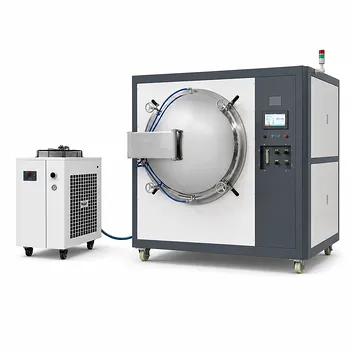
Vacuum hot pressing offers a streamlined, cost-effective alternative to Hot Isostatic Pressing (HIP) for the production of foil-fiber-foil composites. By replacing the complex vacuum canning process with a continuous, single-furnace cycle, it simplifies the workflow while using unidirectional pressure to ensure superior fiber alignment.
Core Takeaway: While HIP applies pressure from all sides, vacuum hot pressing utilizes unidirectional force to maintain critical fiber straightness. This method reduces manufacturing costs by consolidating debinding and bonding into a single step, eliminating the need for pre-process encapsulation.
Streamlining the Manufacturing Workflow
Eliminating Complex Canning
The most immediate operational advantage is the removal of the vacuum canning process. HIP typically requires the composite assembly to be encapsulated in a vacuum-sealed container before pressing, which is labor-intensive. Vacuum hot pressing bypasses this step entirely, allowing for direct processing of the stacked materials.
Single-Furnace Efficiency
This method enables a continuous production cycle. Instead of moving components between different stations for various stages, both debinding (removal of binders) and high-temperature bonding occur within the same furnace cycle. This consolidation significantly reduces total processing time and equipment footprint.
Cost Reduction
By removing the canning step and integrating thermal cycles, the overall manufacturing cost is lowered. The reduction in consumable materials (cans) and the streamlined labor requirements make vacuum hot pressing a more economical choice for flat, layered composites.
Enhancing Structural Integrity
Unidirectional vs. Omnidirectional Pressure
HIP utilizes omnidirectional pressure, applying force equally from all directions. While beneficial for complex shapes, this can be detrimental to layered composites, potentially causing fibers to shift or wavy distortions.
Superior Fiber Alignment
Vacuum hot pressing applies unidirectional mechanical pressure. This vertical force vector is ideal for foil-fiber-foil laminates, as it compresses the layers without disturbing the lateral orientation of the fibers. This ensures the fibers remain straight and aligned, which is critical for maximizing the mechanical properties of the composite.
High-Density Bonding
The combination of heat and uniaxial pressure promotes atomic diffusion and plastic flow in the matrix foils. This forces the matrix material to fill the microscopic gaps between fibers, achieving high relative densities and eliminating porosity without the extreme pressures often required by HIP.
Optimizing the Material Environment
Prevention of Oxidation
The integrated vacuum system is essential for maintaining material purity. It creates an environment that prevents the oxidation of both the metal foils and the reinforcing fibers. This ensures a clean metallurgical bond interface that is free of gas contamination and oxide layers.
Effective Densification Kinetics
Standard sintering often leaves residual pores, but vacuum hot pressing provides the necessary kinetics to overcome this. The applied pressure overcomes the non-wetting behavior of the liquid phase (in applicable alloys), forcing metal to infiltrate fiber bundles effectively for a solid, void-free composite.
Understanding the Trade-offs
Geometric Limitations
The primary limitation of vacuum hot pressing is its reliance on uniaxial force. It is highly effective for flat, laminar structures like foil-fiber-foil composites but is ill-suited for complex, non-symmetrical geometries. If your component requires uniform pressure on complex 3D curves, HIP remains the superior standard despite the added complexity.
Making the Right Choice for Your Goal
To determine if vacuum hot pressing is the correct solution for your specific application, consider your primary performance metrics:
- If your primary focus is Fiber Performance: Choose vacuum hot pressing to leverage unidirectional pressure, which guarantees the fiber straightness and alignment necessary for maximum tensile strength.
- If your primary focus is Cost and Speed: Choose vacuum hot pressing to eliminate the expensive and time-consuming vacuum canning stage, consolidating your workflow into a single cycle.
Vacuum hot pressing transforms the production of layered composites by prioritizing fiber fidelity and process efficiency over the geometric flexibility of HIP.
Summary Table:
| Feature | Vacuum Hot Pressing | Hot Isostatic Pressing (HIP) |
|---|---|---|
| Pressure Direction | Unidirectional (Mechanical) | Omnidirectional (Gas) |
| Canning Requirement | Not Required | Mandatory (Vacuum Sealing) |
| Fiber Alignment | Superior (Maintains Straightness) | Potential for Distortion/Waviness |
| Process Workflow | Single-Cycle (Integrated Debinding) | Multi-Stage Process |
| Ideal Geometry | Flat, Laminar Structures | Complex 3D Shapes |
| Manufacturing Cost | Lower (Less Labor/Consumables) | Higher (Expensive Encapsulation) |
Maximize Your Composite Performance with KINTEK
Elevate your material science outcomes with KINTEK’s advanced thermal processing solutions. Whether you are developing foil-fiber-foil laminates or high-performance ceramics, our vacuum hot pressing furnaces and isostatic presses provide the precision control required for high-density bonding and perfect fiber alignment.
Why partner with KINTEK?
- Precision Engineering: Our range includes muffle, tube, and vacuum furnaces designed for strict atmospheric control.
- Complete Lab Ecosystem: From crushing and milling systems to hydraulic pellet presses and high-temperature reactors, we equip your entire workflow.
- Expert Support: We help you choose the right kinetics—whether you need uniaxial pressure for flat composites or HIP for complex geometries.
Ready to streamline your production and reduce manufacturing costs? Contact our technical experts today to find the perfect equipment for your laboratory or industrial application.
Related Products
- Vacuum Hot Press Furnace Heated Vacuum Press Machine Tube Furnace
- 600T Vacuum Induction Hot Press Furnace for Heat Treat and Sintering
- Vacuum Hot Press Furnace Machine Heated Vacuum Press
- Vacuum Hot Press Furnace Machine for Lamination and Heating
- Vacuum Heat Treat and Pressure Sintering Furnace for High Temperature Applications
People Also Ask
- What advantages does a vacuum hot press furnace provide for LSLBO ceramic electrolytes? Achieve 94% Relative Density
- What role does a Vacuum Hot Press (VHP) furnace play in the densification of austenitic stainless steel 316 composites?
- What are the advantages of using a vacuum hot pressing furnace? Superior Densification for 2024Al/Gr/SiC Composites
- What are the advantages of a vacuum hot press furnace for LTPO solid electrolytes? Boost Density and Conductivity
- What core processing conditions does a vacuum hot press furnace provide? Achieve High-Density Cu-SiC/Diamond Composites