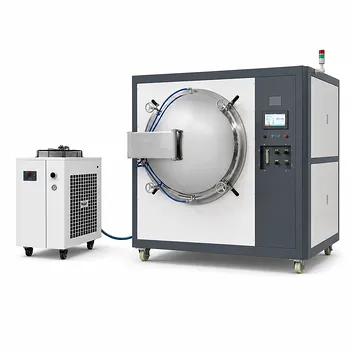
The vacuum system serves as the critical defense against chemical degradation during the consolidation process. When preparing ODS ferritic stainless steel at high temperatures (e.g., 1170 °C), alloying elements like chromium, aluminum, and titanium become highly reactive. A robust vacuum system maintaining levels around $10^{-3}$ Torr is required to eliminate residual oxygen, preventing these elements from forming coarse surface oxide films that would otherwise destroy the material's performance.
The success of ODS steel preparation relies on distinguishing between "good" oxides and "bad" oxides. The vacuum system ensures that while the intentional nano-oxide strengthening phases remain stable, the matrix elements are protected from uncontrolled oxidation and impurity contamination.
The Chemistry of High-Temperature Consolidation
Managing Reactive Elements
Ferritic stainless steels rely on elements such as chromium, aluminum, and titanium for their specific properties. However, at the requisite consolidation temperatures (often nearing 1170 °C), these metals possess a high affinity for oxygen. Without a controlled environment, they react instantly to form unwanted compounds.
Preventing Coarse Oxide Formation
If residual oxygen is present, these reactive elements form coarse surface oxide films. Unlike the dispersed nano-oxides that provide strength, these surface films act as defects. They weaken the material structure and reduce the overall quality of the alloy.
Eliminating Impurities
The vacuum system does more than just lower pressure; it actively removes gaseous impurities. By maintaining a vacuum level of $10^{-3}$ Torr, the system purges the chamber of contaminants that could become trapped within the steel matrix during the hot pressing process.
Achieving Structural Integrity
Ensuring Stable Interfacial Bonding
High-performance ODS steel depends on the relationship between the metal matrix and the nano-oxide particles. The vacuum environment ensures stable interfacial bonding between these two distinct phases. If oxidation occurs at these interfaces, the bond weakens, leading to premature material failure.
Preserving Ultrafine Grain Structures
Vacuum Hot Pressing (VHP) is designed to achieve rapid densification through simultaneous heat and pressure. The vacuum environment aids this by inhibiting excessive grain growth. This preserves the ultrafine or nanocrystalline structure of the alloy, which is essential for high hardness and compressive strength.
Understanding the Trade-offs
Equipment Selection Complexity
Not all vacuum systems are equal. You must select between low, medium, and high vacuum configurations (using rotary vane, Roots, or diffusion pumps) based on specific process needs. A system that cannot reach the required vacuum level (e.g., $7 \times 10^{-3}$ Pa) will result in compromised material properties.
Maintenance and Contamination Risks
A vacuum furnace is sensitive to its own history. The chamber must be cleaned regularly to prevent cross-contamination from previous runs. Neglecting this maintenance can lead to pump inefficiency or safety hazards, such as fires, which disrupts the precise environment needed for ODS steel.
Making the Right Choice for Your Goal
- If your primary focus is mechanical strength: Ensure your vacuum system can reliably maintain $10^{-3}$ Torr to protect the reactivity of Chromium and Titanium, ensuring maximum interfacial bonding.
- If your primary focus is microstructural consistency: Prioritize a VHP system with precise pressure and temperature synchronization to inhibit grain growth while the vacuum prevents surface oxidation.
By rigorously controlling the vacuum environment, you transform a bundle of reactive powders into a cohesive, high-performance alloy capable of withstanding extreme conditions.
Summary Table:
| Feature | Role in ODS Steel Preparation | Key Benefit |
|---|---|---|
| Vacuum Level | $10^{-3}$ Torr to $7 \times 10^{-3}$ Pa | Prevents coarse surface oxide film formation |
| Atmosphere Control | Purges residual oxygen and gaseous impurities | Protects reactive Cr, Al, and Ti elements |
| Interface Bonding | Maintains clean metal-to-oxide interfaces | Ensures high-strength stable interfacial bonds |
| Microstructure | Inhibits excessive grain growth | Preserves ultrafine/nanocrystalline structure |
Elevate Your Material Research with KINTEK Precision
Don't let residual oxidation compromise your high-performance alloys. KINTEK specializes in advanced laboratory equipment, offering high-end Vacuum Hot Pressing (VHP) systems, high-temperature furnaces, and precision crushing and milling tools designed for the rigorous demands of ODS steel production.
Whether you require vacuum, atmosphere, or induction melting furnaces to protect reactive elements, or hydraulic presses for densification, our comprehensive portfolio ensures your research achieves maximum structural integrity and mechanical strength.
Ready to optimize your consolidation process? Contact us today to find the perfect equipment solution for your lab!
References
- Dharmalingam Ganesan, Konda Gokuldoss Prashanth. Vacuum Hot Pressing of Oxide Dispersion Strengthened Ferritic Stainless Steels: Effect of Al Addition on the Microstructure and Properties. DOI: 10.3390/jmmp4030093
This article is also based on technical information from Kintek Solution Knowledge Base .
Related Products
- Vacuum Hot Press Furnace Heated Vacuum Press Machine Tube Furnace
- 600T Vacuum Induction Hot Press Furnace for Heat Treat and Sintering
- Vacuum Hot Press Furnace Machine Heated Vacuum Press
- Vacuum Hot Press Furnace Machine for Lamination and Heating
- Vacuum Heat Treat and Pressure Sintering Furnace for High Temperature Applications
People Also Ask
- What advantages does a vacuum hot press furnace provide for LSLBO ceramic electrolytes? Achieve 94% Relative Density
- What role does a Vacuum Hot Press (VHP) furnace play in the densification of austenitic stainless steel 316 composites?
- What are the advantages of using a vacuum hot pressing furnace? Superior Densification for 2024Al/Gr/SiC Composites
- What are the advantages of a vacuum hot press furnace for LTPO solid electrolytes? Boost Density and Conductivity
- What core processing conditions does a vacuum hot press furnace provide? Achieve High-Density Cu-SiC/Diamond Composites