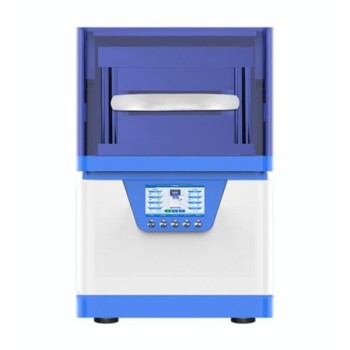
Vacuum Hot Pressing (VHP) fundamentally outperforms traditional sintering by leveraging simultaneous thermal and mechanical energy. While traditional methods rely on pressureless heating which can leave residual porosity, VHP applies high pressure in a controlled vacuum to achieve rapid densification. This process delivers ODS ferritic stainless steel with superior relative density, enhanced mechanical properties, and a preserved nanocrystalline structure.
Core Insight: The definitive advantage of VHP is its ability to decouple densification from grain growth. By introducing mechanical pressure, VHP achieves near-theoretical density at speeds that prevent the microstructure from coarsening, a common failure point in traditional pressureless sintering.
The Mechanism of Superior Densification
Simultaneous Heat and Pressure
Traditional sintering relies primarily on thermal diffusion to bond particles, often leaving gaps. VHP applies mechanical pressure (up to 30 MPa) concurrently with high temperatures (900-1300°C).
Plastic Deformation
This external pressure forces powder particles to rearrange and undergo plastic deformation. This mechanism actively closes voids that thermal energy alone cannot resolve.
Achieving Near-Theoretical Density
Through diffusion creep and physical compression, VHP eliminates residual porosity. This results in material densities reaching up to 98% of the theoretical maximum, comparable to forged materials.
Preserving Microstructural Integrity
Inhibiting Grain Growth
Prolonged exposure to high heat in traditional sintering often causes grains to merge and expand, weakening the alloy. VHP achieves consolidation rapidly, effectively inhibiting excessive grain growth.
Retaining Nanocrystalline Structures
Because the process is faster and pressure-assisted, the alloy retains its original ultrafine or nanocrystalline structure. This structural preservation is critical for the unique performance characteristics of ODS steels.
Enhancing Mechanical Performance
The combination of high density and fine grain structure directly improves mechanical limits. The resulting steel exhibits significantly higher hardness and compressive strength compared to sintered alternatives.
The Critical Role of the Vacuum Environment
Controlling Oxidation
Ferritic steels often contain reactive elements like Chromium, Aluminum, and Titanium. In standard environments, these elements react with oxygen at high temperatures (e.g., 1170°C) to form unwanted, coarse surface oxide films.
Eliminating Impurities
VHP systems maintain a high vacuum (e.g., 10^-3 Torr) to strip residual oxygen from the chamber. This prevents the introduction of impurities that would otherwise compromise the material's integrity.
Ensuring Interfacial Stability
By preventing surface oxidation, the vacuum ensures stable interfacial bonding between the matrix and the intentional nano-oxide strengthening phases. This creates a cohesive material that resists performance degradation.
Understanding the Trade-offs
Equipment Complexity
VHP offers superior results but requires significantly more complex machinery than standard furnaces. Operators must manage hydraulic systems, vacuum integrity, and thermal profiles simultaneously.
Throughput Limitations
Because VHP applies pressure to a specific mold or die, it is generally a batch process. This differs from continuous sintering lines, potentially limiting throughput speed in favor of maximizing individual component quality.
Making the Right Choice for Your Goal
When selecting a consolidation method for ODS ferritic stainless steel, consider your specific performance requirements:
- If your primary focus is Maximum Mechanical Strength: VHP is essential, as the simultaneous pressure yields higher density and hardness than pressureless sintering can achieve.
- If your primary focus is Microstructural Control: VHP is the superior choice, as it densifies the material before grains have time to coarsen, preserving the nanocrystalline state.
By applying force and vacuum simultaneously, VHP transforms ODS steel from a porous aggregate into a fully dense, high-performance structural material.
Summary Table:
| Feature | Traditional Sintering | Vacuum Hot Pressing (VHP) |
|---|---|---|
| Mechanism | Pressureless Thermal Diffusion | Simultaneous Heat & Mechanical Pressure |
| Relative Density | Often < 90% (Residual Porosity) | Up to 98% (Near-Theoretical) |
| Microstructure | Prone to Coarse Grain Growth | Preserves Nanocrystalline Structure |
| Oxidation Control | Dependent on Atmosphere | High Vacuum (Prevents Surface Oxides) |
| Mechanical Properties | Standard Performance | Superior Hardness & Compressive Strength |
Elevate Your Material Research with KINTEK Precision
Unlock the full potential of ODS ferritic stainless steel and advanced alloys with KINTEK’s high-performance Vacuum Hot Pressing (VHP) systems. Whether you are targeting near-theoretical density or precise microstructural control, our expert-grade laboratory equipment is designed to meet the most demanding thermal and mechanical requirements.
Why choose KINTEK?
- Comprehensive Laboratory Solutions: From vacuum, tube, and muffle furnaces to advanced CVD/PECVD systems.
- Precision Engineering: High-pressure hydraulic presses and specialized sintering tools for consistent, repeatable results.
- Full Lifecycle Support: We provide high-quality consumables like crucibles, ceramics, and cooling solutions to keep your lab running efficiently.
Ready to transform your powder metallurgy results? Contact our technical specialists today to find the perfect equipment for your research goals!
References
- Dharmalingam Ganesan, Konda Gokuldoss Prashanth. Vacuum Hot Pressing of Oxide Dispersion Strengthened Ferritic Stainless Steels: Effect of Al Addition on the Microstructure and Properties. DOI: 10.3390/jmmp4030093
This article is also based on technical information from Kintek Solution Knowledge Base .
Related Products
- Vacuum Hot Press Furnace Machine Heated Vacuum Press
- Vacuum Hot Press Furnace Heated Vacuum Press Machine Tube Furnace
- 600T Vacuum Induction Hot Press Furnace for Heat Treat and Sintering
- Electric Heated Hydraulic Vacuum Heat Press for Lab
- Vacuum Hot Press Furnace Machine for Lamination and Heating
People Also Ask
- What advantages does a vacuum hot press furnace provide for LSLBO ceramic electrolytes? Achieve 94% Relative Density
- What role does a Vacuum Hot Press (VHP) furnace play in the densification of austenitic stainless steel 316 composites?
- What are the advantages of using a vacuum hot pressing furnace? Superior Densification for 2024Al/Gr/SiC Composites
- Why is it necessary to maintain a high-vacuum environment within a vacuum hot press furnace? Optimize Cu-SiC Sintering
- Why is a high-precision temperature control system in a vacuum hot press furnace critical? Perfect Cu-Ti3SiC2 Synthesis