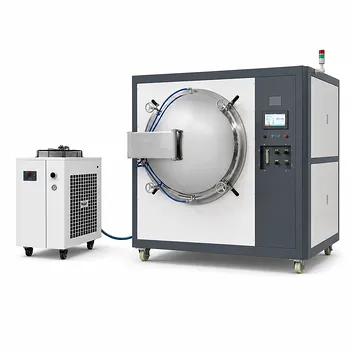
A vacuum hot press sintering furnace creates a synergistic environment defined by precise thermal, atmospheric, and mechanical controls. Specifically, for the fabrication of GNPs-Cu/Ti6Al4V composites, the furnace provides a high-temperature environment of 1150°C, a high vacuum level of 10^-2 Pa, and a continuous mechanical axial pressure of 35 MPa.
Core Takeaway By simultaneously applying axial pressure and high heat within a vacuum, this process drives the relative density of the material to 99.4% while chemically activating the interface between copper and titanium to form essential reinforcing phases.
The Trio of Critical Processing Conditions
The effectiveness of this fabrication method relies on the precise interplay of three distinct physical conditions.
High-Temperature Environment (1150°C)
The furnace maintains a processing temperature of 1150°C. This thermal energy is the primary driver for solid-state diffusion.
At this temperature, the atomic mobility within the powder matrix increases significantly. This heat is necessary to initiate the reactions required to bond the composite materials effectively.
High-Vacuum Atmosphere (10^-2 Pa)
Maintaining a vacuum level of 10^-2 Pa is critical for material purity. This low-pressure atmosphere actively discharges adsorbed gases and volatiles from the gaps between powder particles.
More importantly, this environment prevents the oxidation of the metallic matrix. Since both Titanium (Ti) and Copper (Cu) are susceptible to oxidation at high temperatures, the vacuum ensures that the surface of the particles remains metallic and reactive.
Mechanical Axial Pressure (35 MPa)
Unlike standard sintering, this furnace applies a mechanical axial pressure of 35 MPa during the heating process.
This external force is the key differentiator. It physically forces the powder particles together, overcoming the resistance that typically leaves pores in pressureless sintering.
Mechanisms of Material Transformation
The conditions described above are not merely settings on a machine; they induce specific physical and chemical changes within the composite material.
Promoting Plastic Flow and Densification
The combination of 1150°C heat and 35 MPa pressure creates a "coupling effect." This environment promotes the plastic flow of the powder particles.
Because the material is softened by heat and compressed by force, particles deform to fill voids. This eliminates residual pores often found in cold-pressed materials, resulting in a near-theoretical relative density of 99.4%.
Facilitating Interfacial Reactions
The vacuum hot press process does more than just compact the powder; it acts as a chemical reactor.
Because the vacuum prevents oxide layers from forming, the interface between the Copper (Cu) and the Titanium (Ti) matrix remains active. This facilitates a reaction that generates Ti2Cu and TiC (Titanium Carbide). These are critical reinforcing phases that enhance the properties of the final composite.
Understanding the Trade-offs
While vacuum hot pressing yields superior density and interfacial bonding, it introduces specific constraints that must be managed.
Geometry Limitations
The pressure applied is axial (unidirectional). This generally limits the process to producing simple shapes, such as discs or flat plates. Complex geometries with undercuts or intricate internal features are difficult to fabricate directly and may require post-processing.
Throughput vs. Quality
This is inherently a batch process. Achieving high vacuum and precise thermal equilibrium takes time. While the resulting material quality (density and purity) is significantly higher than conventional sintering, the production rate is generally lower.
Making the Right Choice for Your Goal
To maximize the utility of a vacuum hot press sintering furnace for your GNPs-Cu/Ti6Al4V project, align your parameters with your specific performance targets.
- If your primary focus is Structural Integrity: Ensure the 35 MPa pressure is maintained throughout the peak temperature phase to maximize plastic flow and achieve the 99.4% density benchmark.
- If your primary focus is Material Purity: Verify the vacuum system can consistently hold 10^-2 Pa to prevent matrix oxidation and ensure a clean Cu-Ti interface.
- If your primary focus is Reinforcement Strength: Closely monitor the dwell time at 1150°C, as this thermal window drives the formation of the Ti2Cu and TiC reinforcing phases.
The vacuum hot press is the definitive tool when the goal is converting loose powder into a dense, chemically reacted, and defect-free high-performance composite.
Summary Table:
| Parameter | Specification | Functional Role in Fabrication |
|---|---|---|
| Sintering Temperature | 1150°C | Drives solid-state diffusion and initiates chemical reactions. |
| Vacuum Level | 10^-2 Pa | Prevents oxidation of Ti/Cu and removes adsorbed gases. |
| Axial Pressure | 35 MPa | Promotes plastic flow to eliminate pores and maximize density. |
| Final Density | 99.4% | Ensures superior structural integrity and mechanical performance. |
| Reinforcing Phases | Ti2Cu, TiC | Facilitates interfacial bonding for high-performance composites. |
Elevate Your Materials Research with KINTEK
Precise control over temperature, pressure, and atmosphere is the difference between a failed sample and a high-performance composite. KINTEK specializes in advanced laboratory equipment, providing the cutting-edge vacuum hot press sintering furnaces and hydraulic presses needed to achieve near-theoretical density in complex materials like GNPs-Cu/Ti6Al4V.
From high-temperature furnaces (muffle, tube, vacuum, and CVD) to specialized crushing and milling systems, we provide researchers with the tools to innovate. Our portfolio also features high-pressure reactors, battery research tools, and essential ceramics to support your entire workflow.
Ready to achieve 99.4% density in your next project?
Contact Our Technical Experts Today to find the perfect equipment solution for your laboratory.
Related Products
- 600T Vacuum Induction Hot Press Furnace for Heat Treat and Sintering
- Vacuum Heat Treat and Sintering Furnace with 9MPa Air Pressure
- Vacuum Heat Treat and Pressure Sintering Furnace for High Temperature Applications
- 2200 ℃ Tungsten Vacuum Heat Treat and Sintering Furnace
- Vacuum Hot Press Furnace Heated Vacuum Press Machine Tube Furnace
People Also Ask
- What role does an induction vacuum hot pressing furnace play in sintering? Achieve 98% Density in Carbide Blocks
- What advantages does a vacuum hot press furnace provide for LSLBO ceramic electrolytes? Achieve 94% Relative Density
- What role does a Vacuum Hot Press (VHP) furnace play in the densification of austenitic stainless steel 316 composites?
- What are the advantages of a vacuum hot press furnace for W-50%Cu? Achieve 99.6% Density at Lower Temperatures
- What role does mechanical pressure play during the vacuum diffusion bonding of tungsten and copper? Keys to Solid Bonding