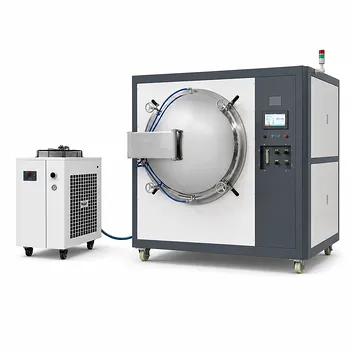
The high-temperature environment of 1750 to 1900°C is the critical catalyst required to overcome the thermodynamic energy barriers essential for in-situ chemical synthesis. Specifically, this thermal energy enables the TiO2 sintering aid to react chemically with the B4C and C matrix, creating the TiB2 reinforcing phase while simultaneously driving the physical diffusion necessary for densification.
Core Insight: The vacuum hot pressing furnace acts as a dual-function reactor. It does not merely heat the material; it supplies the precise thermal activation energy needed to transform raw sintering aids (TiO2) into structural reinforcements (TiB2) while physically fusing ceramic particles to strengthen the composite.
Overcoming Reaction Energy Barriers
The primary significance of reaching the 1750–1900°C range is chemical activation. At lower temperatures, the constituent materials would remain inert or react incompletely.
Activation of Sintering Aids
The furnace provides sufficient thermal energy to activate the TiO2 sintering aid. Without this extreme heat, the reaction kinetics would be too sluggish to be effective within a reasonable processing timeframe.
In-Situ Formation of TiB2
This temperature range drives the specific reaction between the TiO2 aid, the B4C (Boron Carbide), and the Carbon (C) in the matrix. The result is the in-situ formation of Titanium Diboride (TiB2).
Strategic Reinforcement
The creation of TiB2 is not a byproduct but a targeted goal. This phase acts as a reinforcement within the composite, significantly altering its final properties.
Driving Physical Densification
Beyond chemical reactions, the high thermal energy fundamentally changes the physical structure of the composite through material transport mechanisms.
Facilitating Material Diffusion
At 1750–1900°C, atomic mobility increases drastically. This allows atoms to diffuse across particle boundaries, a process that is essentially frozen at lower temperatures.
Promoting Neck Growth
The thermal energy promotes "neck growth" between adjacent ceramic particles. This is the physical merging of particles at their contact points.
Strengthening and Toughening
The combination of diffusion and neck growth eliminates voids and creates a continuous, cohesive structure. This microstructural evolution is directly responsible for the mechanical strengthening and toughening of the final C-SiC-B4C material.
The Critical Role of the Vacuum (Operational Context)
While the temperature drives the reaction, the vacuum environment is the enabler that allows this process to occur without destroying the material.
Preventing Catastrophic Oxidation
At temperatures approaching 1900°C, Carbon and Boron Carbide are highly susceptible to oxidation. The vacuum environment strips away oxygen, preventing the matrix from burning away before the ceramic can sinter.
Enhancing Interface Purity
The vacuum actively extracts volatile gases and impurities trapped between powder particles. This ensures that the diffusion bonding described above occurs between clean surfaces, maximizing the strength of the particle interfaces.
Making the Right Choice for Your Goal
The specific parameters you choose within the 1750–1900°C window will dictate the balance between reaction completeness and microstructural integrity.
- If your primary focus is Phase Composition (Chemistry): Ensure the temperature is sufficient to fully overcome the activation barrier for the TiO2 conversion, ensuring no unreacted sintering aid remains.
- If your primary focus is Mechanical Density (Physics): Prioritize temperatures that maximize neck growth and diffusion to eliminate porosity, but be wary of excessive grain growth if held too long.
Ultimately, the 1750–1900°C window is not just about heating; it is about reaching the precise thermodynamic threshold where sintering aids transform into structural reinforcement.
Summary Table:
| Feature | Significance (1750–1900°C) | Outcome |
|---|---|---|
| Chemical Activation | Overcomes thermodynamic barriers for TiO2 + B4C + C | In-situ TiB2 reinforcing phase |
| Material Diffusion | Increases atomic mobility across particle boundaries | High-density, void-free structure |
| Physical Sintering | Promotes "neck growth" between ceramic particles | Enhanced mechanical toughness |
| Vacuum Environment | Prevents oxidation of Carbon and B4C | High interface purity and strength |
Elevate Your Material Science with KINTEK Precision
Maximize the potential of your C-SiC-B4C composites with KINTEK’s industry-leading thermal technology. Whether you require high-performance vacuum hot pressing furnaces, CVD/PECVD systems, or crushing and milling equipment for powder preparation, we provide the tools necessary to overcome complex thermodynamic barriers.
From high-temperature high-pressure reactors to specialized ceramics and crucibles, KINTEK supports laboratory and industrial-scale research with unrivaled reliability. Let our experts help you achieve the precise temperature control and vacuum integrity your advanced materials demand.
Contact KINTEK Today for a Custom Solution
Related Products
- 600T Vacuum Induction Hot Press Furnace for Heat Treat and Sintering
- Vacuum Hot Press Furnace Heated Vacuum Press Machine Tube Furnace
- Vacuum Hot Press Furnace Machine for Lamination and Heating
- Vacuum Hot Press Furnace Machine Heated Vacuum Press
- Vacuum Heat Treat and Pressure Sintering Furnace for High Temperature Applications
People Also Ask
- What role does an induction vacuum hot pressing furnace play in sintering? Achieve 98% Density in Carbide Blocks
- What advantages does a vacuum hot press furnace provide for LSLBO ceramic electrolytes? Achieve 94% Relative Density
- What role does a Vacuum Hot Press (VHP) furnace play in the densification of austenitic stainless steel 316 composites?
- What are the advantages of a vacuum hot press furnace for W-50%Cu? Achieve 99.6% Density at Lower Temperatures
- What role does mechanical pressure play during the vacuum diffusion bonding of tungsten and copper? Keys to Solid Bonding