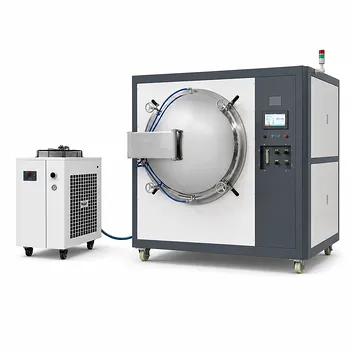
A vacuum hot pressing furnace operates as a comprehensive, synergistic processing platform. Its core function in fabricating Al2O3/Cu-Cr composites is to simultaneously apply high thermal energy (typically 950°C), substantial mechanical pressure (around 22 MPa), and a high-vacuum environment. This combination drives the material to achieve near-theoretical density while strictly controlling the chemical environment to facilitate necessary internal reactions without contamination.
Core Takeaway: The primary value of this equipment is its ability to overcome the limitations of conventional atmospheric sintering. By coupling mechanical pressure with a vacuum, it forces particle rearrangement to achieve densities exceeding 99.5% while effectively removing interstitial gases generated during the critical internal oxidation phase.
The Mechanics of Densification
Promoting Plastic Flow
The application of mechanical pressure is the defining advantage of this process over standard sintering. Under a load of approximately 22 MPa, the powder particles within the composite are forced into close contact. This pressure promotes the plastic flow of the copper matrix, ensuring voids are physically closed.
Achieving Extreme Density
Because the material is compressed while in a heated, malleable state, the furnace enables the composite to reach densities above 99.5%. This level of consolidation is exceptionally difficult to achieve through pressureless heating alone, as the mechanical force actively eliminates porosity that thermal diffusion might miss.
Particle Rearrangement
The simultaneous application of heat and pressure facilitates the physical rearrangement of the Al2O3 and Cu-Cr particles. This ensures a uniform distribution of the reinforcement phase within the matrix, which is essential for consistent mechanical properties across the final component.
Chemical Environment Control
Accelerating Gas Removal
The high-vacuum environment performs a critical extraction function. It accelerates the removal of interstitial gases trapped between powder particles. Without this active extraction, these gases would remain trapped as pores, weakening the final composite.
Facilitating Internal Oxidation
For Al2O3/Cu-Cr composites, the vacuum plays a nuanced role regarding oxidation. While it prevents unwanted external oxidation of the copper, it is essential for managing the gases generated during the internal oxidation reaction. The vacuum ensures these reaction byproducts are evacuated efficiently, allowing the internal oxidation process to complete fully.
Preventing Contamination
By removing oxygen and other reactive atmospheric elements, the furnace preserves the purity of the copper and chromium elements. This ensures that the only oxides present are the intended Al2O3 reinforcements, maintaining the electrical and thermal conductivity of the matrix.
Understanding the Trade-offs
Process Complexity vs. Performance
While vacuum hot pressing offers superior density and purity, it introduces significant complexity compared to atmospheric sintering. The equipment requires precise synchronization of thermal and hydraulic systems, making the process more equipment-intensive.
Throughput Constraints
Because the pressure must be applied physically to the mold, this is inherently a batch process. Unlike continuous sintering furnaces used for lower-grade materials, vacuum hot pressing limits the geometry and quantity of parts that can be produced in a single cycle.
Making the Right Choice for Your Goal
The decision to utilize a vacuum hot pressing furnace depends on the specific performance requirements of your composite material.
- If your primary focus is maximum density: This method is non-negotiable, as it is the only reliable way to achieve >99.5% density through mechanical plastic flow.
- If your primary focus is microstructural purity: The vacuum environment provides the necessary control to remove reaction byproducts and interstitial gases that compromise material integrity.
Summary: For Al2O3/Cu-Cr composites, the vacuum hot pressing furnace is not merely a heating tool, but a requisite densification instrument that mechanically forces porosity closure while chemically cleansing the internal microstructure.
Summary Table:
| Feature | Vacuum Hot Pressing Function | Benefit for Al2O3/Cu-Cr Composites |
|---|---|---|
| Mechanical Pressure | Applies ~22 MPa load | Promotes plastic flow and eliminates internal porosity |
| High Temperature | Precise heating to ~950°C | Enables particle rearrangement and material malleability |
| Vacuum Environment | Active gas extraction | Accelerates removal of interstitial gases and reaction byproducts |
| Atmosphere Control | Oxygen-free processing | Prevents external oxidation while facilitating internal oxidation |
| Final Density | Synergistic densification | Achieves near-theoretical density exceeding 99.5% |
Elevate Your Material Integrity with KINTEK
Precision engineering demands uncompromising material density and purity. KINTEK specializes in advanced laboratory equipment, offering high-performance vacuum hot pressing furnaces, muffle and tube furnaces, and hydraulic presses designed specifically for the most demanding research and production environments.
Whether you are fabricating Al2O3/Cu-Cr composites or exploring new powder metallurgy frontiers, our comprehensive range of high-temperature solutions, crushing systems, and essential consumables like ceramics and crucibles ensures your lab achieves superior results.
Ready to optimize your fabrication process? Contact our technical experts today to find the perfect thermal and pressure solution for your specific application.
Related Products
- Vacuum Hot Press Furnace Heated Vacuum Press Machine Tube Furnace
- 600T Vacuum Induction Hot Press Furnace for Heat Treat and Sintering
- Vacuum Hot Press Furnace Machine Heated Vacuum Press
- Vacuum Hot Press Furnace Machine for Lamination and Heating
- Vacuum Heat Treat and Pressure Sintering Furnace for High Temperature Applications
People Also Ask
- What advantages does a vacuum hot press furnace provide for LSLBO ceramic electrolytes? Achieve 94% Relative Density
- What role does a Vacuum Hot Press (VHP) furnace play in the densification of austenitic stainless steel 316 composites?
- What are the advantages of using a vacuum hot pressing furnace? Superior Densification for 2024Al/Gr/SiC Composites
- What are the advantages of a vacuum hot press furnace for LTPO solid electrolytes? Boost Density and Conductivity
- What core processing conditions does a vacuum hot press furnace provide? Achieve High-Density Cu-SiC/Diamond Composites