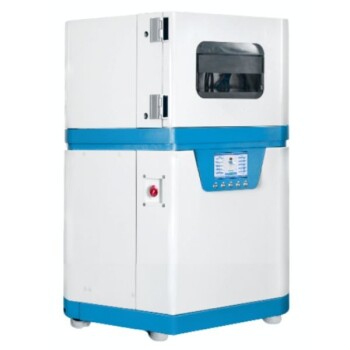
The vacuum hot-press furnace acts as the primary thermodynamic and mechanical driver in the creation of C-SiC-B4C-TiB2 composites, simultaneously managing chemical synthesis and structural densification. It creates a specialized environment characterized by extreme temperatures (1950 to 2000°C), a high vacuum (30 Pa), and substantial axial pressure (25 MPa). This trifecta of conditions enables the in-situ reaction of precursors like TiO2 and B4C to form the reinforcing TiB2 phase while physically forcing the elimination of material porosity.
The vacuum hot-press furnace does not merely heat the material; it provides the activation energy required to chemically grow reinforcing phases inside the matrix while mechanically compressing the structure to near-theoretical density.
Facilitating In-Situ Chemical Synthesis
The production of C-SiC-B4C-TiB2 involves complex chemistry that cannot occur under standard ambient conditions. The furnace provides the precise environment needed to initiate and sustain these reactions.
Overcoming Reaction Energy Barriers
The chemical transformation of precursors requires significant thermal energy. The furnace reaches temperatures between 1950°C and 2000°C, supplying the heat necessary to overcome the reaction energy barriers of the ceramic components.
Driving the TiO2 and B4C Reaction
Specifically, this thermal environment enables the reaction between Titanium Dioxide (TiO2) and Boron Carbide (B4C). Within this high-temperature window, these compounds react in-situ (within the matrix itself) to synthesize Titanium Diboride (TiB2), a critical reinforcing phase for the composite.
Enhancing Atomic Diffusion
The sustained high heat promotes atomic diffusion across grain boundaries. This diffusion is essential for neck growth between ceramic particles, which strengthens the metallurgical bond between the newly formed TiB2 and the surrounding matrix.
Achieving Structural Densification
Synthesis is only half the equation; the material must also be solid and void-free. The vacuum hot-press furnace utilizes mechanical force to achieve densification levels that pressureless sintering cannot match.
Forcing Particle Rearrangement
The furnace applies a continuous axial pressure of 25 MPa. This mechanical force physically pushes the ceramic particles into a tighter configuration, reducing the volume of the bulk material and maximizing contact points.
Inducing Plastic Flow
Under the combination of high heat and high pressure, the ceramic particles undergo plastic flow. This deformation allows the material to fill interstitial gaps, effectively closing the voids that naturally exist between powder particles.
Eliminating Residual Porosity
The primary goal of this mechanical compression is the elimination of pores. By forcing the material to flow and rearrange, the furnace ensures the final composite achieves high density and superior mechanical integrity.
The Critical Role of the Vacuum Environment
The "vacuum" component of the furnace is just as vital as the heat and pressure. Maintained at approximately 30 Pa, the vacuum environment dictates the purity of the final composite.
Preventing Oxidation
At temperatures approaching 2000°C, materials are highly susceptible to oxidation. The vacuum eliminates oxygen from the chamber, preventing the degradation of the carbon and ceramic components during the prolonged heating cycle.
Gas Removal and Impurity Control
The vacuum actively aids in degassing the material. It helps evacuate gases trapped within powder gaps, preventing them from becoming sealed inside the final product as defects.
Understanding the Trade-offs
While the vacuum hot-press furnace is essential for high-performance composites, it introduces specific constraints that must be managed.
Geometric Limitations
The pressure applied is typically unidirectional (axial). This limits the complexity of the shapes that can be produced, often restricting output to simple geometries like plates or discs that require subsequent machining.
Process Efficiency
This is a batch process rather than a continuous one. The requirement to pump down to a high vacuum (30 Pa) and ramp up to extreme temperatures (2000°C) results in longer cycle times compared to other sintering methods.
Making the Right Choice for Your Goal
When utilizing a vacuum hot-press furnace for C-SiC-B4C-TiB2 composites, your operational parameters should align with your specific material objectives.
- If your primary focus is Phase Synthesis: Ensure your temperature profile holds steadily between 1950°C and 2000°C to guarantee the complete conversion of TiO2 and B4C into TiB2.
- If your primary focus is Maximum Density: Prioritize the maintenance of constant axial pressure (25 MPa) throughout the high-temperature dwell time to maximize plastic flow and pore closure.
- If your primary focus is Material Purity: Verify that the vacuum level is maintained at or below 30 Pa to prevent oxidation and ensure the effective removal of trapped gases.
Ultimately, the vacuum hot-press furnace transforms a mixture of loose powders into a unified, high-strength composite by strictly controlling the interplay between thermodynamics and mechanics.
Summary Table:
| Parameter | Operating Specification | Function in Composite Synthesis |
|---|---|---|
| Temperature | 1950°C to 2000°C | Supplies activation energy for TiO2 and B4C reaction |
| Pressure | 25 MPa (Axial) | Drives particle rearrangement and plastic flow for densification |
| Vacuum Level | 30 Pa | Prevents oxidation and enables degassing of trapped impurities |
| Phase Result | In-situ TiB2 formation | Creates high-strength reinforcing phases within the matrix |
| Density | Near-theoretical | Eliminates residual porosity for superior mechanical integrity |
Elevate Your Material Research with KINTEK Precision
Unlock the full potential of high-performance ceramics and composites with KINTEK’s advanced thermal processing solutions. Whether you are synthesizing complex C-SiC-B4C-TiB2 structures or developing the next generation of aerospace materials, our high-temperature vacuum hot-press furnaces provide the exact thermodynamic and mechanical control required for near-theoretical densification.
Our Comprehensive Laboratory Portfolio Includes:
- High-Temperature Furnaces: Muffle, tube, vacuum, and specialized atmosphere furnaces capable of reaching 2000°C+.
- Advanced Pressing Systems: Hydraulic pellet presses, hot presses, and isostatic systems for uniform material compaction.
- Reaction & Synthesis Tools: High-temperature high-pressure reactors, autoclaves, and specialized electrolytic cells.
- Processing & Analysis: Crushing, milling, and sieving equipment, alongside essential consumables like crucibles and ceramics.
Don't let equipment limitations hinder your innovation. Contact KINTEK today to discuss your specific application and discover how our laboratory expertise can optimize your synthesis and densification workflows.
Related Products
- Vacuum Hot Press Furnace Heated Vacuum Press Machine Tube Furnace
- 600T Vacuum Induction Hot Press Furnace for Heat Treat and Sintering
- Vacuum Hot Press Furnace Machine Heated Vacuum Press
- Vacuum Hot Press Furnace Machine for Lamination and Heating
- Vacuum Heat Treat and Pressure Sintering Furnace for High Temperature Applications
People Also Ask
- What advantages does a vacuum hot press furnace provide for LSLBO ceramic electrolytes? Achieve 94% Relative Density
- What role does a Vacuum Hot Press (VHP) furnace play in the densification of austenitic stainless steel 316 composites?
- What are the advantages of using a vacuum hot pressing furnace? Superior Densification for 2024Al/Gr/SiC Composites
- What are the advantages of a vacuum hot press furnace for LTPO solid electrolytes? Boost Density and Conductivity
- What core processing conditions does a vacuum hot press furnace provide? Achieve High-Density Cu-SiC/Diamond Composites