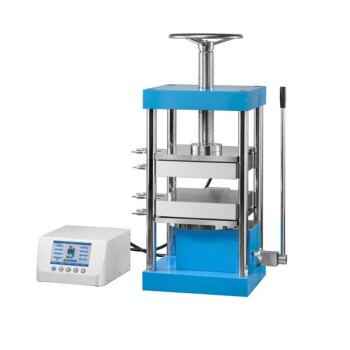
The resistance heating system improves molding results by inducing a "warm pressing" effect, simultaneously heating the mold and powder between 100°C and 400°C while pressure is applied. This thermal application significantly reduces the work-hardening rate of the CuCr50 alloy powder, which enhances its plastic flow capability. By softening the material, the system allows the powder to overcome inter-particle friction at lower pressures, facilitating rapid and uniform densification.
The core advantage of this system is that it alters the mechanical behavior of the powder during compression. By introducing heat during the pressing phase—rather than just after—it minimizes the force required to achieve high density and creates a more cohesive internal structure.
The Mechanism of Warm Pressing
Lowering the Work-Hardening Rate
The primary function of the resistance heating system is to elevate the temperature of the alloy powder to a specific range, typically between 100°C and 400°C.
At ambient temperatures, metal powders often resist deformation due to work-hardening. Resistance heating mitigates this phenomenon, allowing the material to remain malleable under stress.
Enhancing Plastic Flow
As the work-hardening rate decreases, the plastic flow capability of the CuCr50 alloy increases significantly.
This enhanced fluidity is critical for achieving high density. It allows the powder particles to slide past one another and fill voids more effectively, overcoming inter-particle friction that would otherwise impede densification.
Rapid Densification at Lower Pressures
Because the material is more pliable, the system can achieve target densities without requiring excessive mechanical force.
This efficiency not only speeds up the molding process but also reduces the mechanical strain on the equipment, achieving rapid densification that is difficult to replicate with cold-pressing methods.
Synergistic Factors for High Quality
The Role of Vacuum Integration
While resistance heating improves plasticity, it works in tandem with the vacuum system (maintaining levels > 1x10^-2 Pa) to ensure purity.
The vacuum environment exhausts gases and volatiles trapped in the powder gaps before and during the heating phase. This prevents metal oxidation at elevated temperatures and eliminates pore defects, ensuring the high density achieved by the heating system is not compromised by trapped gas.
Pressure Transfer and Mold Stability
The success of the heating system relies on heat-resistant molds that maintain structural stability between 200°C and 400°C.
These molds act as the container for the powder, precisely transferring hydraulic pressure (ranging from 70-240 MPa) to the heated material. The ability of the mold to withstand the resistance heating without deforming is directly responsible for the dimensional control and surface quality of the final ingot.
Process Efficiency and Integration
Combining Manufacturing Steps
Vacuum hot pressing creates a significant efficiency advantage by integrating powder degassing, compression molding, and pre-sintering into a single process.
By applying temperature and pressure simultaneously, the equipment bypasses the separate, lengthy stages required in traditional manufacturing.
overcoming Traditional Limitations
Traditional cold-pressing followed by sintering often struggles with densification difficulties and long process flows.
The resistance heating system eliminates these bottlenecks. By initiating densification during the pressing stage, it simplifies production, reduces costs, and shortens the overall timeframe required to produce CuCr50 alloys.
Understanding the Trade-offs
Mold Material Requirements
Implementing resistance heating introduces thermal stress that standard molds cannot withstand.
You must utilize high-grade, heat-resistant mold materials capable of maintaining precision under high pressure (up to 240 MPa) and temperatures up to 400°C. Using inferior molds will lead to dimensional inaccuracies or structural failure.
Complexity of Process Control
Unlike cold pressing, where pressure is the primary variable, this method requires precise synchronization of heat, pressure, and vacuum.
Operators must carefully control the heating rate to match the pressure application. If the temperature is too low, plastic flow will be insufficient; if inconsistent, the ingot may suffer from uneven density.
Making the Right Choice for Your Goal
The resistance heating system transforms vacuum hot pressing from a simple shaping process into a sophisticated densification method.
- If your primary focus is achieving maximum density: Leverage the "warm pressing" effect (100°C-400°C) to maximize plastic flow and eliminate closed pores.
- If your primary focus is process efficiency: Utilize the system's ability to integrate degassing, molding, and pre-sintering to reduce overall cycle time and manufacturing costs.
- If your primary focus is dimensional precision: Ensure your molds are rated for high-temperature stability to accurately transfer pressure without deformation.
By synchronizing thermal energy with mechanical pressure, you ensure the CuCr50 alloy achieves superior structural integrity before the final sintering phase begins.
Summary Table:
| Feature | Mechanism | Benefit to CuCr50 Alloy |
|---|---|---|
| Warm Pressing | Heating powder to 100°C - 400°C | Reduces work-hardening and improves plasticity |
| Enhanced Flow | Lowering inter-particle friction | Facilitates rapid, uniform densification |
| Vacuum Integration | Maintaining vacuum > 1x10^-2 Pa | Prevents oxidation and eliminates pore defects |
| Process Sync | Simultaneous heat and pressure | Combines degassing, molding, and pre-sintering |
| Force Efficiency | Lower mechanical pressure requirements | Reduces equipment strain while maintaining high density |
Elevate Your Materials Science with KINTEK
Optimize your CuCr50 alloy production with KINTEK’s advanced vacuum hot pressing equipment. Our specialized high-temperature systems and precision-engineered hydraulic presses are designed to deliver the perfect synergy of heat and pressure for superior material density and structural integrity.
Whether you need high-temperature furnaces, isostatic presses, or specialized crushing and milling systems, KINTEK provides the comprehensive laboratory equipment and consumables—including heat-resistant ceramics and crucibles—to streamline your research and manufacturing workflows.
Ready to achieve superior molding results? Contact our technical experts today to find the perfect solution for your lab!
Related Products
- Vacuum Hot Press Furnace Machine for Lamination and Heating
- Electric Heated Hydraulic Vacuum Heat Press for Lab
- Vacuum Hot Press Furnace Machine Heated Vacuum Press
- Vacuum Hot Press Furnace Heated Vacuum Press Machine Tube Furnace
- Heated Hydraulic Press Machine with Heated Plates for Vacuum Box Laboratory Hot Press
People Also Ask
- What advantages does a vacuum hot press furnace provide for LSLBO ceramic electrolytes? Achieve 94% Relative Density
- Why is it necessary to maintain a high-vacuum environment within a vacuum hot press furnace? Optimize Cu-SiC Sintering
- What are the advantages of using a vacuum hot press furnace for sintering CNT/Cu composites? Superior Density & Bonding
- What are the advantages of a vacuum hot press furnace for W-50%Cu? Achieve 99.6% Density at Lower Temperatures
- What role does mechanical pressure play during the vacuum diffusion bonding of tungsten and copper? Keys to Solid Bonding