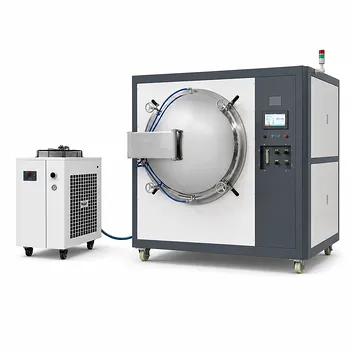
The vacuum environment is non-negotiable when hot pressing mechanically alloyed CoSb3 powders due to their exceptionally high specific surface area and chemical reactivity. Without a vacuum, these "activated" powders would rapidly oxidize during the heating stage, creating impurity phases that severely degrade the phase purity and electrical performance of the final thermoelectric material.
Core Takeaway Mechanically alloyed powders are highly energetic and susceptible to contamination. The vacuum environment serves as a critical protective shield, preventing oxidation and removing volatile impurities to ensure the final material achieves the necessary density, phase purity, and thermoelectric efficiency.
The Reactivity Challenge of Mechanically Alloyed Powders
High Specific Surface Area
Mechanical alloying (MA) involves high-energy ball milling that fractures the material into extremely fine particles.
This process drastically increases the specific surface area of the powder.
With more surface area exposed, there are significantly more sites available for chemical reactions, making the powder far more sensitive to the surrounding atmosphere than standard bulk powders.
Enhanced Chemical Reactivity
The energy imparted during mechanical alloying does not just reduce particle size; it creates internal defects and stores energy within the material.
This makes the CoSb3 powder thermodynamically unstable and highly reactive.
In the presence of even trace amounts of oxygen, these energized powders will oxidize much faster than conventional powders, necessitating a controlled vacuum environment.
Critical Functions of the Vacuum
Prevention of Impurity Phases
The primary reference highlights that the vacuum inhibits the formation of oxide impurity phases.
If oxides form on the grain boundaries of CoSb3, they act as electrical insulators.
This disruption destroys the electrical conductivity required for efficient thermoelectric performance, rendering the material ineffective for its intended application.
Removal of Volatiles and Adsorbed Gases
Powders often retain moisture, adsorbed gases from the air, or residual process control agents (like stearic acid) used during milling.
A vacuum environment allows these volatiles to "outgas" or evaporate cleanly as the temperature rises.
Removing these contaminants prevents them from reacting with the CoSb3 or becoming trapped within the material structure.
Elimination of Porosity
If gases or moisture are not removed via vacuum, they expand during the high-temperature sintering process.
This expansion creates bubbles or void defects within the material.
The vacuum ensures these gases are evacuated before consolidation occurs, allowing the hot press to achieve near-theoretical density and better mechanical reliability.
Understanding the Consequences of Process Failure
The "Oxide Barrier" Effect
If the vacuum level is insufficient, oxide films form on the surface of individual powder particles.
These films act as barriers during sintering, preventing adjacent particles from bonding effectively.
This results in a material that is mechanically weak and electrically resistive, undermining the benefits of the hot pressing process.
Compromised Nanostructure
Hot pressing is chosen specifically to maintain the ultra-fine nanostructure created by mechanical alloying, which boosts thermoelectric efficiency (ZT).
However, impurities introduced by a poor vacuum environment can trigger abnormal grain growth or phase separation.
This alters the microstructure, effectively undoing the work performed during the mechanical alloying stage.
Making the Right Choice for Your Goal
To maximize the quality of your CoSb3 hot pressing process, consider your primary performance metrics:
- If your primary focus is Electrical Conductivity: Prioritize a high-vacuum level to strictly prevent grain-boundary oxidation, which acts as an electrical barrier.
- If your primary focus is Mechanical Density: Ensure the vacuum is applied during the low-temperature ramp-up to thoroughly outgas volatiles and prevent porosity defects.
The vacuum is not merely a precautionary measure; it is the fundamental enabler of phase purity in reactive nanostructured materials.
Summary Table:
| Factor | Impact of Vacuum Environment | Risk Without Vacuum |
|---|---|---|
| Oxidation Control | Prevents oxide formation on high-surface-area powders | Impurity phases create electrical insulation |
| Outgassing | Removes volatiles, moisture, and milling agents | Trapped gases cause porosity and bubbles |
| Phase Purity | Maintains nanostructure and thermodynamic stability | Material degradation and phase separation |
| Consolidation | Enables near-theoretical density and bonding | Oxide films create barriers to particle bonding |
Elevate Your Thermoelectric Research with KINTEK Precision
Don't let oxidation compromise your nanostructured materials. KINTEK specializes in advanced laboratory solutions designed for high-performance metallurgy. From our state-of-the-art hot press furnaces and vacuum systems to precision crushing and milling systems, we provide the tools necessary to achieve maximum phase purity and density in CoSb3 and other reactive alloys.
Our expertise extends to high-temperature high-pressure reactors, dental furnaces, and specialized consumables like crucibles and ceramics, ensuring your research meets the highest standards. Partner with KINTEK today to optimize your material synthesis – Contact us now!
Related Products
- 600T Vacuum Induction Hot Press Furnace for Heat Treat and Sintering
- Vacuum Hot Press Furnace Heated Vacuum Press Machine Tube Furnace
- Vacuum Hot Press Furnace Machine Heated Vacuum Press
- Vacuum Heat Treat and Pressure Sintering Furnace for High Temperature Applications
- Laboratory High Pressure Vacuum Tube Furnace
People Also Ask
- What role does an induction vacuum hot pressing furnace play in sintering? Achieve 98% Density in Carbide Blocks
- What advantages does a vacuum hot press furnace provide for LSLBO ceramic electrolytes? Achieve 94% Relative Density
- What role does a Vacuum Hot Press (VHP) furnace play in the densification of austenitic stainless steel 316 composites?
- What are the advantages of a vacuum hot press furnace for W-50%Cu? Achieve 99.6% Density at Lower Temperatures
- What role does mechanical pressure play during the vacuum diffusion bonding of tungsten and copper? Keys to Solid Bonding