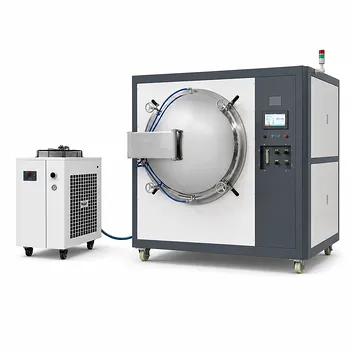
Atmosphere control in a vacuum hot pressing furnace serves as an active purification mechanism that is critical for densifying TiB2-SiC ceramics. By establishing a high-vacuum environment (typically 5 x 10^-2 Pa), the process lowers the evaporation point of surface impurities, effectively stripping oxide layers from the ceramic powders before full sintering occurs.
Core Takeaway The vacuum environment does not simply prevent new oxidation; it actively removes existing surface oxides (B2O3, TiO2) and gaseous reaction by-products (CO, SiO). This "scrubbing" effect removes the physical barriers at grain boundaries, enabling the particle contact necessary for achieving near-theoretical density.
The Mechanism of Impurity Removal
Evaporation of Volatile Oxides
The surface of Titanium Diboride (TiB2) powder often contains native oxide layers, specifically boron trioxide (B2O3) and titanium dioxide (TiO2).
These oxides act as diffusion barriers that physically separate ceramic particles. The low pressure of the vacuum furnace promotes the volatilization and evaporation of these oxides at temperatures lower than standard atmospheric processing would allow.
Discharge of Gaseous By-products
During the sintering of SiC-based composites, chemical reactions inevitably produce gaseous by-products, primarily carbon monoxide (CO) and silicon monoxide (SiO).
In a non-vacuum environment, these gases can become trapped within the material, forming permanent pores. The vacuum atmosphere continuously extracts these gases, preventing the formation of voids that would degrade the material's mechanical integrity.
How Purification Drives Densification
Unblocking Grain Boundaries
For densification to occur, atoms must diffuse across grain boundaries to close the gaps between particles.
Surface oxides and impurities "pin" these boundaries, preventing movement. By stripping these oxides away via vacuum evaporation, the furnace ensures direct particle-to-particle contact, facilitating the mass transport required for sintering.
Inhibiting Abnormal Grain Growth
Impurities at grain boundaries often cause erratic crystal growth, where some grains grow excessively large while others remain small.
This abnormal growth entraps pores inside the large grains, making them impossible to remove. A clean vacuum atmosphere promotes uniform grain boundary movement, leading to a fine, homogeneous microstructure.
Understanding the Trade-offs
Risk of Material Decomposition
While vacuum promotes the evaporation of impurities, excessive vacuum at high temperatures can lead to the unintended evaporation of the ceramic constituents themselves.
For example, Silicon (Si) has a relatively high vapor pressure. If the vacuum is too strong or the temperature too high for the specific pressure, you risk altering the chemical composition (stoichiometry) of the ceramic, potentially weakening the final part.
Equipment Complexity and Cost
maintaining a consistent vacuum of 5 x 10^-2 Pa requires sophisticated pumping systems and rigorous seal maintenance.
Unlike pressureless sintering in air, vacuum hot pressing introduces significant capital and operational costs. The benefits of high density must outweigh the increased complexity of the equipment.
Making the Right Choice for Your Goal
To optimize the densification of TiB2-SiC ceramics, consider your specific processing objectives:
- If your primary focus is maximizing relative density: Prioritize a high-vacuum stage (approx. 5 x 10^-2 Pa) during the initial heating ramp to ensure all B2O3 and TiO2 are evacuated before the pores close.
- If your primary focus is controlling chemical composition: Monitor the vapor pressure of your specific SiC ratio; you may need to backfill with an inert gas (like Argon) at peak temperatures to suppress the decomposition of Silicon.
- If your primary focus is mechanical strength: Ensure the vacuum system is capable of effectively removing CO and SiO by-products, as trapped gas pockets will become the initiation points for fractures.
High-quality densification relies not just on heat and pressure, but on using the vacuum atmosphere to chemically prepare the grain boundaries for bonding.
Summary Table:
| Mechanism | Impact on Densification | Key Benefit |
|---|---|---|
| Vacuum Evaporation | Removes surface oxides like B2O3 and TiO2 | Eliminates diffusion barriers between particles |
| Gas Extraction | Discharges by-products like CO and SiO | Prevents trapped gas pores and voids |
| Boundary Purification | Enables direct particle-to-particle contact | Facilitates mass transport and sintering |
| Grain Control | Inhibits abnormal grain growth | Produces a fine, homogeneous microstructure |
Elevate Your Material Research with KINTEK Precision
Achieving theoretical density in advanced ceramics like TiB2-SiC requires uncompromising atmosphere control. KINTEK specializes in high-performance laboratory equipment, offering a sophisticated range of vacuum hot pressing furnaces, muffle and tube furnaces, and induction melting systems designed to meet the rigorous demands of material science.
From high-temperature high-pressure reactors to crushing, milling, and hydraulic presses, our comprehensive portfolio ensures your lab is equipped for every stage of development. Partner with KINTEK for reliable, high-precision tools and essential consumables like ceramics and crucibles that drive innovation.
Ready to optimize your sintering process? Contact KINTEK today for a tailored solution!
Related Products
- Vacuum Hot Press Furnace Heated Vacuum Press Machine Tube Furnace
- 600T Vacuum Induction Hot Press Furnace for Heat Treat and Sintering
- Vacuum Hot Press Furnace Machine Heated Vacuum Press
- Vacuum Hot Press Furnace Machine for Lamination and Heating
- Vacuum Heat Treat and Pressure Sintering Furnace for High Temperature Applications
People Also Ask
- What advantages does a vacuum hot press furnace provide for LSLBO ceramic electrolytes? Achieve 94% Relative Density
- What role does a Vacuum Hot Press (VHP) furnace play in the densification of austenitic stainless steel 316 composites?
- What are the advantages of using a vacuum hot pressing furnace? Superior Densification for 2024Al/Gr/SiC Composites
- What are the advantages of a vacuum hot press furnace for LTPO solid electrolytes? Boost Density and Conductivity
- What core processing conditions does a vacuum hot press furnace provide? Achieve High-Density Cu-SiC/Diamond Composites