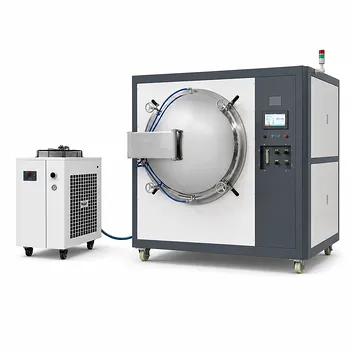
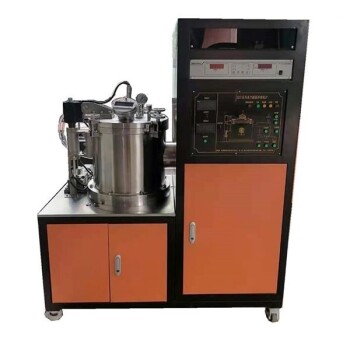
A vacuum hot-pressed furnace drives densification through the simultaneous application of high-temperature conductive heating and uniaxial mechanical pressure. This dual-force approach creates a powerful external drive for particle rearrangement, sliding, and plastic deformation, allowing calcium fluoride (CaF2) ceramics to achieve near-theoretical density at temperatures significantly lower than conventional sintering methods.
By combining mechanical pressure with thermal energy, vacuum hot pressing physically forces grain boundaries together to close pores. This is critical for transparent ceramics, where even microscopic pores scatter light and degrade optical quality.
The Mechanics of Densification
The Synergy of Heat and Pressure
The primary advantage of this furnace is the simultaneous application of heat and mechanical force. While heat activates the ceramic particles, the external pressure (typically around 30 MPa for CaF2) acts as a catalyst for densification.
This combination accelerates mass transport mechanisms that are slow or non-existent in pressureless sintering. The pressure physically forces particles to slide past one another and rearrange into a tighter packing configuration.
Mechanisms of Pore Elimination
To achieve transparency, the ceramic must be virtually pore-free. The furnace facilitates this through plastic deformation and grain boundary bonding.
Under the influence of uniaxial pressure, the grains deform to fill the voids (pores) between them. This significantly promotes the elimination of residual pores that would otherwise scatter light, ensuring the high relative density required for optical applications.
Lower Sintering Temperatures
Because mechanical pressure aids the densification, the process can occur at relatively lower temperatures (e.g., 850°C to 1000°C for CaF2).
Achieving high density at lower temperatures is vital for transparency. It prevents the excessive grain growth often associated with higher-temperature sintering, resulting in a fine-grained microstructure that supports better mechanical and optical properties.
The Role of the Vacuum Environment
Prevention of Oxidation
The vacuum environment is essential for maintaining the chemical purity of the calcium fluoride. It prevents the oxidation of the ceramic powder at high temperatures, which is detrimental to optical transmission.
Protection of Tooling
This process typically utilizes graphite molds to apply the uniaxial pressure. The vacuum protects these molds from oxidizing and degrading, ensuring consistent pressure application and preventing carbon contamination of the ceramic.
Understanding the Process Constraints
Complexity of Mold Interactions
While the vacuum protects the mold, the interaction between the graphite and the ceramic powder must be carefully managed. The process relies on the mold's integrity to transfer the 30 MPa of axial pressure uniformly; any degradation in the mold can lead to uneven densification.
The Trade-off of Batch Processing
Unlike continuous sintering methods, vacuum hot pressing is inherently a batch process. It requires precise control over heating rates, pressure application steps, and vacuum levels (often reaching 10^-1 Pa or better) to ensure all volatile impurities are evacuated before the pores close completely.
Making the Right Choice for Your Goal
To maximize the quality of your transparent ceramics, align your process parameters with your specific objectives.
- If your primary focus is Optical Clarity: Prioritize the precise control of the vacuum level to prevent oxidation and ensure the complete removal of volatile impurities before full densification occurs.
- If your primary focus is Microstructural Integrity: Leverage the mechanical pressure to sinter at the lowest possible temperature (near 850°C) to achieve full density while minimizing grain growth.
The successful densification of CaF2 relies not just on heat, but on the mechanical force that physically closes pores to create a solid, transparent medium.
Summary Table:
| Feature | Vacuum Hot Pressing Advantage | Impact on CaF2 Ceramics |
|---|---|---|
| Dual Force | Heat + Uniaxial Pressure (30 MPa) | Accelerates particle rearrangement & sliding |
| Pore Removal | Plastic deformation & boundary bonding | Eliminates light-scattering microscopic pores |
| Temperature | Lower range (850°C - 1000°C) | Prevents grain growth for fine microstructure |
| Environment | High Vacuum (10^-1 Pa) | Prevents oxidation and maintains optical purity |
| Efficiency | Enhanced mass transport | Achieves near-theoretical density faster |
Elevate Your Material Research with KINTEK
Precision is paramount when developing transparent ceramics and advanced materials. KINTEK specializes in high-performance laboratory equipment, offering a comprehensive range of vacuum hot-pressing systems, muffle and tube furnaces, and hydraulic presses designed to meet the rigorous demands of material science.
Whether you are focusing on optical clarity through vacuum-controlled sintering or microstructural integrity using our high-pressure reactors and crushing systems, our expertise ensures your lab achieves superior results. From essential consumables like graphite crucibles and ceramics to advanced CVD and PECVD systems, we provide the tools you need for innovation.
Ready to optimize your densification process? Contact KINTEK today to discuss your project requirements and discover our full range of laboratory solutions!
Related Products
- Vacuum Hot Press Furnace Heated Vacuum Press Machine Tube Furnace
- 600T Vacuum Induction Hot Press Furnace for Heat Treat and Sintering
- Vacuum Hot Press Furnace Machine Heated Vacuum Press
- Vacuum Hot Press Furnace Machine for Lamination and Heating
- Vacuum Heat Treat and Pressure Sintering Furnace for High Temperature Applications
People Also Ask
- What advantages does a vacuum hot press furnace provide for LSLBO ceramic electrolytes? Achieve 94% Relative Density
- What role does a Vacuum Hot Press (VHP) furnace play in the densification of austenitic stainless steel 316 composites?
- What are the advantages of using a vacuum hot pressing furnace? Superior Densification for 2024Al/Gr/SiC Composites
- What are the advantages of a vacuum hot press furnace for LTPO solid electrolytes? Boost Density and Conductivity
- What core processing conditions does a vacuum hot press furnace provide? Achieve High-Density Cu-SiC/Diamond Composites