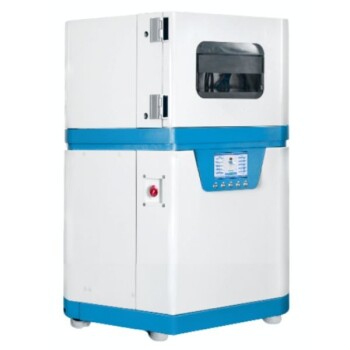
The primary advantage of a vacuum hot pressing furnace is its ability to apply mechanical pressure simultaneously with high-temperature sintering. This pressure-assisted mechanism is critical for Copper/Tungsten Carbide (Cu/WC) composites because it forces the softer copper matrix to flow around the hard, resistant WC particles. Unlike conventional pressureless equipment, this process actively closes internal pores and breaks down particle agglomerates to achieve superior density.
Core Takeaway: Conventional heat simply cannot overcome the physical resistance required to densify hard-particle composites like Cu/WC. Vacuum hot pressing solves this by using mechanical force to drive plastic deformation, resulting in near-perfect density (up to 99.1%) and oxide-free interfacial bonding that maximizes both structural and electrical performance.
Overcoming the "Hard Particle" Barrier
The Role of Mechanical Pressure
In a conventional resistance furnace, densification relies primarily on thermal energy to induce sintering. However, Tungsten Carbide (WC) particles are extremely hard and naturally resist the flow of the copper matrix.
Vacuum hot pressing overcomes this resistance by applying significant uniaxial pressure (e.g., 30 MPa) during the heating cycle. This external force physically pushes the materials together, breaking down clusters of particles that would otherwise remain separated.
Inducing Plastic Deformation
The application of pressure forces the softer copper matrix to undergo plastic deformation. This allows the copper to physically fill the microscopic gaps and voids between the rigid tungsten particles.
This mechanism forcibly closes internal pores that pressureless sintering would leave behind. Consequently, the composite achieves a significantly higher density, often reaching upwards of 99.1% theoretical density, compared to the ~77% often seen in lower-performance pressureless methods.
Optimizing the Material Environment
Eliminating Oxidation
Copper and Tungsten Carbide are susceptible to oxidation at high sintering temperatures (e.g., 950°C). In a conventional furnace, even trace oxygen can lead to the formation of oxide layers on particle surfaces.
The high-vacuum environment of a hot press furnace prevents these oxides from forming. This is critical for Cu/WC composites, as oxide inclusions act as impurities that scatter electrons, severely degrading the material's thermal and electrical conductivity.
Surface Purification and Wetting
Beyond simple protection, the vacuum environment helps purify the surface of the powder particles. Clean surfaces promote better "wetting," which is the ability of the copper to spread across and bond to the WC particles.
This improved contact facilitates stronger chemical reactions between the solid and liquid phases. The result is a substantial increase in interfacial bonding strength, ensuring the material is mechanically robust and fracture-resistant.
Understanding the Trade-offs
Process Complexity vs. Throughput
While vacuum hot pressing delivers superior material properties, it is inherently a batch process. Unlike continuous belt furnaces used for lower-grade sintering, hot pressing requires sealing the chamber, pulling a vacuum, and applying pressure for a specific cycle.
Parameter Sensitivity
The success of this method relies on precise control over the synchronization of heat and pressure. If pressure is applied too early or too late relative to the temperature curve, it can lead to suboptimal densification or deformed components. Therefore, this equipment demands a higher level of operational expertise than standard atmospheric furnaces.
Making the Right Choice for Your Goal
The choice between vacuum hot pressing and conventional sintering depends entirely on the performance requirements of your final component.
- If your primary focus is maximum electrical and thermal conductivity: Choose vacuum hot pressing to eliminate the oxide inclusions and porosity that scatter electrons and impede heat transfer.
- If your primary focus is mechanical durability and wear resistance: Choose vacuum hot pressing to achieve the high density and strong interfacial bonding required to prevent fractures under stress.
- If your primary focus is high-volume, low-cost production: Conventional pressureless sintering may be sufficient, provided the lower density and conductivity are acceptable for the application.
For high-performance Cu/WC composites, vacuum hot pressing is not just an alternative; it is the prerequisite for achieving professional-grade density and conductivity.
Summary Table:
| Feature | Vacuum Hot Pressing | Conventional Sintering |
|---|---|---|
| Densification Mechanism | Thermal energy + Uniaxial Pressure | Thermal energy only |
| Typical Density | ~99.1% Theoretical | ~77% (Lower for hard particles) |
| Atmosphere Control | High Vacuum (Oxide-free) | Atmospheric or inert (Oxide risk) |
| Interfacial Bonding | High (Enhanced wetting/plastic flow) | Moderate to Low |
| Key Performance | Superior Conductivity & Strength | Standard properties for low-cost needs |
Elevate Your Material Performance with KINTEK
Maximize the density, conductivity, and mechanical strength of your Cu/WC composites with KINTEK’s precision vacuum hot pressing furnaces. Our advanced high-temperature systems—including vacuum, tube, and rotary furnaces—are engineered to deliver the oxide-free environments and uniform pressure-assisted sintering required for professional-grade lab research and industrial production.
Beyond furnace technology, KINTEK offers a comprehensive suite of laboratory solutions, from crushing and milling systems to isostatic hydraulic presses and high-pressure reactors.
Ready to achieve 99.1% theoretical density in your next project? Contact our technical experts today to find the perfect equipment configuration for your specific material requirements.
Related Products
- Vacuum Hot Press Furnace Heated Vacuum Press Machine Tube Furnace
- 600T Vacuum Induction Hot Press Furnace for Heat Treat and Sintering
- Vacuum Hot Press Furnace Machine Heated Vacuum Press
- Vacuum Hot Press Furnace Machine for Lamination and Heating
- Vacuum Heat Treat and Pressure Sintering Furnace for High Temperature Applications
People Also Ask
- What advantages does a vacuum hot press furnace provide for LSLBO ceramic electrolytes? Achieve 94% Relative Density
- What role does a Vacuum Hot Press (VHP) furnace play in the densification of austenitic stainless steel 316 composites?
- What are the advantages of using a vacuum hot pressing furnace? Superior Densification for 2024Al/Gr/SiC Composites
- What are the advantages of a vacuum hot press furnace for LTPO solid electrolytes? Boost Density and Conductivity
- What core processing conditions does a vacuum hot press furnace provide? Achieve High-Density Cu-SiC/Diamond Composites