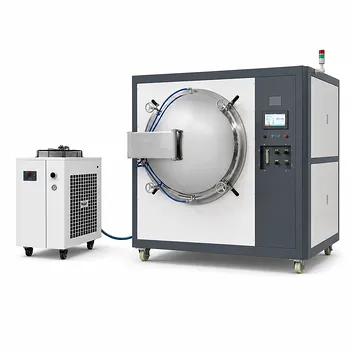
The vacuum hot press furnace serves as the critical integration point for fabricating high-density Cr-50 wt% Si alloys by simultaneously applying thermal energy and mechanical pressure within a protected environment. This equipment overcomes the limitations of standard sintering by utilizing graphite molds to transfer up to 50 MPa of uniaxial pressure directly to the powder, driving atomic diffusion and plastic deformation to achieve near-theoretical density at relatively low temperatures.
Core Takeaway The vacuum hot press furnace operates on a principle of synergy: by combining heat with significant external pressure, it forces particle rearrangement and plastic flow that thermal energy alone cannot achieve. This process is essential for eliminating internal pores and inhibiting grain growth, resulting in a mechanically superior, high-density alloy structure.
The Mechanisms of Densification
The Synergy of Heat and Pressure
The primary function of the furnace is to integrate powder metallurgy sintering with pressure processing. While thermal energy activates the atoms, the external mechanical pressure provides the driving force for densification.
This combination promotes diffusion creep and plastic deformation. The pressure forces the powder particles into voids that would otherwise remain empty during pressureless sintering, effectively closing residual pores.
The Role of Graphite Molds
To apply this pressure effectively, the furnace utilizes graphite molds. These molds act as the medium to transfer mechanical force directly to the Cr-Si powder mixture.
Because graphite retains strength at high temperatures, it allows for the application of substantial uniaxial pressure (typically around 50 MPa) without deforming the mold itself.
Lowering Sintering Temperatures
A distinct advantage of this method is the ability to achieve high density without extreme thermal loads.
The application of external pressure provides additional energy to the system. This lowers the required thermal activation energy, allowing the material to densify at lower sintering temperatures compared to conventional methods.
The Critical Role of the Vacuum Environment
Preventing Oxidation
Chromium and Silicon are susceptible to oxidation at high temperatures. The furnace maintains a high vacuum (e.g., 1.33 x 10^-1 Pa) or an inert atmosphere throughout the process.
This environment is non-negotiable for Cr-50 wt% Si alloys. It prevents the formation of oxides that would weaken the material and degrade the interface between particles.
Protecting the Tooling
The vacuum environment serves a dual purpose: it protects the alloy and the equipment.
Graphite molds oxidize and degrade rapidly in the presence of oxygen at high temperatures. The vacuum ensures the structural integrity of the molds, ensuring consistent pressure application throughout the cycle.
Specific Impacts on Cr-50 wt% Si Alloys
Controlling Grain Structure
One of the most significant challenges in alloy fabrication is "grain growth," where crystals become too large, weakening the material.
The vacuum hot press furnace inhibits this phenomenon. The applied pressure restricts the movement of grain boundaries, resulting in a refined grain size (typically 10–12 micrometers). This fine-grained microstructure is directly linked to superior mechanical properties.
Stabilizing Alloy Phases
For Cr-50 wt% Si specifically, the processing conditions promote the formation of stable phases.
Increasing pressure from 20 MPa to 50 MPa has been shown to promote the generation of stable CrSi2 compound phases. This phase stability is essential for the long-term performance of the alloy.
Understanding the Trade-offs
The Pressure-Density Correlation
Success in this process is heavily dependent on the magnitude of pressure applied.
There is a distinct difference in results between 20 MPa and 50 MPa. Lower pressures may initiate the process, but 50 MPa is often required to maximize plastic deformation and fully fill internal pores. Failing to reach this pressure threshold can lead to lower density and inferior mechanical strength.
Complexity of Uniaxial Loading
The furnace typically applies pressure uniaxially (from one direction).
While effective for flat or simple shapes, this can theoretically lead to density gradients in complex parts if the powder does not rearrange uniformly. The use of high-quality graphite molds and proper powder preparation (such as ball milling) is required to mitigate this.
Making the Right Choice for Your Goal
The vacuum hot press furnace is a precision tool. To maximize its utility for Cr-50 wt% Si alloys, align your process parameters with your specific metallurgical targets.
- If your primary focus is Maximum Density: Prioritize increasing the sintering pressure to 50 MPa to drive plastic deformation and close residual pores.
- If your primary focus is Microstructural Strength: Focus on the synergy of pressure and moderate temperature to refine grain size to the 10-12 micrometer range.
- If your primary focus is Phase Purity: Ensure a rigorous vacuum level (10^-1 Pa range) to prevent oxidation and protect the formation of the CrSi2 phase.
The vacuum hot press furnace is not just a heater; it is a mechanism for forcing material cohesion, turning loose powder into a dense, high-performance solid through the precise application of force and environment.
Summary Table:
| Feature | Function in Cr-50 wt% Si Fabrication | Key Benefit |
|---|---|---|
| Uniaxial Pressure | Applies up to 50 MPa via graphite molds | Closes residual pores through plastic deformation |
| Vacuum Environment | Maintains high vacuum (1.33 x 10^-1 Pa) | Prevents oxidation and protects alloy phase purity |
| Thermal Synergy | Combines heat with mechanical force | Lowers required sintering temperature & activation energy |
| Grain Control | Restricts grain boundary movement | Produces refined microstructure (10–12 μm) |
Elevate Your Material Research with KINTEK Precision
Unlock the full potential of your alloy fabrication with KINTEK’s advanced laboratory solutions. Whether you are developing high-density Cr-Si alloys or exploring new material boundaries, our specialized equipment provides the precision and reliability your research demands.
Our comprehensive portfolio includes:
- High-Temperature Vacuum & Atmosphere Furnaces: Including muffle, tube, and specialized vacuum hot press systems.
- Material Processing Systems: Precision crushing, milling, and hydraulic presses (pellet, hot, and isostatic).
- Advanced Reactors: High-temperature high-pressure reactors and autoclaves for complex synthesis.
- Lab Essentials: Electrolytic cells, cooling solutions (ULT freezers), and high-quality PTFE or ceramic consumables.
Why choose KINTEK? We provide the tools that bridge the gap between loose powders and high-performance solids. Contact us today to discuss your laboratory requirements and discover how our expertise can accelerate your project success!
Related Products
- Vacuum Hot Press Furnace Heated Vacuum Press Machine Tube Furnace
- 600T Vacuum Induction Hot Press Furnace for Heat Treat and Sintering
- Vacuum Hot Press Furnace Machine Heated Vacuum Press
- Vacuum Hot Press Furnace Machine for Lamination and Heating
- Vacuum Heat Treat and Pressure Sintering Furnace for High Temperature Applications
People Also Ask
- What advantages does a vacuum hot press furnace provide for LSLBO ceramic electrolytes? Achieve 94% Relative Density
- What role does a Vacuum Hot Press (VHP) furnace play in the densification of austenitic stainless steel 316 composites?
- What are the advantages of using a vacuum hot pressing furnace? Superior Densification for 2024Al/Gr/SiC Composites
- What are the advantages of a vacuum hot press furnace for LTPO solid electrolytes? Boost Density and Conductivity
- What core processing conditions does a vacuum hot press furnace provide? Achieve High-Density Cu-SiC/Diamond Composites