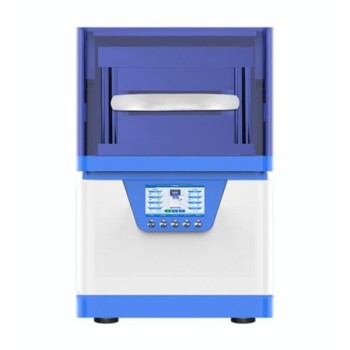
Precise temperature control is the critical variable that allows vacuum hot pressing equipment to bond graphite film and aluminum near the aluminum's melting point (approx. 655°C) without triggering destructive chemical reactions. By maintaining a narrow thermal window, the equipment secures mechanical adhesion while actively suppressing the formation of brittle Aluminum Carbide ($Al_4C_3$).
The Core Takeaway In Graphite/Aluminum composites, temperature precision determines the difference between a high-performance heat sink and a brittle, conductive failure. It allows the matrix to flow and bond significantly without reacting chemically to consume the graphite, thereby preserving the material's essential thermal conductivity.
The Chemistry of the Interface
Suppressing Brittle Compounds
The primary threat in sintering aluminum with graphite is the formation of Aluminum Carbide ($Al_4C_3$).
This reaction product is notoriously brittle and degrades the structural integrity of the composite. Precise control ensures the temperature stays just below the threshold where this reaction accelerates, preventing the "excessive reaction zones" that compromise the material.
Optimizing Mechanical Bonding
While avoiding reactions is key, the temperature cannot be too low.
To achieve a strong bond, the aluminum must soften sufficiently to wet the graphite surface. Precision control allows the process to hover right at the melting point (e.g., 655°C), facilitating physical bonding and matrix densification without transitioning into a purely chemical reaction.
Preserving Thermal Conductivity
The graphite film is selected specifically for its high thermal transport properties.
If the manufacturing process allows the aluminum to chemically digest the graphite into carbide, those thermal properties are lost. Strict temperature regulation ensures the graphite structure remains intact, maintaining the high thermal conductivity required for the final application.
Process Stability and Environment
Controlling Heating Rates
Beyond the final hold temperature, the rate of heating is equally critical.
Modern vacuum hot pressing furnaces control the ramp-up speed (e.g., 10°C/min or 20°C/min) to prevent thermal shock. This steady increase allows for uniform heat distribution, preventing local hot spots that could trigger premature carbide formation or grain coarsening.
Synergy with Vacuum Pressure
Temperature control works in tandem with the vacuum environment (typically below $5 \times 10^{-3}$ Pa).
The vacuum removes oxide films from the aluminum and interlaminar gases from the graphite. By eliminating these barriers, the equipment enables successful bonding at optimized temperatures, reducing the need to overheat the material just to force adhesion through an oxide layer.
Understanding the Trade-offs
The Thermal-Mechanical Conflict
Operators must navigate a strict trade-off between mechanical strength and material purity.
If the temperature is too high: You achieve excellent interface wetting and high mechanical strength. However, you generate excessive $Al_4C_3$, causing the material to become brittle and drastically reducing its thermal conductivity.
If the temperature is too low: You preserve the graphite structure and its conductivity perfectly. However, the aluminum may fail to wet the surface adequately, resulting in a weak interface, porosity, and eventual delamination under stress.
Making the Right Choice for Your Goal
The "ideal" temperature is not a fixed point, but a calculated balance based on your performance requirements.
- If your primary focus is Thermal Conductivity: Prioritize the lower end of the process window to minimize any conversion of graphite to carbides, accepting slightly lower mechanical shear strength.
- If your primary focus is Mechanical Durability: Operate closer to the melting point to maximize interface density and bonding, ensuring the equipment can hold this temperature without overshooting.
- If your primary focus is Complex Geometry: Utilize precise heating rates to ensure uniform heat soak before applying peak pressure, preventing internal stress fractures in the graphite film.
Success relies on equipment capable of holding the material in the narrow "Goldilocks zone"—hot enough to flow, but cool enough to remain chemically stable.
Summary Table:
| Variable | High Temperature (>660°C) | Precise "Goldilocks" Zone (~655°C) | Low Temperature (<640°C) |
|---|---|---|---|
| Interface Reaction | Excessive $Al_4C_3$ (Brittle) | Minimal/Controlled Reaction | Insufficient Bonding |
| Thermal Conductivity | Significant Degradation | Maximum Preservation | High (but poor interface) |
| Mechanical Bond | Strong but Brittle | High Density & Ductile | Weak/Delamination Risk |
| Matrix State | Liquid/Over-melted | Softened/Near-melting | Solid/Rigid |
Master the Interface with KINTEK Precision
At KINTEK, we understand that in advanced material synthesis, a few degrees make the difference between a high-performance composite and a brittle failure. Our state-of-the-art vacuum hot pressing systems and isostatic presses provide the industry-leading thermal stability required to navigate the narrow processing windows of graphite and aluminum.
Whether you are developing next-generation heat sinks or aerospace components, KINTEK offers a comprehensive suite of laboratory solutions—including high-temperature vacuum furnaces, crushing and milling systems, and specialized hydraulic presses—designed to give you total control over your material properties.
Ready to achieve superior thermal conductivity and bond integrity? Contact our technical experts today to find the perfect equipment for your research or production goals.
Related Products
- Vacuum Hot Press Furnace Machine for Lamination and Heating
- Electric Heated Hydraulic Vacuum Heat Press for Lab
- Vacuum Hot Press Furnace Machine Heated Vacuum Press
- Vacuum Hot Press Furnace Heated Vacuum Press Machine Tube Furnace
- Heated Hydraulic Press Machine with Heated Plates for Vacuum Box Laboratory Hot Press
People Also Ask
- What advantages does a vacuum hot press furnace provide for LSLBO ceramic electrolytes? Achieve 94% Relative Density
- Why is it necessary to maintain a high-vacuum environment within a vacuum hot press furnace? Optimize Cu-SiC Sintering
- What are the advantages of using a vacuum hot press furnace for sintering CNT/Cu composites? Superior Density & Bonding
- What are the advantages of a vacuum hot press furnace for W-50%Cu? Achieve 99.6% Density at Lower Temperatures
- What role does mechanical pressure play during the vacuum diffusion bonding of tungsten and copper? Keys to Solid Bonding