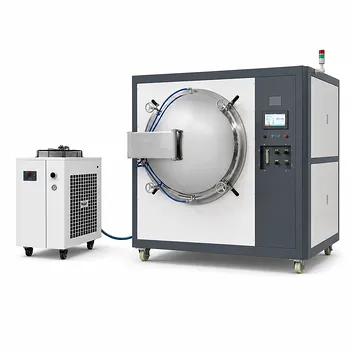
The vacuum environment within a hot-pressing furnace serves as a critical purification mechanism that directly enhances the structural integrity of B4C/Al composites. By lowering the oxygen partial pressure and actively removing volatile contaminants, the vacuum prevents chemical degradation of the aluminum matrix and eliminates gas pockets that would otherwise weaken the final material.
Core Insight The vacuum environment does not just facilitate the process; it fundamentally alters the material quality. By preventing oxidation and removing trapped gases before densification occurs, the vacuum ensures the composite achieves maximum density and fracture toughness.
The Role of Vacuum in Material Integrity
The vacuum environment addresses two specific chemical and physical challenges that occur during the sintering of Boron Carbide (B4C) and Aluminum (Al).
Prevention of Matrix Oxidation
Aluminum is highly reactive to oxygen, especially at the elevated temperatures required for sintering. Without a vacuum, the aluminum matrix suffers from severe and uncontrolled oxidation.
The vacuum environment significantly reduces the oxygen partial pressure within the furnace.
By removing oxygen from the equation, the aluminum remains in its metallic state, ensuring strong bonding with the B4C reinforcement particles rather than forming brittle oxide layers.
Elimination of Internal Porosity
Powder metallurgy processes often struggle with gases trapped between particles. These can be adsorbed gases or volatile substances inherent to the raw powders.
The vacuum facilitates the extraction/removal of these volatiles from the gaps between powder particles.
This degassing step is vital because it prevents the formation of closed pores. If these gases were not removed, they would be trapped inside the material as it densifies, creating weak points that act as crack initiation sites.
Synergy with Mechanical Pressure
While the vacuum creates a chemically clean environment, the "hot-pressing" aspect provides the mechanical force necessary to capitalize on that cleanliness. The performance of B4C/Al composites is maximized by the combination of these forces.
Driving Plastic Flow
The furnace applies a uniaxial mechanical pressure (often around 30 MPa) simultaneously with the vacuum.
This pressure forces the softened or semi-solid aluminum matrix to undergo plastic flow. Because the vacuum has already evacuated the air from the interstitial gaps, the aluminum can flow freely to fill the voids between the hard B4C particles.
Achieving Near-Theoretical Density
The combination of vacuum degassing and mechanical pressure leads to densification levels that are impossible with pressureless sintering.
While cold-press sintering might only achieve a density of roughly 71%, vacuum hot-pressing can drive the relative density to over 96%, and in some cases, as high as 99.1%.
This high density is directly correlated to improved mechanical properties, specifically fracture toughness.
Understanding the Trade-offs
While vacuum hot-pressing offers superior performance, it introduces specific complexities that must be managed.
Equipment Complexity and Cost
Achieving high-vacuum levels (such as $10^{-3}$ Pa) while simultaneously applying high heat and hydraulic pressure requires sophisticated equipment.
The system must integrate precise temperature control with a hydraulic loading system, making the capital investment and operational complexity significantly higher than standard sintering furnaces.
The Necessity of Balance
Vacuum alone is insufficient for densification; pressure alone risks trapping gases.
The process relies entirely on the synergistic effect of heat, vacuum, and pressure working in unison. If the vacuum is broken too early, oxidation occurs; if pressure is applied before adequate degassing, pores are locked in.
Making the Right Choice for Your Project
The vacuum hot-pressing process is ideal when material performance is non-negotiable.
- If your primary focus is Fracture Toughness: Prioritize the vacuum cycle to ensure maximum removal of adsorbed gases, minimizing the micropores that lead to brittle failure.
- If your primary focus is Density: Ensure the mechanical pressure (e.g., 30 MPa) is applied continuously while the matrix is in a softened state to fill all interstitial gaps.
By leveraging the vacuum to purify the environment and pressure to drive the structure, you transform a loose powder mixture into a dense, high-performance composite capable of withstanding extreme conditions.
Summary Table:
| Feature | Impact on B4C/Al Composites | Benefit to Material Performance |
|---|---|---|
| Vacuum Environment | Reduces oxygen partial pressure & removes volatiles | Prevents matrix oxidation and eliminates internal gas pockets |
| Mechanical Pressure | Drives plastic flow of the Al matrix | Fills interstitial voids for near-theoretical density (up to 99.1%) |
| Synergistic Effect | Simultaneous heat, vacuum, and pressure | Maximizes fracture toughness and structural integrity |
| Pore Management | Prevents formation of closed pores | Reduces crack initiation sites and improves mechanical strength |
Elevate Your Material Research with KINTEK
Achieve uncompromising material performance with KINTEK’s precision engineering solutions. Whether you are developing advanced B4C/Al composites or specialized alloys, our high-performance vacuum hot-pressing furnaces and isostatic presses provide the exact control over vacuum, temperature, and pressure required to reach near-theoretical density.
From high-temperature furnaces (muffle, tube, vacuum, CVD) and crushing systems to high-pressure reactors and battery research tools, KINTEK empowers laboratories to transform complex powder mixtures into superior high-performance materials.
Ready to optimize your densification process?
Contact our technical experts today to find the perfect equipment for your specific research needs.
Related Products
- Vacuum Hot Press Furnace Heated Vacuum Press Machine Tube Furnace
- 600T Vacuum Induction Hot Press Furnace for Heat Treat and Sintering
- Vacuum Hot Press Furnace Machine Heated Vacuum Press
- Vacuum Hot Press Furnace Machine for Lamination and Heating
- Vacuum Heat Treat and Pressure Sintering Furnace for High Temperature Applications
People Also Ask
- What advantages does a vacuum hot press furnace provide for LSLBO ceramic electrolytes? Achieve 94% Relative Density
- What role does a Vacuum Hot Press (VHP) furnace play in the densification of austenitic stainless steel 316 composites?
- What are the advantages of using a vacuum hot pressing furnace? Superior Densification for 2024Al/Gr/SiC Composites
- What are the advantages of a vacuum hot press furnace for LTPO solid electrolytes? Boost Density and Conductivity
- What core processing conditions does a vacuum hot press furnace provide? Achieve High-Density Cu-SiC/Diamond Composites