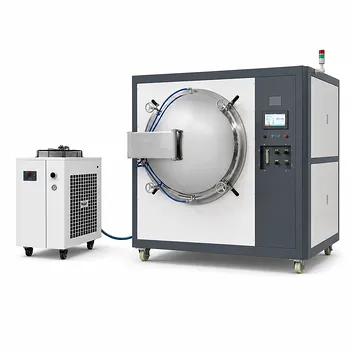
Precise pressure regulation is critical because it directly controls the containment of the liquid phase during the synthesis process. Specifically, when the aluminum foil melts, the vacuum hot pressing furnace must immediately reduce applied pressure to a minimal level, typically 0 MPa, to prevent the molten aluminum from being mechanically squeezed out of the mold.
The system must drop pressure to near-zero at the exact moment of melting to preserve the correct ratio of reactants, ensuring the complete formation of intermetallic layers without material loss.
The Physics of Material Retention
Preventing Liquid Phase Extrusion
During the synthesis of Ti/Ti-Al composites, the process reaches a stage where the aluminum component transitions from solid to liquid.
If the furnace maintains high pressure during this phase transition, the mechanical force will expel the liquid aluminum from the mold.
Precise regulation allows the furnace to effectively "release" the hold on the material, dropping the pressure to 0 MPa to accommodate this physical change.
Ensuring Stoichiometric Accuracy
The quality of the final composite depends on maintaining a specific chemical balance, known as stoichiometry.
If molten aluminum is squeezed out, the amount of reactant available decreases, altering the intended Titanium-to-Aluminum ratio.
By reducing pressure, the furnace ensures that all the aluminum remains within the reaction zone to participate in the synthesis.
Facilitating Intermetallic Diffusion
The ultimate goal of this process is to trigger an interfacial diffusion reaction between titanium and aluminum.
This reaction generates the in situ Al3Ti phase, which provides the material with high hardness and penetration resistance.
Maintaining the liquid aluminum in place is a prerequisite for the complete and uniform formation of these intermetallic compound layers.
Understanding Dynamic Pressure Requirements
The Necessity of Variable Control
It is important to note that "precise regulation" does not imply keeping pressure low throughout the entire process.
The furnace must be capable of dynamic adjustments because different stages have opposing requirements.
Contrast with the Debinding Stage
Prior to the reaction stage, during low-temperature debinding, the furnace must actually apply a micro-pressure of approximately 5 MPa.
This pressure is required to physically fix the position of fiber bundles while the temporary binder decomposes and volatilizes.
Without this initial pressure, escaping gases could displace fibers; however, once the high-temperature melting stage begins, that same pressure becomes detrimental and must be removed.
Making the Right Choice for Your Goal
To achieve high-quality Ti/Ti-Al composites, your furnace programming must align pressure settings with the material's physical state.
- If your primary focus is Fiber Alignment (Debinding Stage): Maintain a micro-pressure (approx. 5 MPa) to prevent displacement caused by binder volatilization.
- If your primary focus is Chemical Composition (Reaction Stage): Reduce pressure to a minimum (0 MPa) immediately upon reaching the aluminum melting point to prevent liquid loss.
Success relies on the furnace's ability to switch instantly from physical fixation to passive containment.
Summary Table:
| Synthesis Stage | Material State | Required Pressure | Purpose |
|---|---|---|---|
| Debinding | Solid + Binder | Micro-pressure (~5 MPa) | Fix fiber position & prevent displacement during volatilization |
| Melting Point | Solid to Liquid | 0 MPa | Prevent mechanical extrusion of molten aluminum from the mold |
| Solid-Liquid Reaction | Molten Al + Ti | Near-Zero | Facilitate Al3Ti intermetallic diffusion and maintain chemical ratio |
Elevate Your Material Research with KINTEK Precision
Precision is the difference between a failed experiment and a high-performance composite. KINTEK specializes in advanced vacuum hot pressing furnaces and high-temperature high-pressure reactors designed to handle complex dynamic cycles like the Ti/Ti-Al synthesis process.
Our equipment provides the sophisticated pressure regulation and thermal stability required to:
- Prevent Material Loss: Maintain stoichiometry by precisely timing pressure drops.
- Ensure Structural Integrity: Optimize debinding and diffusion stages for superior hardness.
- Maximize Lab Efficiency: Leverage our comprehensive portfolio, including crushing systems, hydraulic presses, and specialized ceramics.
Ready to achieve uncompromising accuracy in your laboratory? Contact KINTEK today for a customized solution and let our experts support your next breakthrough in advanced materials.
Related Products
- Vacuum Hot Press Furnace Heated Vacuum Press Machine Tube Furnace
- 600T Vacuum Induction Hot Press Furnace for Heat Treat and Sintering
- Vacuum Hot Press Furnace Machine Heated Vacuum Press
- Vacuum Hot Press Furnace Machine for Lamination and Heating
- Vacuum Heat Treat and Pressure Sintering Furnace for High Temperature Applications
People Also Ask
- What advantages does a vacuum hot press furnace provide for LSLBO ceramic electrolytes? Achieve 94% Relative Density
- What role does a Vacuum Hot Press (VHP) furnace play in the densification of austenitic stainless steel 316 composites?
- What are the advantages of using a vacuum hot pressing furnace? Superior Densification for 2024Al/Gr/SiC Composites
- What are the advantages of a vacuum hot press furnace for LTPO solid electrolytes? Boost Density and Conductivity
- What core processing conditions does a vacuum hot press furnace provide? Achieve High-Density Cu-SiC/Diamond Composites