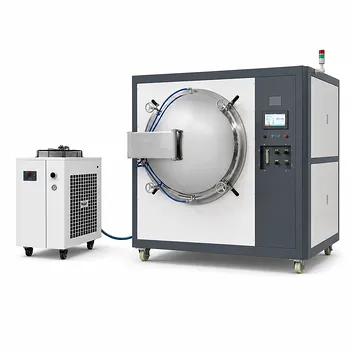
The primary advantage of using a vacuum hot-press furnace lies in its ability to simultaneously apply high vacuum, uniform heat, and axial pressure to create a denser, more structurally sound composite. Unlike other methods, this process actively eliminates internal stresses and oxidation while forcing material into microscopic voids, resulting in superior interfacial bonding between the diamond and aluminum. It offers a unique balance of high-performance material properties and cost-effective scalability for industrial production.
Core Takeaway The vacuum hot-press furnace is not just a heating device; it is a densification tool that leverages micrometer-scale diffusion bonding to maximize material density. By combining stress relief with precise pressure, it solves the twin challenges of porosity and weak bonding that plague traditional infiltration methods.
Optimizing Material Density and Structure
The Synergistic Effect of Pressure and Vacuum
The vacuum hot-press furnace utilizes a powerful combination of a high vacuum environment and axial pressure. While the vacuum prevents the oxidation of the aluminum matrix, the pressure mechanically forces the metal into plastic deformation.
This creates a "plastic flow" that fills interlaminar gaps and microscopic voids. This mechanism is critical for overcoming the infiltration difficulties often encountered in liquid-phase methods, ensuring near-full densification.
Eliminating Porosity Through Degassing
Porosity is a major failure point in composite materials. Through segmented temperature control (such as holding at intermediate temperatures like 400°C), the furnace removes adsorbed gases and volatiles before the material is fully sintered.
This "gradient heating" ensures that gases are not trapped inside the matrix. The result is a composite with significantly higher thermal conductivity and structural integrity.
Superior Interfacial Bonding
Achieving Micrometer-Scale Diffusion
The core of the diamond/aluminum composite's performance is the bond between the two materials. The vacuum hot-press facilitates micrometer-scale diffusion bonding.
By maintaining a stable thermal field, the process encourages atomic diffusion between the matrix and the reinforcement. This creates a robust interface that effectively transfers heat and mechanical load.
Reducing Internal Stress
Composite materials often suffer from internal stresses due to the mismatch in thermal expansion coefficients between the diamond (or graphite) and aluminum.
The furnace's precise cooling zones and uniform thermal field help manage these thermal stresses. This controlled environment effectively prevents interlaminar delamination, a common defect in layered composites.
Industrial Viability and Scalability
Cost-Effectiveness for Mass Production
Despite the advanced technology involved, the vacuum hot-press process remains relatively simple and cost-effective.
It avoids the complex multi-step preparations required by some chemical vapor infiltration or pressureless sintering methods. This simplicity makes it highly attractive for transitioning from lab-scale research to full industrial production.
Suitability for Large-Scale Components
The stability of the heating and cooling zones allows for the processing of large-scale components without sacrificing quality.
Because the thermal field is uniform, large parts receive the same consistent treatment as small samples. This ensures uniform density and mechanical properties across the entire volume of the component.
Understanding the Trade-offs
Geometric Constraints
While axial pressure is excellent for densification, it generally limits part geometry. Vacuum hot pressing is most effective for simple shapes, such as plates or discs.
Complex, near-net-shape components with intricate internal features may require additional machining or alternative processing methods like die-casting or pressure infiltration, which offer more geometric freedom but potentially lower density.
Cycle Time Intensity
The process relies on gradient heating and controlled cooling to manage stress and degassing.
This means the cycle times can be longer compared to rapid casting methods. You are trading production speed for material purity and density.
Making the Right Choice for Your Goal
To maximize the value of a vacuum hot-press furnace, align the process capabilities with your specific project requirements:
- If your primary focus is Thermal Conductivity: Prioritize the degassing and vacuum capabilities to eliminate porosity, as even micro-voids act as thermal insulators.
- If your primary focus is Mechanical Strength: Rely on the axial pressure and diffusion bonding, which ensures the diamond and aluminum act as a cohesive unit rather than separate layers.
- If your primary focus is Industrial Scaling: Leverage the process simplicity and uniform thermal fields to scale up component size without incurring prohibitive costs or quality variances.
The vacuum hot-press furnace is the definitive choice when material density and interfacial integrity cannot be compromised.
Summary Table:
| Feature | Vacuum Hot-Press Benefit | Impact on Composite Quality |
|---|---|---|
| Atmosphere Control | High vacuum environment | Prevents oxidation; ensures matrix purity |
| Densification | Axial pressure + plastic flow | Eliminates porosity and micro-voids |
| Interfacial Bonding | Micrometer-scale diffusion | Superior thermal and mechanical load transfer |
| Thermal Management | Uniform thermal fields | Minimizes internal stress and delamination |
| Process Scale | Simple, stable operation | Cost-effective for large-scale production |
Elevate Your Material Performance with KINTEK
Precision matters in advanced material synthesis. KINTEK specializes in high-performance laboratory equipment, offering state-of-the-art vacuum hot-press furnaces, high-temperature furnaces (muffle, tube, vacuum, CVD), and hydraulic presses designed to meet the rigorous demands of diamond/aluminum composite research and industrial production.
Whether you need to maximize thermal conductivity or ensure structural integrity, our comprehensive range of sintering solutions, cooling systems (ULT freezers, freeze dryers), and high-quality consumables like ceramics and crucibles provides everything you need for success.
Ready to optimize your densification process? Contact us today to speak with our technical experts and find the perfect equipment for your laboratory.
Related Products
- Vacuum Hot Press Furnace Heated Vacuum Press Machine Tube Furnace
- 600T Vacuum Induction Hot Press Furnace for Heat Treat and Sintering
- Vacuum Hot Press Furnace Machine Heated Vacuum Press
- Vacuum Hot Press Furnace Machine for Lamination and Heating
- Vacuum Heat Treat and Pressure Sintering Furnace for High Temperature Applications
People Also Ask
- What advantages does a vacuum hot press furnace provide for LSLBO ceramic electrolytes? Achieve 94% Relative Density
- What role does a Vacuum Hot Press (VHP) furnace play in the densification of austenitic stainless steel 316 composites?
- What are the advantages of using a vacuum hot pressing furnace? Superior Densification for 2024Al/Gr/SiC Composites
- What are the advantages of a vacuum hot press furnace for LTPO solid electrolytes? Boost Density and Conductivity
- What core processing conditions does a vacuum hot press furnace provide? Achieve High-Density Cu-SiC/Diamond Composites