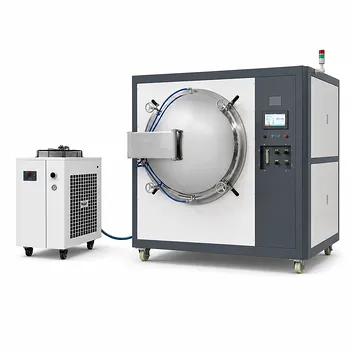
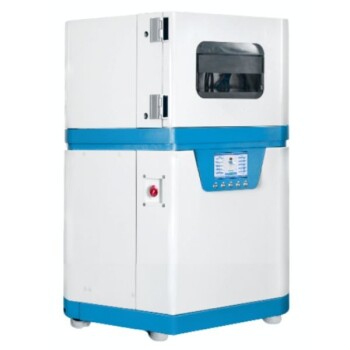
A vacuum hot pressing furnace facilitates densification by creating a synergistic environment of high thermal energy, mechanical force, and atmospheric control. Specifically for (Ti,M)3AlC2 solid solution ceramics, this process utilizes a high vacuum ($10^{-1}$ Pa) to prevent oxidation while simultaneously applying 1350°C heat and 28 MPa of pressure to drive reaction synthesis and full densification at temperatures significantly lower than conventional methods.
By combining reaction synthesis and densification into a single step, vacuum hot pressing overcomes the kinetic barriers of solid-state diffusion. It utilizes mechanical pressure to physically force particle contact, ensuring near-theoretical density for complex MAX phase ceramics that are otherwise difficult to sinter.
The Role of Environmental Control
Preventing Oxidation
The presence of oxygen is a critical barrier to processing MAX phase ceramics like (Ti,M)3AlC2. The metal powders used in synthesis (such as Titanium and Aluminum) are highly susceptible to oxidation at elevated temperatures.
Maintaining Purity
A vacuum environment, maintained at approximately $10^{-1}$ Pa, effectively eliminates oxygen from the processing chamber. This ensures that the precursors react to form the desired solid solution rather than degrading into unwanted oxides.
Mechanisms of Densification
Mechanical Driving Force
Unlike pressureless sintering, which relies solely on thermal energy, this furnace applies a uniaxial pressure of roughly 28 MPa. This external force is the primary driver for particle rearrangement.
Plastic Flow and Diffusion
The combination of heat and pressure induces plastic flow in the material. This physical deformation closes inter-particle voids and accelerates atomic diffusion across grain boundaries.
Reaction Synthesis
For (Ti,M)3AlC2 ceramics, the furnace enables reaction synthesis simultaneous with densification. The environment allows the constituent elements to chemically react and form the final ceramic phase while the pressure immediately compacts the newly formed material.
Lowering Thermal Requirements
The mechanical pressure provides an additional driving force for sintering, reducing the need for extreme thermal energy. This allows full densification at 1350°C, a temperature lower than what would be required for conventional sintering, thereby preserving the microstructure.
Understanding the Trade-offs
Geometrical Limitations
Vacuum hot pressing typically applies force along a single axis (uniaxial). This restricts the production of ceramic parts to simple geometries, such as flat plates, discs, or cylinders, often requiring post-process machining for complex shapes.
Throughput and Cost
This is a batch process rather than a continuous one. The cycle times for heating, holding, and cooling under vacuum, combined with the equipment cost, generally result in higher production costs compared to pressureless sintering.
Making the Right Choice for Your Goal
- If your primary focus is material quality: Vacuum hot pressing is essential for achieving near-theoretical density and high purity in MAX phase ceramics.
- If your primary focus is component complexity: You must account for the high cost of machining, as this method produces only simple, near-net shapes.
Vacuum hot pressing transforms the processing of (Ti,M)3AlC2 from a theoretical challenge into a practical reality by substituting extreme heat with precise mechanical force.
Summary Table:
| Feature | Vacuum Hot Pressing Advantage | Impact on (Ti,M)3AlC2 Ceramics |
|---|---|---|
| Environment | High Vacuum ($10^{-1}$ Pa) | Prevents oxidation of Titanium and Aluminum powders. |
| Pressure | 28 MPa Uniaxial Force | Drives particle rearrangement and closes inter-particle voids. |
| Temperature | 1350°C (Lowered) | Preserves microstructure while enabling reaction synthesis. |
| Density | Near-theoretical | Achieves full compaction of difficult-to-sinter MAX phases. |
| Process | Single-step Synthesis | Combines chemical reaction and densification efficiently. |
Elevate Your Material Research with KINTEK
Achieving near-theoretical density in complex MAX phase ceramics like (Ti,M)3AlC2 requires precision control over thermal, mechanical, and atmospheric variables. KINTEK specializes in advanced laboratory equipment designed to meet these rigorous standards.
Our comprehensive range of vacuum hot pressing systems, high-temperature furnaces (muffle, tube, vacuum, and CVD), and hydraulic presses provides the reliability needed for high-performance ceramic synthesis. Beyond sintering, we offer high-pressure reactors, crushing and milling systems, and essential consumables like ceramics and crucibles to support your entire workflow.
Ready to optimize your densification process? Contact KINTEK today to discover how our tailored solutions can enhance your laboratory's efficiency and material purity.
Related Products
- Vacuum Hot Press Furnace Heated Vacuum Press Machine Tube Furnace
- 600T Vacuum Induction Hot Press Furnace for Heat Treat and Sintering
- Vacuum Hot Press Furnace Machine Heated Vacuum Press
- Vacuum Hot Press Furnace Machine for Lamination and Heating
- Vacuum Heat Treat and Pressure Sintering Furnace for High Temperature Applications
People Also Ask
- What advantages does a vacuum hot press furnace provide for LSLBO ceramic electrolytes? Achieve 94% Relative Density
- What role does a Vacuum Hot Press (VHP) furnace play in the densification of austenitic stainless steel 316 composites?
- What are the advantages of using a vacuum hot pressing furnace? Superior Densification for 2024Al/Gr/SiC Composites
- What are the advantages of a vacuum hot press furnace for LTPO solid electrolytes? Boost Density and Conductivity
- What core processing conditions does a vacuum hot press furnace provide? Achieve High-Density Cu-SiC/Diamond Composites