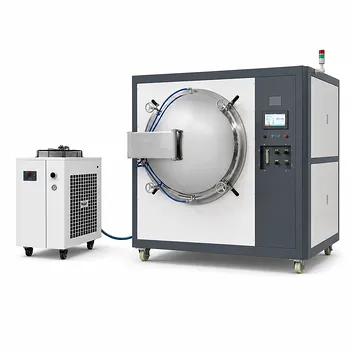
A vacuum hot pressing sintering furnace serves as the critical enabler for achieving near-theoretical density in AZ31 magnesium alloy components.
It creates a specialized environment that simultaneously applies precise thermal energy (515°C to 555°C) and axial mechanical pressure (typically around 10 MPa). This dual-action process forces the alloy particles to physically bond by breaking down stubborn surface oxide films and collapsing internal voids, resulting in a compact material with superior mechanical properties.
Core Insight: The primary value of this furnace lies in its ability to overcome the natural barriers to sintering magnesium—specifically oxidation and pore formation. By combining a vacuum atmosphere with mechanical force, it mechanically disrupts particle surfaces to trigger atomic diffusion that heat alone often cannot achieve.
The Mechanics of Densification
Breaking the Oxide Barrier
Magnesium alloys like AZ31 naturally form a tough oxide film on their particle surfaces. This film acts as a barrier, preventing adjacent particles from fusing together during standard heating.
The vacuum hot pressing furnace utilizes mechanical pressure to physically fracture this oxide layer. Once the film is broken, clean metal surfaces come into contact, allowing for the atomic diffusion necessary for strong metallurgical bonding.
Accelerating Plastic Flow
In a standard sintering process, particles rely mostly on thermal energy to move and bond. However, the application of uniaxial mechanical pressure forces the powder particles to undergo plastic flow.
This pressure physically pushes the material into interstitial pores (the gaps between particles). By mechanically closing these gaps, the furnace ensures the material reaches high density at temperatures significantly lower than the alloy's melting point.
The Function of the Vacuum Environment
While pressure handles the physical compaction, the vacuum environment manages chemical purity. It actively exhausts adsorbed gases and volatile impurities trapped between powder particles.
If these gases were not removed, they would become trapped inside the material as the grains bond, creating residual micropores. The vacuum ensures that as the pores close, they are empty rather than gas-filled, preventing internal defects.
Processing Parameters for AZ31
Precise Temperature Control
For AZ31 magnesium alloy, the furnace maintains a strict temperature window between 515°C and 555°C.
This range is critical: it is high enough to soften the material and accelerate diffusion, but controlled enough to prevent melting or excessive grain growth, which would degrade the material's strength.
The Role of Axial Pressure
The application of approximately 10 MPa of pressure is calibrated specifically for this alloy.
This pressure level is sufficient to deform the particles and close voids without damaging the equipment or the sample geometry. It acts as the driving force that transforms a loose powder compact into a solid, structural component.
Understanding the Trade-offs
Geometric Limitations
The "uniaxial" nature of the pressure means force is applied in one direction (usually top-down).
This limits the complexity of the shapes you can produce. Vacuum hot pressing is ideal for simple geometries like discs, cylinders, or flat plates, but it is generally unsuitable for parts with complex overhangs or intricate internal features.
Throughput vs. Quality
This is a batch process that creates high-quality materials but at a slower rate than continuous sintering methods.
The cycle times—which include pulling a vacuum, heating, pressing, and cooling—are significant. You are trading production speed for maximum density and material integrity.
Making the Right Choice for Your Project
To determine if vacuum hot pressing is the correct solution for your AZ31 application, consider your specific performance requirements:
- If your primary focus is mechanical strength: Use this method to ensure the oxide film is broken and porosity is eliminated, which maximizes fatigue life and tensile strength.
- If your primary focus is complex geometry: You may need to consider alternative methods, as this furnace restricts you to simple, flat, or cylindrical shapes.
- If your primary focus is material purity: The vacuum environment is essential for removing volatile impurities and preventing oxidation during the high-temperature phase.
The vacuum hot pressing furnace effectively replaces the uncertainty of standard sintering with the certainty of mechanically forced densification.
Summary Table:
| Feature | Role in AZ31 Densification | Key Benefit |
|---|---|---|
| Vacuum Environment | Removes adsorbed gases and prevents oxidation | Eliminates internal micropores and impurities |
| Axial Pressure (10 MPa) | Fractures surface oxide films and induces plastic flow | Forces particles together for metallurgical bonding |
| Thermal Energy (515-555°C) | Accelerates atomic diffusion below melting point | Prevents grain growth while softening material |
| Uniaxial Pressing | Directs mechanical force into interstitial gaps | Ensures high density for simple geometries |
Elevate Your Material Integrity with KINTEK Precision
Don't let oxidation and porosity compromise your AZ31 magnesium alloy research. KINTEK specializes in advanced laboratory solutions, providing high-performance vacuum hot pressing furnaces and isostatic presses designed to achieve maximum material density and superior mechanical properties.
Whether you are working on advanced metallurgy or battery research, our comprehensive portfolio—including high-temperature furnaces, crushing systems, and hydraulic presses—is engineered to meet the rigorous demands of your lab.
Ready to transform your powder compacts into high-strength structural components? Contact our technical experts today to find the perfect equipment for your specific application.
Related Products
- 600T Vacuum Induction Hot Press Furnace for Heat Treat and Sintering
- Vacuum Heat Treat and Pressure Sintering Furnace for High Temperature Applications
- Vacuum Heat Treat and Sintering Furnace with 9MPa Air Pressure
- Vacuum Hot Press Furnace Heated Vacuum Press Machine Tube Furnace
- Vacuum Hot Press Furnace Machine Heated Vacuum Press
People Also Ask
- What role does an induction vacuum hot pressing furnace play in sintering? Achieve 98% Density in Carbide Blocks
- What advantages does a vacuum hot press furnace provide for LSLBO ceramic electrolytes? Achieve 94% Relative Density
- What role does a Vacuum Hot Press (VHP) furnace play in the densification of austenitic stainless steel 316 composites?
- What role does mechanical pressure play during the vacuum diffusion bonding of tungsten and copper? Keys to Solid Bonding
- What are the advantages of a vacuum hot press furnace for W-50%Cu? Achieve 99.6% Density at Lower Temperatures