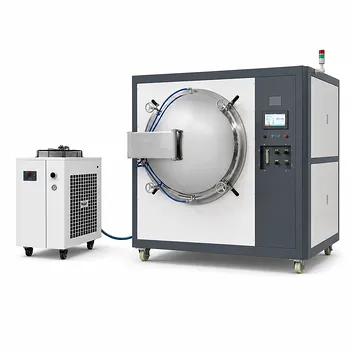
A vacuum hot pressing furnace (VHP) establishes a critical "triple-field" environment defined by the simultaneous application of high temperatures (900–1300°C), mechanical pressure (typically 30–50 MPa), and a high-vacuum atmosphere. This specific combination accelerates plastic deformation and creep in titanium powder particles, enabling the material to reach relative densities as high as 99% while strictly preventing the oxidation that compromises titanium's mechanical properties.
The core advantage of this process is the substitution of thermal energy with mechanical energy. By applying external pressure, VHP forces material densification at lower temperatures than conventional sintering, which preserves fine grain structures and ensures near-theoretical density.
The Synergistic Process Variables
To fabricate high-density titanium alloys, the VHP process must rigorously control three interdependent variables.
Thermal Activation
The furnace operates within a specific temperature window, primarily cited as 900–1300°C.
This temperature range is sufficient to soften the titanium alloy and activate atomic diffusion. However, because mechanical pressure is also applied, this operating temperature is significantly lower than what is required for pressure-less sintering.
Mechanical Driving Force
A uniaxial mechanical pressure, typically ranging from 30 MPa to 50 MPa, is applied directly to the material.
This pressure acts as the primary driving force for densification. It physically forces powder particles together, overcoming the internal friction that usually creates voids in ceramic or metallic powders.
Environmental Purity (Vacuum)
The process occurs within a vacuum environment, generally maintained around $10^{-1}$ mbar (though some protocols push for tighter vacuums of $10^{-1}$ to $10^{-2}$ Pa).
For titanium, this is non-negotiable. Titanium is highly reactive to oxygen at high temperatures; the vacuum inhibits the formation of brittle oxide layers (alpha-case) and promotes the removal of volatile impurities.
Mechanisms of Densification
Understanding how these conditions interact reveals why VHP is superior for achieving high material density.
Accelerated Plastic Flow and Creep
The combination of heat and pressure induces rapid plastic deformation in the powder particles.
Under these conditions, the material undergoes "creep"—a slow, permanent deformation under mechanical stress. This allows the particles to rearrange and fill interstitial voids much more efficiently than thermal diffusion alone could achieve.
Grain Boundary Diffusion
The applied pressure significantly promotes diffusion along grain boundaries.
This mechanism helps eliminate residual pores that become trapped between particles. By facilitating atomic movement across these interfaces, the process transforms distinct powder granules into a solid, cohesive mass.
Inhibition of Grain Growth
Because VHP achieves density at lower temperatures and faster rates, it effectively inhibits abnormal grain growth.
High temperatures usually cause grains to coarsen, which reduces material strength. VHP allows for full densification before grains have time to grow excessively, resulting in a fine microstructure and superior mechanical properties.
Understanding the Trade-offs
While VHP is highly effective for density, it introduces specific constraints that must be managed.
Geometry Limitations
VHP is inherently a uniaxial process. Pressure is applied from the top and bottom (or just one direction) within a rigid die.
This makes it difficult to fabricate complex, net-shape components. It is best suited for simple geometries like flat plates, discs, or cylinders, which often require post-process machining.
Cycle Time and Throughput
The process is generally a batch operation.
Heating a massive die, applying pressure, and cooling generally takes longer than continuous sintering methods. The necessity of maintaining a high vacuum adds to the cycle time and equipment cost.
Making the Right Choice for Your Goal
To maximize the potential of a vacuum hot pressing furnace for titanium alloys, tailor your parameters to your specific material objectives.
- If your primary focus is Maximum Density (>99%): Prioritize the mechanical pressure parameter (30–50 MPa) to physically close pores, even if it requires slightly higher die strength.
- If your primary focus is Material Purity and Ductility: Prioritize the vacuum level and temperature control. ensuring the vacuum is consistent ($10^{-1}$ mbar or better) to prevent oxygen embrittlement.
The ultimate value of the VHP process lies in its ability to force complete densification without overheating the material, delivering a titanium component that is both fully dense and structurally refined.
Summary Table:
| Parameter | Typical Range/Condition | Primary Function for Titanium |
|---|---|---|
| Temperature | 900–1300°C | Softens material and activates atomic diffusion |
| Mechanical Pressure | 30–50 MPa (Uniaxial) | Primary driving force for densification and pore closure |
| Atmosphere | High Vacuum (10⁻¹ mbar) | Prevents oxidation and removes volatile impurities |
| Resulting Density | Up to 99% Relative Density | Achieves near-theoretical density with fine microstructure |
Elevate Your Material Fabrication with KINTEK
Precision is paramount when dealing with titanium alloys. At KINTEK, we specialize in advanced vacuum hot pressing systems and a comprehensive range of high-temperature solutions—including muffle, tube, and vacuum furnaces, as well as hydraulic presses and isostatic systems—designed to help you achieve 99%+ relative density without compromising material purity.
Whether you are performing cutting-edge battery research, ceramic sintering, or high-pressure reactor studies, our technical experts are ready to provide the high-performance tools and consumables your lab requires.
Ready to optimize your densification process? Contact KINTEK Today to Consult with Our Experts
Related Products
- Vacuum Hot Press Furnace Heated Vacuum Press Machine Tube Furnace
- 600T Vacuum Induction Hot Press Furnace for Heat Treat and Sintering
- Vacuum Hot Press Furnace Machine Heated Vacuum Press
- Vacuum Hot Press Furnace Machine for Lamination and Heating
- Vacuum Heat Treat and Pressure Sintering Furnace for High Temperature Applications
People Also Ask
- What advantages does a vacuum hot press furnace provide for LSLBO ceramic electrolytes? Achieve 94% Relative Density
- What role does a Vacuum Hot Press (VHP) furnace play in the densification of austenitic stainless steel 316 composites?
- What are the advantages of using a vacuum hot pressing furnace? Superior Densification for 2024Al/Gr/SiC Composites
- What are the advantages of a vacuum hot press furnace for LTPO solid electrolytes? Boost Density and Conductivity
- What core processing conditions does a vacuum hot press furnace provide? Achieve High-Density Cu-SiC/Diamond Composites