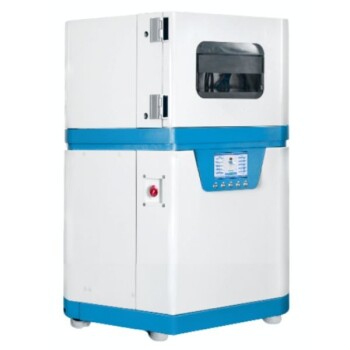
The application value of a high-precision vacuum hot press (HP) furnace lies in its ability to achieve superior densification through the simultaneous application of high temperature and mechanical pressure. For complex-composition carbide ceramics, this technology is essential for synthesizing large-sized, high-density, single-phase samples, offering a distinct advantage over standard sintering by preventing oxidation and lowering the temperature required for densification.
By inducing plastic deformation and diffusion migration in powder particles, the HP furnace overcomes the natural resistance of carbide ceramics to sintering. It serves as a vital production method that acts as a reliable alternative or supplement to spark plasma sintering (SPS) processes.
Mechanisms of Densification
Inducing Plastic Deformation
The core function of the HP furnace is to apply mechanical pressure directly to the ceramic powder. This pressure provides the physical force necessary to rearrange particles and induce plastic flow.
This mechanical intervention bridges the gaps between particles more effectively than thermal energy alone. It creates a compact structure even before maximum temperatures are reached.
Facilitating Diffusion Migration
In addition to physical rearrangement, the furnace promotes diffusion migration.
By maintaining a stable high-temperature and high-pressure field, the system accelerates the movement of atoms across particle boundaries. This is the fundamental mechanism that transforms loose powder into a solid, cohesive mass.
Critical Advantages for Carbide Ceramics
Preventing High-Temperature Oxidation
Complex carbides, particularly those containing boron carbide (B4C) and silicon (Si), are highly susceptible to oxidation at elevated temperatures.
The HP furnace operates in a controlled vacuum environment. This effectively eliminates oxygen from the chamber, preserving the chemical purity of the material even at temperatures reaching 1850°C.
Achieving Near-Theoretical Density
Standard sintering methods often leave microscopic pores in the final material, weakening its structure.
By applying pressures such as 60 MPa, the HP furnace provides an additional driving force for densification. This allows complex carbides to reach a relative density of 99.8%, a level of structural integrity difficult to achieve through pressureless heating.
Production of Large-Sized Samples
A distinct advantage of this technology is its scalability regarding sample size.
The HP furnace is specifically noted as a reliable method for preparing large-sized single-phase ceramic samples. This capability is crucial for researchers moving from microscopic analysis to testing bulk material properties.
Strategic Positioning and Trade-offs
The Relationship with Spark Plasma Sintering (SPS)
The HP furnace should not be viewed in isolation. It serves as a vital supplement or alternative to spark plasma sintering (SPS).
While SPS is often lauded for speed, the HP furnace offers specific reliability in creating large, uniform samples where managing thermal gradients is critical.
Operational Requirements
Achieving the high densities mentioned requires precise control over the pressure parameters.
The system relies on the application of significant mechanical force (e.g., 60 MPa) to lower the sintering temperature threshold. Without this mechanical leverage, the material would require significantly higher temperatures to sinter, increasing the risk of grain growth or degradation.
Making the Right Choice for Your Research
When determining if a vacuum hot press furnace is the correct tool for your ceramic synthesis, consider your specific material goals.
- If your primary focus is Structural Integrity: The HP furnace is ideal for achieving maximum relative density (up to 99.8%) through plastic deformation and particle rearrangement.
- If your primary focus is Material Purity: The vacuum environment is non-negotiable for preventing the oxidation of reactive components like Boron Carbide and Silicon.
- If your primary focus is Sample Scale: Choose the HP furnace when you need to produce large-sized, single-phase samples that other rapid sintering methods may struggle to consolidate uniformly.
The high-precision vacuum hot press furnace ultimately bridges the gap between raw powder and high-performance structural ceramics through the precise synergy of heat, pressure, and vacuum control.
Summary Table:
| Feature | Vacuum Hot Press (HP) Furnace Value | Benefit for Carbide Ceramics |
|---|---|---|
| Environment | High Vacuum / Controlled Atmosphere | Prevents oxidation of B4C, Si, and reactive phases |
| Driving Force | Simultaneous Heat & Mechanical Pressure | Achieves near-theoretical density (up to 99.8%) |
| Mechanism | Plastic Deformation & Diffusion | Overcomes sintering resistance at lower temperatures |
| Scalability | Uniform Pressure Distribution | Ideal for large-sized, single-phase bulk samples |
| Alternative | Reliable SPS Supplement | Provides superior thermal gradient control for large parts |
Elevate Your Materials Research with KINTEK Precision
Are you struggling to achieve full densification or prevent oxidation in your complex carbide ceramics? KINTEK specializes in high-performance laboratory equipment, offering advanced high-temperature vacuum hot press furnaces designed to meet the rigorous demands of advanced materials science.
Our extensive portfolio supports every stage of your workflow, including:
- High-Temperature Furnaces: Muffle, tube, vacuum, and specialized HP systems for superior sintering.
- Sample Preparation: Crushing and milling systems, hydraulic pellet presses, and isostatic presses.
- Lab Essentials: High-temperature high-pressure reactors, autoclaves, and high-purity ceramic crucibles.
Ready to produce large-scale, high-density samples with near-theoretical integrity? Contact our technical experts today to find the perfect solution for your laboratory’s unique requirements.
References
- Lanh Trinh, Bai Cui. Compositionally complex carbide ceramics: A perspective on irradiation damage. DOI: 10.1063/5.0202275
This article is also based on technical information from Kintek Solution Knowledge Base .
Related Products
- Vacuum Hot Press Furnace Heated Vacuum Press Machine Tube Furnace
- 600T Vacuum Induction Hot Press Furnace for Heat Treat and Sintering
- Vacuum Hot Press Furnace Machine for Lamination and Heating
- Vacuum Hot Press Furnace Machine Heated Vacuum Press
- Vacuum Heat Treat and Pressure Sintering Furnace for High Temperature Applications
People Also Ask
- What advantages does a vacuum hot press furnace provide for LSLBO ceramic electrolytes? Achieve 94% Relative Density
- What role does a Vacuum Hot Press (VHP) furnace play in the densification of austenitic stainless steel 316 composites?
- What are the advantages of using a vacuum hot pressing furnace? Superior Densification for 2024Al/Gr/SiC Composites
- What are the advantages of a vacuum hot press furnace for LTPO solid electrolytes? Boost Density and Conductivity
- What core processing conditions does a vacuum hot press furnace provide? Achieve High-Density Cu-SiC/Diamond Composites