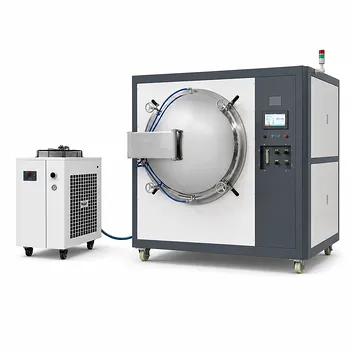
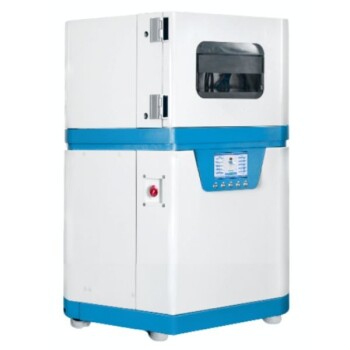
The application of 25 MPa axial pressure serves as a critical external driving force that enables powder particles to overcome inter-particle friction. This mechanical force facilitates immediate particle rearrangement and induces plastic deformation, allowing NiCr-based composites to eliminate internal pores rapidly and achieve high density at temperatures lower than those required by conventional methods.
Core Insight: While heat initiates sintering, it is the addition of 25 MPa of mechanical pressure that physically forces material consolidation. This effectively solves the "porosity problem" inherent in pressureless sintering, resulting in a composite with superior mechanical hardness and strength.
Mechanisms of Pressure-Assisted Sintering
Overcoming Internal Friction
In a loose powder bed, friction between particles resists the consolidation process.
Thermal energy alone is often insufficient to overcome this resistance completely. The application of 25 MPa of axial pressure provides the necessary mechanical work to override this friction, forcing particles into closer proximity immediately.
Plastic Deformation and Rearrangement
Once friction is overcome, the pressure drives two specific physical changes: particle rearrangement and plastic deformation.
Particles physically shift to fill void spaces, and where contact prevents movement, the material plastically deforms. This ensures that the interlayer voids and microscopic gaps are mechanically closed, rather than relying solely on slow atomic diffusion to fill them.
Impact on Material Structure and Performance
Rapid Pore Elimination
The primary structural benefit of this technique is the rapid elimination of internal pores.
By forcing the material components into atomic-scale contact, the furnace minimizes the distance atoms must diffuse. This creates a dense, defect-free bulk material much faster than pressureless sintering, which often leaves residual porosity.
Superior Mechanical Properties
The structural density directly correlates to performance.
NiCr-based composites processed under this pressure exhibit hardness and strength superior to those produced via pressureless sintering. The elimination of voids removes stress concentrators that would otherwise weaken the material.
The Synergy of Pressure and Vacuum
Preventing Oxidation
While pressure drives densification, the high-vacuum environment (typically below 1.5 x 10^-1 Pa) is essential for chemical integrity.
The vacuum removes oxygen and impurity gases from powder gaps. This prevents the oxidation of the metal powders, ensuring that the interfaces between grains remains clean, which is a prerequisite for strong bonding.
Promoting Atomic Diffusion
The combination of heat (e.g., 1100°C) and pressure creates a "coupling effect."
This environment promotes plastic flow and accelerates in-situ phase synthesis. Unlike rapid pulse methods, the sustained heat and pressure allow for thorough elemental diffusion, creating distinct and robust interfacial transition layers between the matrix and reinforcement particles.
Understanding the Trade-offs
Process Duration vs. Speed
While effective, vacuum hot pressing is generally slower than techniques like Spark Plasma Sintering (SPS).
SPS uses pulsed current for rapid heating, whereas hot pressing often requires extended holding times (e.g., one hour) to ensure uniform heat distribution. However, this prolonged time is often beneficial for developing complex interfacial diffusion layers that rapid methods might miss.
Geometric Constraints
The application of axial pressure generally limits the geometry of the final part.
Because the pressure is unidirectional (axial), this method is best suited for simple shapes like discs or cylinders. Achieving uniform density in complex, non-symmetrical parts can be challenging compared to Isostatic pressing or pressureless sintering.
Making the Right Choice for Your Goal
- If your primary focus is Maximum Density and Strength: Utilize the 25 MPa vacuum hot pressing method to mechanically force pore closure and ensure superior hardness.
- If your primary focus is Interface Characterization: The extended holding times and sustained pressure of this method allow for thicker, more measurable diffusion layers than rapid sintering techniques.
- If your primary focus is Complex Geometry: Recognize that axial pressure may limit your shape options, and alternative methods like HIP (Hot Isostatic Pressing) might be required.
The application of 25 MPa pressure transforms the sintering process from a passive thermal event into an active mechanical consolidation, guaranteeing a denser, stronger NiCr composite.
Summary Table:
| Feature | Effect of 25 MPa Axial Pressure | Benefit for NiCr Composites |
|---|---|---|
| Particle Interaction | Overcomes inter-particle friction | Facilitates immediate particle rearrangement |
| Material Density | Induces plastic deformation | Rapid elimination of internal pores |
| Mechanical Performance | Closes microscopic voids | Superior hardness and structural strength |
| Diffusion Process | Reduces atomic diffusion distance | Faster densification at lower temperatures |
| Interface Quality | Works with vacuum to clean grain boundaries | Robust bonding and cleaner interfaces |
Elevate Your Material Research with KINTEK Precision
Unlock the full potential of your NiCr-based composites and advanced materials with KINTEK’s high-performance vacuum hot pressing furnaces. Our systems provide the precise control over axial pressure and high-vacuum environments required to eliminate porosity and achieve superior mechanical properties.
From high-temperature furnaces (muffle, tube, and rotary) to isostatic and hydraulic presses, KINTEK specializes in laboratory equipment designed for extreme precision. Whether you are working on battery research, advanced ceramics, or complex crushing and milling, we provide the tools and consumables—like high-quality crucibles and PTFE products—to ensure your lab's success.
Ready to achieve maximum density and strength in your samples?
Contact KINTEK today for a custom solution
Related Products
- 600T Vacuum Induction Hot Press Furnace for Heat Treat and Sintering
- Vacuum Hot Press Furnace Heated Vacuum Press Machine Tube Furnace
- Vacuum Hot Press Furnace Machine for Lamination and Heating
- Vacuum Hot Press Furnace Machine Heated Vacuum Press
- Vacuum Heat Treat and Pressure Sintering Furnace for High Temperature Applications
People Also Ask
- What role does an induction vacuum hot pressing furnace play in sintering? Achieve 98% Density in Carbide Blocks
- What advantages does a vacuum hot press furnace provide for LSLBO ceramic electrolytes? Achieve 94% Relative Density
- What role does a Vacuum Hot Press (VHP) furnace play in the densification of austenitic stainless steel 316 composites?
- What role does mechanical pressure play during the vacuum diffusion bonding of tungsten and copper? Keys to Solid Bonding
- What are the advantages of a vacuum hot press furnace for W-50%Cu? Achieve 99.6% Density at Lower Temperatures