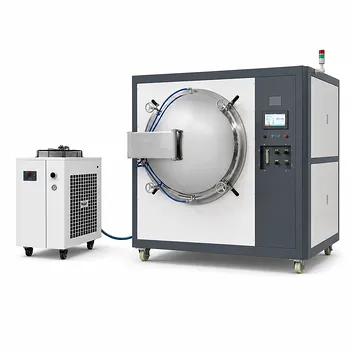
The use of a vacuum hot pressing furnace is non-negotiable for CrFeMoNbZr fabrication because it simultaneously applies high thermal energy (up to 1400 °C) and significant mechanical force (30 MPa) within a controlled, inert environment. This specific combination is the only reliable method to achieve full densification while preventing the catastrophic oxidation of reactive refractory elements like niobium and zirconium.
The Core Insight High-performance sputtering targets require nearly zero porosity and absolute chemical purity. Vacuum hot pressing achieves this by mechanically forcing particle fusion at temperatures below the melting point, while an argon shield ensures the alloy's chemical integrity remains uncompromised.
Overcoming the Refractory Challenge
Fabricating targets from a high-entropy alloy containing refractory metals (Chromium, Iron, Molybdenum, Niobium, Zirconium) presents unique physical hurdles. Standard sintering methods often fail to achieve the necessary density without degrading the material.
The Synergy of Heat and Pressure
The furnace operates by creating a powerful synergy between thermal energy and mechanical force.
It heats the powder mixture to 1400 °C while simultaneously applying 30 MPa of axial pressure. This dual-action approach is far more effective than heat alone.
Accelerating Densification
The applied pressure actively forces powder particles together.
This mechanical compression accelerates the diffusion process between the different metal atoms. It promotes densification, effectively squeezing out voids to minimize porosity in the final target.
Achieving High Density at Lower Temperatures
By using pressure, the material does not need to be melted to form a solid block.
This allows for consolidation at temperatures lower than the melting points of the most refractory components (like Molybdenum and Niobium). This prevents segregation and ensures a uniform microstructure.
Chemical Integrity and Oxidation Control
Beyond physical density, the chemical purity of the target is critical for semiconductor and coating applications. CrFeMoNbZr contains elements that are highly sensitive to their environment.
Protecting Reactive Elements
The alloy contains niobium (Nb) and zirconium (Zr), both of which are active refractory metals.
These elements react aggressively with oxygen at high temperatures. Without strict environmental control, they would undergo "uncontrolled oxidation," ruining the target's conductivity and sputtering performance.
The Role of the Argon Atmosphere
While the equipment is a "vacuum" furnace, for this specific alloy, it utilizes an argon-protected atmosphere.
The furnace chamber is isolated from ambient air and filled with inert argon gas. This creates a shield that prevents oxygen from contacting the hot metal surfaces during the sintering process.
Understanding the Trade-offs
While vacuum hot pressing is essential for quality, it introduces specific constraints that you must manage.
Production Throughput vs. Quality
This is inherently a batch process, not a continuous one.
The time required to heat, press, and cool the chamber limits production speed compared to other methods like atmospheric sintering. However, the gain in density and purity justifies this lower throughput for high-value targets.
Size Limitations
The axial pressure is applied via a mechanical ram.
This physical constraint limits the maximum diameter and geometry of the target that can be produced. You are generally restricted to simple flat shapes (disks or plates) rather than complex geometries.
Making the Right Choice for Your Goal
When evaluating fabrication methods for CrFeMoNbZr targets, align your choice with your specific technical requirements.
- If your primary focus is Film Quality: Use vacuum hot pressing to ensure the target has low porosity, which reduces particle generation (spitting) during the sputtering process.
- If your primary focus is Chemical Composition: Rely on this method to prevent the loss or alteration of reactive elements like Zirconium and Niobium through oxidation.
Ultimately, the vacuum hot pressing furnace transforms a loose mixture of refractory powders into a dense, chemically stable solid capable of high-performance deposition.
Summary Table:
| Parameter | Vacuum Hot Pressing (VHP) Value | Technical Purpose |
|---|---|---|
| Temperature | Up to 1400 °C | Promotes fusion below the melting point of refractory metals |
| Mechanical Force | 30 MPa (Axial) | Forces particle fusion and eliminates voids (porosity) |
| Atmosphere | Argon-protected / Vacuum | Prevents catastrophic oxidation of reactive Nb and Zr |
| Final Quality | Full Densification | Minimizes 'spitting' and ensures uniform sputtering performance |
Maximize Your Material Performance with KINTEK
Elevate your alloy fabrication to industrial standards with KINTEK’s precision laboratory equipment. Our specialized high-temperature vacuum furnaces and hydraulic presses are engineered to deliver the simultaneous thermal energy and mechanical force required to produce high-density CrFeMoNbZr targets without oxidation risk.
Beyond sintering, KINTEK offers a comprehensive range of crushing and milling systems for powder preparation, high-temperature high-pressure reactors, and essential consumables like ceramics and crucibles to support your entire material synthesis workflow. Don't compromise on chemical integrity—contact our technical experts today to find the perfect solution for your high-performance research and production needs.
References
- Xiaoyu Gu, Na Chen. Formation and Properties of Amorphous Multi-Component (CrFeMoNbZr)Ox Thin Films. DOI: 10.3390/met10050599
This article is also based on technical information from Kintek Solution Knowledge Base .
Related Products
- 600T Vacuum Induction Hot Press Furnace for Heat Treat and Sintering
- Vacuum Hot Press Furnace Heated Vacuum Press Machine Tube Furnace
- Vacuum Hot Press Furnace Machine for Lamination and Heating
- Vacuum Hot Press Furnace Machine Heated Vacuum Press
- Vacuum Heat Treat and Pressure Sintering Furnace for High Temperature Applications
People Also Ask
- What role does an induction vacuum hot pressing furnace play in sintering? Achieve 98% Density in Carbide Blocks
- What advantages does a vacuum hot press furnace provide for LSLBO ceramic electrolytes? Achieve 94% Relative Density
- What role does a Vacuum Hot Press (VHP) furnace play in the densification of austenitic stainless steel 316 composites?
- What are the advantages of a vacuum hot press furnace for W-50%Cu? Achieve 99.6% Density at Lower Temperatures
- What role does mechanical pressure play during the vacuum diffusion bonding of tungsten and copper? Keys to Solid Bonding