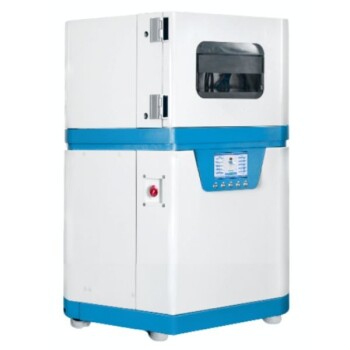
The application of mechanical pressure via a vacuum hot press serves as a critical external driving force that compels the rearrangement and plastic deformation of powder particles within A356-SiCp composites. By physically forcing the matrix material to flow, this pressure overcomes the natural resistance created by hard Silicon Carbide (SiC) particles, enabling the composite to achieve near-theoretical density at significantly lower temperatures than pressureless sintering would require.
Core Insight: The presence of hard ceramic particles (SiC) creates a "pinning effect" that naturally resists the shrinkage and densification of the metal matrix. Mechanical pressure is the essential counter-measure that breaks this resistance, forcing the soft aluminum matrix to flow around the hard obstacles and fill microscopic voids.
Mechanisms of Densification
Driving Plastic Deformation
In standard sintering, densification relies heavily on thermal energy. However, in A356-SiCp composites, thermal energy alone is often insufficient to fully densify the material.
Mechanical pressure forces the aluminum alloy matrix to undergo rheological flow while it is in a plastic state. This allows the matrix to physically move and fill the interstitial voids between the reinforcement particles.
Particle Rearrangement
Before the matrix fully deforms, the powder particles must be packed as tightly as possible.
The applied pressure creates a shearing force that reorganizes the powder arrangement. This eliminates large gaps early in the process, setting the stage for effective diffusion bonding.
Lowering Sintering Temperatures
Because mechanical pressure provides substantial energy for densification, the process relies less on extreme heat.
This allows the composite to reach near-theoretical density at lower temperatures. Lower temperatures are beneficial as they reduce the risk of excessive grain growth or deleterious chemical reactions between the matrix and the reinforcement.
Overcoming Microstructural Barriers
Countering the Pinning Effect
The primary challenge in sintering this composite is the SiC particles themselves. They are rigid and effectively "pin" the grain boundaries of the matrix, preventing the natural shrinkage that leads to densification.
The vacuum hot press applies sufficient force (often around 70 MPa) to overcome this pinning effect, pushing the matrix past the flow resistance caused by the hard particles.
Eliminating the Bridging Effect
Hard particles often form rigid bridges that shield the pores beneath them from closing.
Without external pressure, these pores would remain as defects. The mechanical force crushes these bridges or forces the matrix to flow around them, effectively eliminating internal porosity.
The Role of the Vacuum Environment
Enhancing Interfacial Contact
While pressure drives physical contact, the vacuum environment is essential for chemical integrity.
The vacuum removes adsorbed gases and moisture from particle surfaces. When combined with high pressure, this ensures that the "clean" surfaces are pressed into intimate contact, maximizing interfacial bonding strength.
Preventing Oxidation
Aluminum (A356) is highly reactive to oxygen. High-pressure sintering in a non-vacuum environment would trap oxides inside the material.
The vacuum isolates oxygen, preventing the formation of brittle oxide layers that would otherwise degrade the mechanical performance of the composite.
Understanding the Trade-offs
Equipment Complexity and Cost
Achieving the synergy of high vacuum and high uniaxial pressure requires specialized, expensive machinery. Unlike simple pressureless sintering in a furnace, vacuum hot pressing is a batch process that is generally slower and more capital-intensive.
Geometrical Limitations
The pressure in a hot press is typically uniaxial (applied from one direction). This can lead to density gradients in complex shapes, where "shadowed" areas may not receive the full force of the press. This method is most effective for simple geometries like plates or discs.
Making the Right Choice for Your Goal
To maximize the performance of your A356-SiCp composites, align your processing parameters with your specific material objectives:
- If your primary focus is Maximum Density: utilize high mechanical pressure (e.g., 70 MPa) to forcefully overcome the bridging effects of high-volume fraction SiC particles.
- If your primary focus is Microstructural Integrity: rely on the combination of pressure and lower sintering temperatures to densify the material without causing grain coarsening or excessive interfacial reactions.
- If your primary focus is Interface Strength: ensure the vacuum level is maintained to strip surface oxides while pressure forces the matrix into atomic-level contact with the reinforcement.
By substituting thermal energy with mechanical force, you achieve a dense, high-strength composite without compromising the microstructure through excessive heat.
Summary Table:
| Feature | Impact on A356-SiCp Composite |
|---|---|
| Mechanical Pressure | Drives plastic deformation and overcomes SiC particle pinning |
| Vacuum Environment | Removes adsorbed gases and prevents aluminum oxidation |
| Lower Temperature | Minimizes grain growth and deleterious interfacial reactions |
| Particle Rearrangement | Eliminates large gaps and bridges for near-theoretical density |
| Uniaxial Force | Ensures intimate interfacial contact and bonding strength |
Elevate Your Material Performance with KINTEK Precision Solutions
Achieve near-theoretical density and superior microstructural integrity for your advanced composites. KINTEK specializes in high-performance laboratory equipment, providing state-of-the-art vacuum hot presses designed for the rigorous demands of A356-SiCp sintering.
Our comprehensive range of high-temperature furnaces, vacuum systems, and hydraulic presses empowers researchers and manufacturers to overcome the 'pinning effect' and maximize interfacial bonding strength. Whether you need precise crushing and milling systems or specialized ceramic crucibles, KINTEK offers the total solution for your material science innovations.
Ready to optimize your sintering process? Contact us today to discover how our expertise can enhance your laboratory's efficiency and results.
Related Products
- Vacuum Hot Press Furnace Machine Heated Vacuum Press
- Vacuum Hot Press Furnace Machine for Lamination and Heating
- Vacuum Hot Press Furnace Heated Vacuum Press Machine Tube Furnace
- 600T Vacuum Induction Hot Press Furnace for Heat Treat and Sintering
- Touchscreen Automatic Vacuum Heat Press
People Also Ask
- What advantages does a vacuum hot press furnace provide for LSLBO ceramic electrolytes? Achieve 94% Relative Density
- What role does a Vacuum Hot Press (VHP) furnace play in the densification of austenitic stainless steel 316 composites?
- What are the advantages of using a vacuum hot pressing furnace? Superior Densification for 2024Al/Gr/SiC Composites
- Why is it necessary to maintain a high-vacuum environment within a vacuum hot press furnace? Optimize Cu-SiC Sintering
- What is the purpose of remelting heat treatment in a vacuum hot press for UHMWPE? Ensure Oxidative Stability