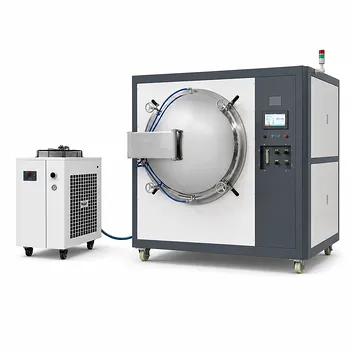
A vacuum hot press furnace is essential for the degreasing treatment of TiAl-based composite preforms because it provides the strict environmental control necessary to remove organic binders without compromising the material's purity. By maintaining a stable temperature around 380°C under a high vacuum (typically $10^{-2}$ Pa), the furnace ensures the PMMA binder completely decomposes and is extracted before the sintering phase begins. This specific environment prevents the formation of carbon residues and gas pores, which are detrimental to the density and mechanical integrity of the final composite.
Core Takeaway The vacuum hot press furnace is not merely for applying pressure; during degreasing, it acts as a precision extraction chamber. Its primary function is to eliminate organic binders in a high-vacuum, moderate-heat environment to prevent carbon contamination and oxidation, ensuring the TiAl composite is chemically pure and void-free prior to final densification.
The Critical Role of Environmental Control
Facilitating Complete Binder Decomposition
The primary challenge in processing TiAl-based preforms is the removal of the binder agent, typically PMMA (polymethyl methacrylate).
The vacuum hot press furnace allows for precisely controlled heating, specifically targeting temperatures such as 380°C. This temperature is engineered to thermally decompose the binder without inducing premature reactions in the metal powders.
Extraction via High Vacuum
Simple heating is insufficient; the decomposed binder byproducts must be physically removed from the matrix.
The furnace operates at a high vacuum level, generally around $10^{-2}$ Pa. This pressure differential actively draws the volatile decomposition products out of the preform, preventing them from re-settling or becoming trapped within the material structure.
Ensuring Material Purity and Density
Preventing Carbon Contamination
If the binder is not fully evacuated, residual carbon remains within the preform.
During subsequent high-temperature processing, this residual carbon can react with Titanium or Aluminum. Utilizing a vacuum hot press furnace for degreasing avoids carbon contamination, ensuring the chemical composition of the alloy remains accurate to the design specifications.
Eliminating Gas Porosity
Organic residues that survive the degreasing phase will eventually gasify when sintering temperatures are reached.
If these gases are released during the high-pressure sintering stage, they form internal voids or pores. By using a vacuum furnace to complete this process beforehand, you prevent the formation of gas pores, thereby guaranteeing the high density required for structural applications.
Protection from Oxidation
Titanium (Ti) and Aluminum (Al) are highly reactive elements that oxidize readily in the presence of oxygen.
While the primary goal is binder removal, the vacuum environment simultaneously serves to prevent the oxidation of these active elements. This preserves the surface energy of the powder particles, which is critical for successful diffusion bonding in later stages.
Understanding the Trade-offs
Process Sensitivity and Control limits
While effective, the use of a vacuum hot press furnace requires rigorous control logic.
If the temperature exceeds critical limits during degreasing, you risk triggering early interfacial reactions or brittle phase formation. The equipment must be capable of stabilizing temperatures strictly within the densification or degreasing range to avoid degrading mechanical performance.
Throughput Limitations
Vacuum hot pressing is inherently a batch process.
Because the degreasing and subsequent sintering occur in a controlled, sealed environment, the cycle times are longer compared to continuous atmosphere furnaces. This makes the process excellent for high-performance, high-value components but potentially less viable for mass-production of lower-grade parts.
Making the Right Choice for Your Goal
To maximize the quality of your TiAl-based composites, align your process parameters with your specific objectives:
- If your primary focus is Structural Integrity: Ensure the vacuum level remains at or below $10^{-2}$ Pa during the 380°C hold to eliminate all sources of gas porosity.
- If your primary focus is Chemical Purity: Prioritize precise temperature ramping to prevent binder residue from charring into carbon contaminants before it can be extracted.
- If your primary focus is Mechanical Hardness: Verify that the degreasing cycle transitions seamlessly into the high-pressure sintering phase (up to 30 MPa) to achieve full densification.
Success in TiAl composite fabrication relies on treating the degreasing phase not just as a cleaning step, but as a critical foundation for material performance.
Summary Table:
| Parameter | Target Value | Function in Degreasing |
|---|---|---|
| Temperature | ~380°C | Facilitates PMMA binder decomposition without reacting metal powders. |
| Vacuum Level | $10^{-2}$ Pa | Actively extracts volatile byproducts to prevent gas pores. |
| Pressure (Sintering) | Up to 30 MPa | Applied after degreasing to achieve full material densification. |
| Atmosphere | High Vacuum | Prevents oxidation of reactive Titanium and Aluminum elements. |
Elevate Your Advanced Material Synthesis with KINTEK
Precise degreasing and sintering are the foundations of high-performance TiAl composites. KINTEK specializes in cutting-edge laboratory equipment, offering a comprehensive range of vacuum hot press furnaces, high-temperature muffle and tube furnaces, and CVD/PECVD systems designed to meet the rigorous demands of aerospace and structural engineering research.
By choosing KINTEK, you gain access to:
- Superior Environmental Control: Maintain the high vacuum and temperature stability necessary for zero-contamination processing.
- Complete Lab Solutions: From crushing and milling systems to isostatic presses and high-purity ceramic crucibles, we provide the tools for every stage of material development.
- Unmatched Expertise: Our equipment supports critical applications in battery research, dental ceramics, and high-pressure reactors.
Ready to achieve void-free, chemically pure results for your research?
Related Products
- Vacuum Hot Press Furnace Heated Vacuum Press Machine Tube Furnace
- 600T Vacuum Induction Hot Press Furnace for Heat Treat and Sintering
- Vacuum Hot Press Furnace Machine Heated Vacuum Press
- Vacuum Hot Press Furnace Machine for Lamination and Heating
- Vacuum Heat Treat and Pressure Sintering Furnace for High Temperature Applications
People Also Ask
- What advantages does a vacuum hot press furnace provide for LSLBO ceramic electrolytes? Achieve 94% Relative Density
- What role does a Vacuum Hot Press (VHP) furnace play in the densification of austenitic stainless steel 316 composites?
- What are the advantages of using a vacuum hot pressing furnace? Superior Densification for 2024Al/Gr/SiC Composites
- What are the advantages of a vacuum hot press furnace for LTPO solid electrolytes? Boost Density and Conductivity
- What core processing conditions does a vacuum hot press furnace provide? Achieve High-Density Cu-SiC/Diamond Composites