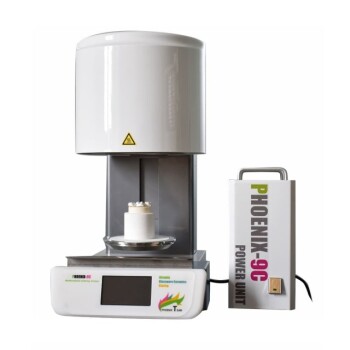
High-performance sintering furnaces are the absolute requirement for the large-scale production of Oxide Solid Electrolytes. To successfully transition from lab to factory, you need industrial-grade equipment capable of delivering a continuous, uniform high-temperature environment. This equipment must specifically offer high standards of thermal efficiency and precise temperature control to ensure material quality during scale-up.
Scaling production involves more than just increasing heat; it requires industrial furnaces that balance high thermal efficiency with the rigorous precision needed to overcome energy barriers and achieve uniform material densification.
The Physics of Production: Overcoming Energy Barriers
The manufacturing process for Oxide Solid Electrolytes is chemically complex and energy-intensive. The equipment selected must be robust enough to drive specific physical changes in the material.
Driving Material Densification
The primary role of the furnace is to facilitate densification.
Heating systems must provide sufficient thermal energy to eliminate porosity within the material. Without this intense heat, the electrolyte remains porous, which significantly degrades its performance.
Triggering Phase Changes
Production requires more than just melting or drying.
The equipment must reach specific high-temperature thresholds to trigger necessary phase changes. These transformations are critical for establishing the correct crystalline structure required for ion conductivity.
High-Energy Requirements
Because these processes encounter high energy barriers, standard ovens are insufficient.
Only industrial-grade sintering furnaces can supply the sustained, intense energy required to break through these barriers and stabilize the material.
Critical Equipment Capabilities for Scale-Up
When moving to large-scale manufacturing, consistency is the primary challenge. The heating system acts as the control center for product quality.
Continuous Temperature Uniformity
In a large-scale setting, every unit of product must experience the exact same thermal profile.
Furnaces must provide a continuous and uniform high-temperature environment. Any fluctuation or "cold spot" within the heating zone can lead to inconsistent batches and wasted material.
Precision Control Standards
As production scales, the margin for error shrinks.
Heating systems must meet high standards for temperature control precision. This ensures that the delicate phase changes occur exactly as intended, protecting the quality of the final electrolyte.
Thermal Efficiency
Scale-up manufacturing amplifies energy consumption.
To maintain economic viability, the chosen equipment must demonstrate superior thermal efficiency. This minimizes energy waste during the energy-intensive sintering process, keeping operational costs manageable.
Understanding the Trade-offs
While high-end heating equipment is essential, there are inherent challenges in selecting the right system for mass production.
Uniformity vs. Volume
As furnace size increases to handle larger volumes, maintaining thermal uniformity becomes exponentially more difficult.
Achieving perfect consistency across a massive continuous belt requires sophisticated engineering, which often increases the initial capital expenditure.
Efficiency vs. Complexity
Maximizing thermal efficiency often requires advanced insulation and heat recovery systems.
While these features reduce long-term energy costs, they add complexity to the equipment maintenance and operation. You must balance the need for low operating costs with the reality of equipment uptime and maintenance.
Making the Right Choice for Your Goal
Selecting the right heating equipment is a strategic decision that defines your production capabilities.
- If your primary focus is Material Quality: Prioritize systems with the highest ratings for temperature control precision and uniformity to ensure perfect densification and phase purity.
- If your primary focus is Operational Scalability: Prioritize furnaces that emphasize thermal efficiency and continuous processing capabilities to manage the high energy costs of large-scale sintering.
The success of your production line depends on a heating system that delivers precise energy exactly where it is needed.
Summary Table:
| Key Requirement | Industrial Need | Impact on Production |
|---|---|---|
| Thermal Uniformity | Consistent heat throughout the furnace | Prevents 'cold spots' and ensures batch-to-batch consistency |
| Temperature Precision | High-accuracy control systems | Triggers critical phase changes for ion conductivity |
| Energy Density | High-energy sintering capability | Overcomes physical barriers to achieve material densification |
| Thermal Efficiency | Optimized insulation & heat recovery | Minimizes energy waste and reduces operational costs in mass production |
Scale Your Oxide Solid Electrolyte Production with KINTEK
Transitioning from laboratory research to industrial-scale manufacturing requires more than just heat—it requires precision engineering and uncompromising thermal control. KINTEK specializes in advanced laboratory and industrial heating solutions designed to meet the rigorous energy barriers of solid-state battery materials.
Our extensive portfolio includes high-performance muffle, tube, and rotary furnaces, vacuum and CVD systems, and specialized sintering equipment tailored for high-temperature material densification. Whether you are optimizing material phase purity or scaling for mass production, KINTEK provides the thermal efficiency and precise temperature control your facility demands.
Ready to elevate your production capabilities? Contact our technical experts today to find the perfect sintering solution for your oxide solid electrolytes and explore our full range of hydraulic presses, crushing systems, and specialized lab consumables.
Related Products
- Spark Plasma Sintering Furnace SPS Furnace
- Vacuum Heat Treat and Sintering Furnace with 9MPa Air Pressure
- High Temperature Muffle Oven Furnace for Laboratory Debinding and Pre Sintering
- 600T Vacuum Induction Hot Press Furnace for Heat Treat and Sintering
- Vacuum Heat Treat and Pressure Sintering Furnace for High Temperature Applications
People Also Ask
- What is SPS sintering method? A Guide to High-Speed, High-Performance Material Fabrication
- Why are Spark Plasma Sintering (SPS) furnaces or hot presses utilized in the preparation of Li3PS4 solid electrolytes?
- What is the difference between spark plasma sintering and flash sintering? A Guide to Advanced Sintering Methods
- What technical advantages does a Spark Plasma Sintering (SPS) furnace offer for LZP ceramics? Enhance Ionic Conductivity
- What is the theory of spark plasma sintering? A Guide to Rapid, Low-Temperature Densification