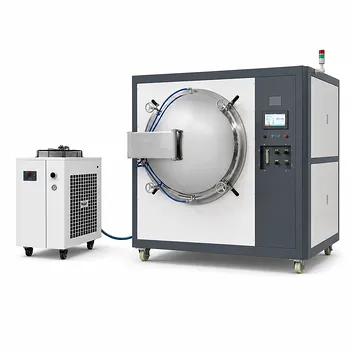
The requirement for a vacuum hot press furnace stems from a fundamental conflict in processing copper-diamond composites: you must heat the materials enough to bond them, but that very heat threatens to destroy them. A vacuum hot press furnace solves this by synchronizing three critical variables—temperature, pressure, and atmosphere—to protect the diamond's structure while forcing the copper matrix into a dense, unified solid.
The Core Insight Sintering copper and diamond requires a protective environment to prevent degradation and mechanical force to ensure cohesion. The vacuum hot press furnace creates a unique synergy where a high-vacuum preserves material purity, while uniaxial pressure physically forces the metal to flow around the diamond, achieving densities and bond strengths that pressureless sintering cannot provide.
The Critical Role of the Vacuum Environment
A standard furnace cannot handle copper-diamond composites because oxygen is detrimental to both materials at sintering temperatures.
Preventing Matrix Oxidation
At the high temperatures required for sintering (often around 940°C), copper is highly susceptible to oxidation.
A high-vacuum environment (e.g., -0.1 MPa) effectively minimizes oxygen partial pressure. This prevents the formation of copper oxides, ensuring the metallic matrix remains pure and conductive.
Inhibiting Diamond Degradation
Diamonds are metastable; at elevated temperatures, they are prone to graphitization (turning into graphite) and oxidation.
If diamonds graphitize, they lose their unique thermal and mechanical properties. The vacuum environment starves the reaction of oxygen, preserving the diamond's crystal structure even under high heat.
Cleaning Particle Surfaces
The vacuum does more than just protect; it actively cleans the materials.
It facilitates the removal of adsorbed gases and volatile impurities from the powder surfaces. Clean surfaces are a prerequisite for atomic diffusion, which is the mechanism that allows the copper and diamond to chemically and mechanically bond.
The Necessity of Mechanical Pressure
Protecting the materials is only half the battle; you must also densify them. Copper does not naturally "wet" or flow around diamond particles easily without assistance.
Forcing Material Rearrangement
The hot press applies uniaxial pressure (e.g., 15 MPa) directly to the powder mixture.
This mechanical force overcomes the friction between particles, forcing them to rearrange into a tighter packing configuration before sintering even fully begins.
Promoting Plastic Deformation
As the temperature rises, the pressure induces plastic deformation in the copper matrix.
This causes the copper to flow like a viscous liquid, filling the microscopic gaps between the hard diamond particles. This "liquid phase filling" is essential for eliminating voids that would otherwise act as thermal barriers.
Closing Internal Pores
Pressureless sintering often leaves residual porosity, which kills thermal conductivity.
The pressure-assisted mechanism forcibly closes internal pores and breaks down particle agglomerates. This results in a composite with significantly higher density and mechanical strength compared to conventional resistance sintering.
Understanding the Trade-offs
While the vacuum hot press is the superior choice for quality, it is important to understand the operational limitations compared to other methods like Spark Plasma Sintering (SPS).
Cycle Time vs. Diffusion Quality
SPS furnaces offer rapid heating and short cycles, but this speed can be a disadvantage for specific metal-diamond systems.
The vacuum hot press utilizes longer diffusion times. While this extends the manufacturing cycle, it allows for superior interface thermal conductance—often achieving over 85% of the theoretical predicted value—which rapid processes may fail to develop due to insufficient bonding time.
Throughput Limitations
Vacuum hot pressing is inherently a batch process.
Because the system must be evacuated, heated, pressed, and cooled under controlled conditions, the throughput is lower than continuous belt furnaces. However, for high-performance composites, the trade-off in speed is necessary to achieve the required material properties.
Making the Right Choice for Your Goal
When deciding on your sintering equipment strategy, consider your primary performance metrics:
- If your primary focus is Maximum Thermal Conductivity: Use a vacuum hot press to ensure sufficient atomic diffusion time and minimized phonon scattering at the interface.
- If your primary focus is Structural Integrity: Rely on the vacuum hot press to maximize density and mechanical bonding force, reducing the risk of component failure under stress.
- If your primary focus is Material Purity: The vacuum environment is non-negotiable to prevent oxide inclusion and diamond graphitization.
The vacuum hot press furnace is not merely a heating vessel; it is a precision tool that forces two dissimilar materials to act as a single, high-performance unit.
Summary Table:
| Feature | Benefit for Copper-Diamond Composites |
|---|---|
| High-Vacuum Environment | Prevents copper oxidation and diamond graphitization; cleans particle surfaces. |
| Uniaxial Pressure | Forcing copper to flow into voids, achieving near-theoretical density (>85%). |
| Controlled Heating | Optimizes atomic diffusion for superior interface thermal conductance. |
| Impurity Removal | Eliminates adsorbed gases and volatiles for stronger chemical/mechanical bonds. |
Elevate Your Material Performance with KINTEK Precision
Don't let oxidation or porosity compromise your copper-based diamond composites. KINTEK specializes in advanced laboratory solutions, providing high-performance vacuum hot press furnaces and a comprehensive range of high-temperature furnaces (muffle, vacuum, CVD, and more) designed for the most demanding sintering applications.
Whether you require precise hydraulic presses, crushing and milling systems, or specialized crucibles and ceramics, our expertise ensures your lab achieves maximum thermal conductivity and structural integrity.
Ready to optimize your sintering process? Contact our technical experts today to find the perfect equipment for your research and production needs.
Related Products
- Vacuum Hot Press Furnace Heated Vacuum Press Machine Tube Furnace
- 600T Vacuum Induction Hot Press Furnace for Heat Treat and Sintering
- Vacuum Hot Press Furnace Machine Heated Vacuum Press
- Vacuum Hot Press Furnace Machine for Lamination and Heating
- Vacuum Heat Treat and Pressure Sintering Furnace for High Temperature Applications
People Also Ask
- What advantages does a vacuum hot press furnace provide for LSLBO ceramic electrolytes? Achieve 94% Relative Density
- What role does a Vacuum Hot Press (VHP) furnace play in the densification of austenitic stainless steel 316 composites?
- What are the advantages of using a vacuum hot pressing furnace? Superior Densification for 2024Al/Gr/SiC Composites
- What are the advantages of a vacuum hot press furnace for LTPO solid electrolytes? Boost Density and Conductivity
- What core processing conditions does a vacuum hot press furnace provide? Achieve High-Density Cu-SiC/Diamond Composites