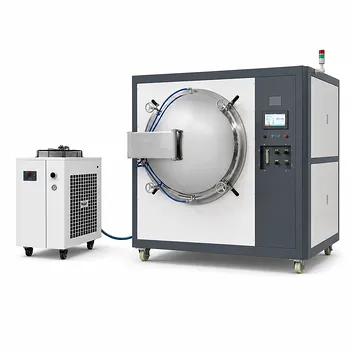
The hydraulic pressing device drives densification by applying continuous, constant axial pressure to the material while it is softened by heat. This external force causes the metal particles to undergo plastic flow, physically forcing them into the empty spaces between reinforcing particles to eliminate voids and achieve near-full density.
Core Insight: The hydraulic system transforms the sintering process from a passive thermal event into an active mechanical one. By applying pressure (e.g., 30 MPa) exactly when the metal matrix is thermally softened, it forces material into microscopic voids and accelerates atomic diffusion, achieving densities that heat alone cannot produce.
The Mechanics of Pressure-Assisted Densification
Inducing Plastic Flow
The primary function of the hydraulic device is to capitalize on the material's thermal softening. As the furnace heats the metal matrix to a pliable state, the hydraulic ram applies specific axial pressure.
This pressure overcomes the yield strength of the softened metal. The metal particles physically deform and flow like a viscous fluid, wrapping tightly around harder ceramic reinforcements (such as TiC or SiC) and filling interstitial gaps.
Eliminating Internal Porosity
In traditional sintering, pores must close slowly through surface tension and diffusion. The hydraulic device aggressively accelerates this by mechanically collapsing these voids.
By forcing particles together, the device ensures that even stubborn gaps between the metal matrix and ceramic reinforcements are filled. This is critical for creating a continuous, solid structure with high mechanical integrity.
Enhancing Atomic Diffusion
Closing the Atomic Distance
The application of external force brings powder particles into intimate contact, significantly reducing the distance atoms must travel to bond.
This proximity accelerates the rate of atomic diffusion. The material consolidates faster because the barrier to bonding—the physical gap between particles—is mechanically removed.
Lowering Thermal Requirements
Because pressure aids the densification process, the furnace does not need to rely solely on extreme temperatures to fuse the material.
This allows for processing at temperatures lower than those required for traditional pressureless sintering. Lower temperatures help prevent grain coarsening (which weakens metals) and reduce the risk of degrading sensitive reinforcing fibers.
The Synergy with the Vacuum Environment
Why Pressure Needs Vacuum
While the hydraulic device provides the force, the vacuum environment is the prerequisite for that force to be effective.
Before the hydraulic ram compresses the powder, the high-vacuum system (often down to 0.1 Pa) extracts air and volatile impurities from the powder gaps.
Preventing Trapped Gases
If pressure were applied without a vacuum, gases would be trapped inside the closing pores, creating high-pressure pockets that prevent full density.
By degassing the material first, the hydraulic device can compress the powder into a solid, void-free billet without locking in pockets of air or oxidation.
Understanding the Trade-offs
Uniaxial Limitations
The hydraulic device typically applies pressure in a single axial direction (top-down or bottom-up).
This creates "density gradients," where the material closest to the ram may be denser than material in the center of a tall sample. Complex geometries are difficult to press uniformly compared to isostatic pressing (pressure from all sides).
Mold Constraints
The application of 30+ MPa of pressure at high temperatures requires robust graphite or ceramic dies.
This limits production to simple shapes (cylinders, blocks) that can be ejected from a mold. The friction between the powder and the die wall can also result in uneven density distribution near the edges.
Making the Right Choice for Your Goal
The hydraulic pressing device is a powerful tool, but its parameters must be tuned to your specific material targets.
- If your primary focus is Maximum Density (>99%): Prioritize higher hydraulic pressure (30 MPa or higher) during the peak softening phase to mechanically collapse all residual pores.
- If your primary focus is Microstructure Control: Use the pressure capability to lower the maximum sintering temperature, which preserves fine grain structure and prevents reaction between the matrix and reinforcement.
- If your primary focus is Complex Geometry: Recognize that uniaxial hydraulic pressing is limited; you may need to press a simple billet and machine it later, rather than pressing to net shape.
The hydraulic device acts as the catalyst for densification, substituting mechanical force for thermal energy to produce superior composites.
Summary Table:
| Feature | Function in Densification | Key Benefit |
|---|---|---|
| Plastic Flow Induction | Applies axial pressure to softened metal | Fills gaps between reinforcing particles |
| Porosity Elimination | Mechanically collapses internal voids | Achieves near-full density (>99%) |
| Enhanced Diffusion | Increases particle-to-particle contact | Faster bonding at lower temperatures |
| Vacuum Synergy | Removes gases before compression | Prevents trapped air and oxidation pockets |
| Thermal Control | Substitutes force for extreme heat | Prevents grain coarsening and degradation |
Elevate Your Material Research with KINTEK Precision
Unlock superior mechanical integrity for your composites with KINTEK’s advanced vacuum hot press furnaces. Our systems integrate powerful hydraulic pressing devices with high-vacuum environments to ensure your metal matrix composites achieve maximum density and optimal microstructure.
Beyond hot presses, KINTEK specializes in a comprehensive range of laboratory equipment, including:
- High-Temperature Furnaces: Muffle, tube, rotary, and CVD/PECVD/MPCVD systems.
- Material Processing: Crushing, milling, sieving, and hydraulic presses (pellet, hot, isostatic).
- Advanced Reactors: High-temperature high-pressure reactors and autoclaves.
- Specialized Labs: Electrolytic cells, battery research tools, and cooling solutions (ULT freezers).
- Essential Consumables: High-purity ceramics, crucibles, and PTFE products.
Ready to optimize your sintering process? Contact our technical experts today to find the perfect equipment solution for your laboratory.
Related Products
- Vacuum Hot Press Furnace Heated Vacuum Press Machine Tube Furnace
- 600T Vacuum Induction Hot Press Furnace for Heat Treat and Sintering
- Vacuum Hot Press Furnace Machine Heated Vacuum Press
- Vacuum Hot Press Furnace Machine for Lamination and Heating
- Vacuum Heat Treat and Pressure Sintering Furnace for High Temperature Applications
People Also Ask
- What advantages does a vacuum hot press furnace provide for LSLBO ceramic electrolytes? Achieve 94% Relative Density
- What role does a Vacuum Hot Press (VHP) furnace play in the densification of austenitic stainless steel 316 composites?
- What are the advantages of using a vacuum hot pressing furnace? Superior Densification for 2024Al/Gr/SiC Composites
- What are the advantages of a vacuum hot press furnace for LTPO solid electrolytes? Boost Density and Conductivity
- What core processing conditions does a vacuum hot press furnace provide? Achieve High-Density Cu-SiC/Diamond Composites