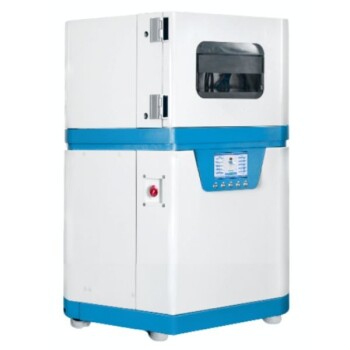
Vacuum hot-press (VHP) equipment creates a fundamentally denser material structure compared to conventional methods. While standard atmospheric sintering typically limits Ca3Co4O9 to a relative density of approximately 77%, VHP leverages external mechanical pressure to drive this value to over 94%.
The Core Takeaway Conventional sintering relies on heat alone, leaving significant gaps between grains. Vacuum hot-pressing introduces mechanical force as an additional driving factor, physically compressing the microstructure to eliminate residual porosity and drastically improve material performance.
The Mechanics of Densification
The Limitation of Atmospheric Sintering
Conventional sintering furnaces rely primarily on thermal energy to bond particles.
For materials like Ca3Co4O9, this process is often insufficient to fully close the voids between grains. Consequently, the final product retains a porous structure with a relative density of only roughly 77%.
Pressure as a Driving Force
VHP equipment overcomes these thermal limitations by applying external mechanical pressure during the heating process.
This pressure acts as a powerful driving force, compelling the material to compact. It actively eliminates residual porosity that thermal energy alone cannot resolve.
Quantifiable Density Gains
The difference in results is substantial. By switching to VHP, you can increase the relative density of Ca3Co4O9 from ~77% to over 94%.
In broader applications, this combination of high temperature and pressure has been shown to achieve densities as high as 99.1% in other matrix materials by facilitating plastic deformation to fill inter-particle gaps.
Performance Implications of High Density
Reducing Carrier Scattering
The primary benefit of this increased density is the enhancement of electrical transport properties.
Low-density materials contain numerous voids and grain boundaries that scatter charge carriers. By eliminating these structural defects, VHP significantly improves the material's overall performance.
The Role of the Vacuum Environment
Beyond pressure, the vacuum environment plays a critical role in achieving high density.
Vacuum processing minimizes the presence of gases like oxygen and nitrogen within the pores. This prevents high-temperature oxidation and removes oxide films, promoting cleaner, denser bonding between particles.
Critical Process Considerations
Lowering Activation Energy
One of the distinct characteristics of VHP is its ability to alter the energy requirements of the process.
The application of mechanical pressure significantly reduces the activation energy needed for sintering. This allows materials to reach high densities at potentially lower temperatures compared to pressure-less methods.
Controlling Grain Growth
Achieving high density often comes with the risk of uncontrolled grain growth, which can degrade mechanical properties.
However, the pressure-assisted consolidation in VHP helps inhibit excessive grain growth. This ensures that the material retains mechanical strength alongside its improved density and electrical properties.
Making the Right Choice for Your Goal
To maximize the potential of Ca3Co4O9, you must align your processing method with your specific performance targets.
- If your primary focus is electrical efficiency: Choose Vacuum Hot-Press equipment to achieve >94% density, minimizing carrier scattering and optimizing transport properties.
- If your primary focus is structural integrity: Utilize the VHP process to eliminate porosity and inhibit excessive grain growth, resulting in a mechanically stronger component.
Switching to vacuum hot-press equipment is the definitive method for transforming Ca3Co4O9 from a porous, 77% dense solid into a highly compact, high-performance material.
Summary Table:
| Feature | Conventional Sintering | Vacuum Hot-Press (VHP) |
|---|---|---|
| Driving Force | Thermal Energy Only | Heat + Mechanical Pressure |
| Relative Density | ~77% | >94% (up to 99.1%) |
| Microstructure | High Porosity / Voids | Dense / Compact |
| Carrier Scattering | High (due to voids) | Low (optimized transport) |
| Grain Growth | Hard to Control | Inhibited / Controlled |
| Atmosphere | Atmospheric / Inert | Vacuum (Prevents Oxidation) |
Elevate Your Material Research with KINTEK
Precision matters in advanced material synthesis. KINTEK specializes in high-performance laboratory equipment designed to push the boundaries of density and structural integrity. Whether you are working on Ca3Co4O9 or other advanced ceramics, our vacuum hot-presses, high-temperature furnaces, and isostatic presses provide the exact control needed to eliminate porosity and maximize electrical efficiency.
From pellet and hydraulic presses to vacuum and CVD furnaces, we offer the complete toolkit for battery research, material science, and industrial applications. Don't let 77% density limit your results—leverage KINTEK's expertise to achieve superior material performance.
Ready to upgrade your sintering process? Contact KINTEK today to find the perfect solution!
Related Products
- Vacuum Hot Press Furnace Heated Vacuum Press Machine Tube Furnace
- 600T Vacuum Induction Hot Press Furnace for Heat Treat and Sintering
- Vacuum Hot Press Furnace Machine Heated Vacuum Press
- Vacuum Hot Press Furnace Machine for Lamination and Heating
- Vacuum Heat Treat and Pressure Sintering Furnace for High Temperature Applications
People Also Ask
- What advantages does a vacuum hot press furnace provide for LSLBO ceramic electrolytes? Achieve 94% Relative Density
- What role does a Vacuum Hot Press (VHP) furnace play in the densification of austenitic stainless steel 316 composites?
- What are the advantages of using a vacuum hot pressing furnace? Superior Densification for 2024Al/Gr/SiC Composites
- What are the advantages of a vacuum hot press furnace for LTPO solid electrolytes? Boost Density and Conductivity
- What core processing conditions does a vacuum hot press furnace provide? Achieve High-Density Cu-SiC/Diamond Composites