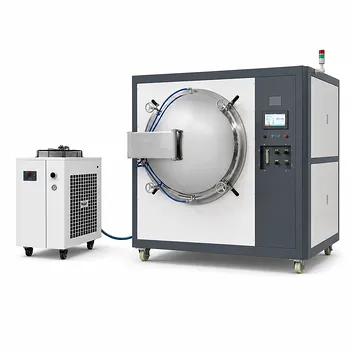
The primary function of a vacuum hot pressing furnace is to simultaneously apply high temperature and uniaxial mechanical pressure within a protected environment. Specifically, during the manufacturing of Cu/Ti3SiC2/C/Graphene composites, this equipment creates a high-vacuum atmosphere to prevent oxidation while leveraging heat (typically 950°C) and pressure (27.7 MPa) to force particle densification. This process transforms loose mixed powders into a solid, high-density composite without compromising the chemical integrity of the copper matrix or the carbon nanomaterials.
Core Takeaway The vacuum hot pressing furnace solves two competing challenges: it forces difficult-to-sinter materials to densify through mechanical pressure, while the vacuum environment acts as a chemical shield. This ensures that the copper matrix flows plastically around the carbon reinforcements without the risk of oxidation or ablation that usually occurs at sintering temperatures.
Preserving Chemical Integrity via Vacuum
Prevention of Oxidation
The most critical role of the vacuum environment is limiting oxygen exposure. Copper is highly susceptible to oxidation at elevated temperatures, which degrades electrical conductivity.
Simultaneously, carbon nanomaterials (such as graphene) and the Ti3SiC2 phase are prone to oxidation or ablation (burning away) in air. The vacuum effectively isolates these materials to preserve their properties.
Removal of Adsorbed Gases
Beyond preventing external oxygen ingress, the vacuum plays an active role in purification. It helps extract gases that are naturally adsorbed in the interstices of the powder particles.
By removing these trapped gases before the material fully densifies, the process significantly reduces micro-porosity in the final product. This reduction in gas-induced defects is essential for achieving optimal electrical and mechanical performance.
Stabilization of Sensitive Phases
Certain ceramic phases, such as Ti3SiC2, can decompose under unstable atmospheric conditions. The controlled vacuum (or essentially inert) environment maintains the thermodynamic stability required to keep these complex phases intact during the heating cycle.
Achieving Densification via Heat and Pressure
Facilitating Plastic Flow
While heat softens the material, pressure is the driver of form. The application of uniaxial pressure (e.g., 27.7 MPa) causes the copper matrix to undergo plastic flow.
This allows the metal to fill the voids between the harder Ti3SiC2 particles and carbon reinforcements more effectively than heat alone could achieve.
Promoting Grain Boundary Mechanisms
The combination of thermal energy and mechanical force accelerates kinetic processes at the atomic level. It promotes particle contact, rearrangement, and grain boundary sliding.
These mechanisms lead to the rapid formation of "sintering necks" between particles, which is the physical bridging process that turns powder into a solid.
Maximizing Relative Density
The ultimate goal of applying this pressure is to eliminate internal pores. By mechanically forcing the material together, relative densities can reach high levels (e.g., upwards of 93.51%).
High density is directly correlated with superior mechanical strength and electrical conductivity in the final composite.
The Role of Graphite Tooling
Thermal and Mechanical Transmission
The process relies on graphite molds to contain the powder. These molds utilize graphite’s excellent thermal conductivity to ensure heat is transferred uniformly to the composite core.
Geometric Containment
Simultaneously, the molds must withstand the significant uniaxial pressure being applied. They fix the powders into a specific shape (often a disk) and ensure consistent sintering quality across the entire geometry of the specimen.
Understanding the Trade-offs
Geometric Limitations
Vacuum hot pressing applies pressure from a single axis (uniaxial). This inherently limits the complexity of the shapes you can produce. It is ideal for simple geometries like plates or disks but unsuitable for complex 3D components without extensive post-machining.
Production Scalability
This is typically a batch process. The cycle times for heating, holding under pressure, and cooling in a vacuum are significant. While it produces superior material properties compared to pressureless sintering, the throughput is generally lower and the cost per part is higher.
Making the Right Choice for Your Project
To maximize the utility of vacuum hot pressing for your specific Cu/Ti3SiC2/C/Graphene application, consider your primary performance metric:
- If your primary focus is Electrical Conductivity: Prioritize the vacuum level to ensure zero oxidation of the copper matrix, as even minor oxides act as insulators.
- If your primary focus is Mechanical Strength: Focus on optimizing the pressure magnitude (27.7 MPa or higher) to minimize porosity and maximize the interfacial bonding between the matrix and reinforcements.
- If your primary focus is Microstructural Homogeneity: Ensure your heating ramp rates are slow enough to allow the graphite mold to transfer heat evenly, preventing thermal gradients across the sample.
The vacuum hot press is not just a furnace; it is a consolidation tool that trades geometric flexibility for superior density and chemical purity.
Summary Table:
| Feature | Function in Composite Manufacturing | Impact on Material |
|---|---|---|
| High Vacuum | Prevents oxidation and removes adsorbed gases | Maximizes electrical conductivity and reduces porosity |
| Uniaxial Pressure | Drives plastic flow of the copper matrix | Achieves high relative density (up to 93.51%+) |
| Heat (950°C+) | Facilitates sintering kinetics and particle bonding | Ensures structural integrity and solid consolidation |
| Graphite Tooling | Provides thermal transmission and geometric containment | Uniform heating and consistent part shape |
Elevate Your Materials Research with KINTEK
Ready to achieve superior densification and chemical purity in your advanced composites? KINTEK specializes in high-performance laboratory equipment, offering a comprehensive range of vacuum hot pressing furnaces, high-temperature furnaces (muffle, tube, vacuum, CVD), and precision hydraulic presses designed for the most demanding sintering applications.
Whether you are developing next-generation Cu/Graphene composites or specialized ceramics, our expert solutions ensure precise temperature control and atmospheric stability. Contact us today to find the perfect equipment for your lab!
Related Products
- Vacuum Hot Press Furnace Heated Vacuum Press Machine Tube Furnace
- 600T Vacuum Induction Hot Press Furnace for Heat Treat and Sintering
- Vacuum Hot Press Furnace Machine Heated Vacuum Press
- Vacuum Hot Press Furnace Machine for Lamination and Heating
- Vacuum Heat Treat and Pressure Sintering Furnace for High Temperature Applications
People Also Ask
- What advantages does a vacuum hot press furnace provide for LSLBO ceramic electrolytes? Achieve 94% Relative Density
- What role does a Vacuum Hot Press (VHP) furnace play in the densification of austenitic stainless steel 316 composites?
- What are the advantages of using a vacuum hot pressing furnace? Superior Densification for 2024Al/Gr/SiC Composites
- What are the advantages of a vacuum hot press furnace for LTPO solid electrolytes? Boost Density and Conductivity
- What core processing conditions does a vacuum hot press furnace provide? Achieve High-Density Cu-SiC/Diamond Composites