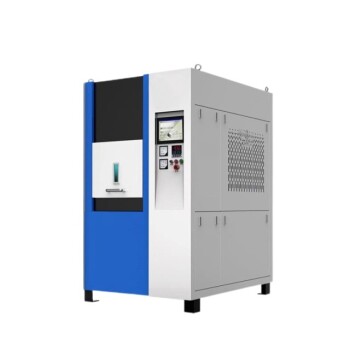
The primary advantage of a vacuum hot press sintering furnace (VHPS) is its ability to decouple densification from temperature through the application of external mechanical pressure. For refractory alloys like Niobium-Tungsten (Nb-W), which possess extremely high melting points, VHPS facilitates the production of near-fully dense materials at significantly lower temperatures than standard sintering requires. This process simultaneously inhibits grain growth and prevents oxidation, resulting in superior mechanical properties.
Core Takeaway Standard sintering relies heavily on thermal diffusion, often requiring excessive heat that degrades material microstructure. By introducing uniaxial pressure in a vacuum, VHPS mechanically forces particle rearrangement and plastic flow, allowing you to achieve maximum density and purity while preserving a fine-grained microstructure.
The Mechanics of Enhanced Densification
Overcoming Thermal Limitations with Pressure
Standard sintering depends on high temperatures to induce atomic diffusion between particles. For refractory alloys like Nb-W, this requires extreme heat.
VHPS introduces uniaxial mechanical pressure as an additional driving force. This pressure actively promotes plastic flow and particle rearrangement, forcing powder particles together mechanically rather than waiting for them to fuse thermally.
Achieving Density at Lower Temperatures
Because mechanical pressure assists in closing pores, the system does not need to reach the extreme temperatures required by pressureless sintering.
You can achieve near-full density at a lower thermal threshold. This is critical for refractory metals, where the energy cost and equipment strain of reaching conventional sintering temperatures are prohibitive.
Inhibiting Excessive Grain Growth
There is a direct competition between densification (good) and grain growth (bad) during sintering. High temperatures typically accelerate both.
By allowing for densification at lower temperatures, VHPS effectively inhibits excessive grain growth. This preserves the fine microstructure of the Nb-W alloy, which is directly correlated to improved yield strength and hardness.
The Critical Role of the Vacuum Environment
Preventing Material Degradation
Refractory metals like Niobium and Tungsten are highly susceptible to oxidation at elevated temperatures. Even trace amounts of oxygen can form brittle oxides at grain boundaries.
The high-vacuum environment eliminates oxygen and other contaminants. This ensures the cleanliness of the grain boundaries, preventing the formation of oxide inclusions that would scatter electrons (reducing thermal conductivity) or act as crack initiation sites.
Eliminating Residual Micropores
In standard atmospheric sintering, gas can become trapped inside the powder compact as pores close, preventing full density.
The vacuum environment actively facilitates the removal of gases from powder gaps before the grains bond. This prevents the formation of residual micropores, ensuring the final bulk material is solid and structurally sound.
Understanding the Trade-offs
While VHPS offers superior material quality for refractory alloys, it introduces specific constraints that must be weighed against project goals.
Geometrical Constraints
The pressure in a hot press is typically uniaxial (applied from one direction). This generally limits part geometry to simple shapes like discs, cylinders, or plates. Unlike pressureless sintering, creating complex, net-shape components with undercuts is rarely feasible without extensive post-machining.
Production Efficiency vs. Cycle Time
VHPS is generally a batch process that processes one or a few parts at a time. While the sintering time per part may be shorter due to rapid densification, the overall throughput is lower compared to continuous belt furnaces used in standard sintering. It is a high-performance solution, not a high-volume one.
Making the Right Choice for Your Project
When working with high-performance alloys like Nb-W, the choice of furnace dictates the final capabilities of the material.
- If your primary focus is Maximum Density and Strength: Choose VHPS. The mechanical pressure provides a density level that pressureless sintering cannot match without degrading the microstructure.
- If your primary focus is Microstructural Control: Choose VHPS. The ability to sinter at lower temperatures is the only reliable way to prevent grain coarsening in refractory metals.
- If your primary focus is Complex Geometry: Consider Cold Isostatic Pressing (CIP) followed by vacuum sintering, acknowledging that you may sacrifice some theoretical density compared to hot pressing.
For refractory applications where performance is non-negotiable, the synergy of pressure and vacuum makes VHPS the definitive processing method.
Summary Table:
| Feature | Standard Sintering | Vacuum Hot Press Sintering (VHPS) |
|---|---|---|
| Driving Force | Thermal diffusion only | Thermal diffusion + Uniaxial mechanical pressure |
| Sintering Temp. | Very high (risks grain growth) | Significantly lower (preserves microstructure) |
| Material Density | Lower / Inconsistent | Near-theoretical maximum density |
| Environment | Atmospheric or inert gas | High vacuum (prevents oxidation) |
| Part Geometry | Complex shapes possible | Simple shapes (discs, plates, cylinders) |
| Microstructure | Coarse grains common | Fine-grained, high-strength results |
Elevate Your Material Research with KINTEK Precision
For refractory alloys like Niobium-Tungsten, the difference between failure and peak performance lies in your equipment. KINTEK specializes in advanced vacuum hot press sintering furnaces and isostatic presses designed to deliver unmatched material density and microstructural control.
Whether you require high-temperature furnace solutions (muffle, tube, or vacuum), specialized crushing systems, or precise hydraulic pellet presses, our technical experts are ready to equip your lab with the tools needed for breakthrough results.
Ready to optimize your sintering process? Contact KINTEK today to find the perfect solution for your high-performance alloy development.
Related Products
- 600T Vacuum Induction Hot Press Furnace for Heat Treat and Sintering
- Vacuum Heat Treat and Sintering Furnace with 9MPa Air Pressure
- Vacuum Heat Treat and Pressure Sintering Furnace for High Temperature Applications
- 2200 ℃ Tungsten Vacuum Heat Treat and Sintering Furnace
- Vacuum Hot Press Furnace Heated Vacuum Press Machine Tube Furnace
People Also Ask
- What role does an induction vacuum hot pressing furnace play in sintering? Achieve 98% Density in Carbide Blocks
- What advantages does a vacuum hot press furnace provide for LSLBO ceramic electrolytes? Achieve 94% Relative Density
- What role does a Vacuum Hot Press (VHP) furnace play in the densification of austenitic stainless steel 316 composites?
- What are the advantages of a vacuum hot press furnace for W-50%Cu? Achieve 99.6% Density at Lower Temperatures
- What role does mechanical pressure play during the vacuum diffusion bonding of tungsten and copper? Keys to Solid Bonding