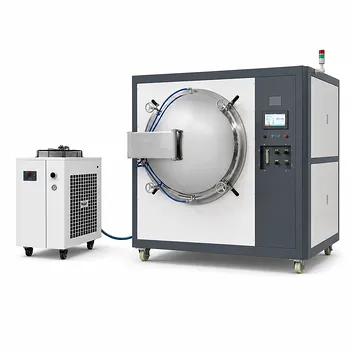
Vacuum hot pressing offers a decisive advantage by fundamentally altering the microstructure of Fe–Cu–Ni–Sn–VN matrices. While traditional cold-pressing and sintering methods result in significant grain coarsening, vacuum hot pressing inhibits this growth, maintaining grain sizes within the 20–400 nm range. This preservation of the nanostructure directly correlates to a near-doubling of nanohardness and superior wear resistance.
Core Takeaway The integration of heat and mechanical pressure in a vacuum environment allows for full densification at lower temperatures and shorter timeframes. This prevents the excessive grain growth typical of traditional sintering, resulting in a harder, denser, and more durable material.
The Mechanics of Microstructural Control
Inhibition of Grain Coarsening
The primary technical benefit of vacuum hot pressing is its ability to restrict grain growth during the consolidation phase. Traditional cold-press-sinter-repress methods expose the material to thermal cycles that often cause grains to expand to the 5–50 μm range.
By contrast, the one-step vacuum hot pressing process effectively locks the grain structure in the 20–400 nm range. This maintenance of a fine, nanoscale microstructure is the foundational driver for the material's enhanced performance.
Simultaneous Pressure and Heating
Unlike traditional methods where pressing and heating are separate steps, vacuum hot pressing applies mechanical force (e.g., 30 MPa) during the heating cycle. This forces powder particles into a plastic state, accelerating surface diffusion and filling internal voids.
This mechanical assistance means the material does not rely solely on thermal energy for densification. Consequently, the process requires lower sintering temperatures and shorter holding times, which further limits the window of opportunity for grains to coarsen.
Prevention of Oxidation
The vacuum environment eliminates the presence of oxygen during the high-temperature phase. For matrices containing reactive elements like Iron (Fe) and Copper (Cu), this prevents surface oxidation and decarburization. The result is a "clean" microstructure free from the embrittling oxides that can plague traditional sintering methods.
Superior Mechanical Properties
Drastic Increase in Nanohardness
The impact of the refined grain structure is measurable and significant. Due to the preservation of the nanostructure, the nanohardness of the Fe–Cu–Ni–Sn–VN matrix increases from approximately 2.68 GPa to 5.37 GPa.
Enhanced Wear Resistance
The combination of high density and fine grain size creates a material that is significantly more resistant to physical degradation. The elimination of internal pores and the strengthening of the material matrix translate directly to improved overall wear resistance in operational environments.
Understanding the Trade-offs
Equipment Complexity vs. Material Quality
While vacuum hot pressing produces superior materials, it represents a more complex "one-step" operation compared to the segregated steps of cold pressing. The equipment requires high mechatronic integration to manage vacuum levels, temperature, and hydraulic pressure simultaneously.
Throughput Considerations
The application of pressure usually implies a batch process restricted by the size of the die. While traditional sintering can often be done in continuous belt furnaces for high volume, vacuum hot pressing is generally optimized for high-performance, lower-volume components where material integrity is paramount.
Making the Right Choice for Your Goal
To determine if vacuum hot pressing is the correct manufacturing route for your project, evaluate your specific performance requirements:
- If your primary focus is Maximum Durability: Choose vacuum hot pressing to achieve nanohardness levels exceeding 5 GPa and superior wear resistance through grain size inhibition.
- If your primary focus is Microstructural Integrity: Select this method to ensure grain sizes remain in the 20–400 nm range and to eliminate porosity through pressure-assisted densification.
- If your primary focus is Material Purity: Rely on the vacuum environment to prevent oxidation and decarburization of the Fe–Cu–Ni matrix.
Summary: Vacuum hot pressing transforms the sintering process from a simple heating step into a precision densification method, trading process simplicity for a massive leap in material hardness and structural longevity.
Summary Table:
| Feature | Traditional Cold-Press & Sinter | One-Step Vacuum Hot Pressing |
|---|---|---|
| Grain Size | Coarse (5–50 μm) | Nanoscale (20–400 nm) |
| Nanohardness | ~2.68 GPa | ~5.37 GPa (Double) |
| Atmosphere | Risk of Oxidation/Decarburization | Controlled Vacuum (No Oxidation) |
| Densification | Thermal Energy Only | Simultaneous Heat + Mechanical Pressure |
| Performance | Standard Wear Resistance | Superior Durability & Density |
Elevate Your Material Integrity with KINTEK Advanced Solutions
Don't settle for grain coarsening and oxidation. At KINTEK, we specialize in high-performance laboratory equipment designed to push the boundaries of material science. Our range of vacuum hot pressing systems, muffle and tube furnaces, and isostatic hydraulic presses provides the precision needed to achieve superior nanohardness and full densification for complex matrices like Fe–Cu–Ni.
Whether you are developing cutting-edge wear-resistant materials or conducting advanced battery research, our comprehensive portfolio—including high-temperature reactors, crushing and milling systems, and specialized ceramics—ensures your lab has the tools to succeed.
Ready to optimize your sintering process? Contact our technical experts today to find the perfect equipment solution for your specific research goals!
Related Products
- 600T Vacuum Induction Hot Press Furnace for Heat Treat and Sintering
- Vacuum Hot Press Furnace Heated Vacuum Press Machine Tube Furnace
- Vacuum Hot Press Furnace Machine for Lamination and Heating
- Vacuum Hot Press Furnace Machine Heated Vacuum Press
- Vacuum Heat Treat and Pressure Sintering Furnace for High Temperature Applications
People Also Ask
- What role does an induction vacuum hot pressing furnace play in sintering? Achieve 98% Density in Carbide Blocks
- What advantages does a vacuum hot press furnace provide for LSLBO ceramic electrolytes? Achieve 94% Relative Density
- What role does a Vacuum Hot Press (VHP) furnace play in the densification of austenitic stainless steel 316 composites?
- What are the advantages of a vacuum hot press furnace for W-50%Cu? Achieve 99.6% Density at Lower Temperatures
- What role does mechanical pressure play during the vacuum diffusion bonding of tungsten and copper? Keys to Solid Bonding