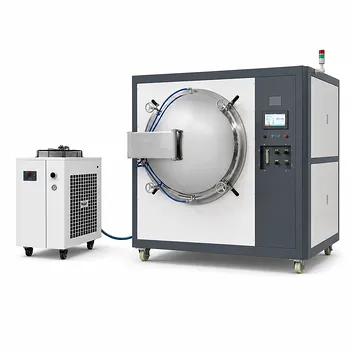
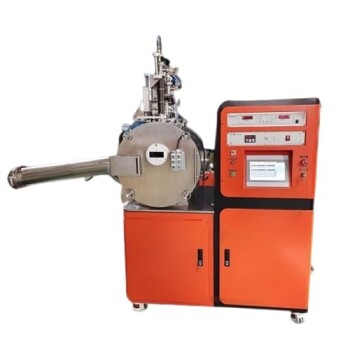
Vacuum sintering is non-negotiable for hot pressing sub-micron metal powders because these fine particles possess a massive specific surface area that makes them chemically unstable at high temperatures. Without a vacuum to remove oxygen and adsorbed gases, the powder will rapidly oxidize and retain impurities, catastrophically degrading the material's electrical conductivity and mechanical integrity.
Sub-micron powders are inherently reactive due to their high surface-to-volume ratio. A vacuum environment is the only reliable mechanism to prevent oxidation and extract trapped volatiles, ensuring the final alloy achieves high density and superior electrical performance (IACS).
The Physics of Sub-Micron Reactivity
The Surface Area Challenge
Sub-micron metal powders, such as chromium and copper, are defined by their incredibly small particle size. This results in a massive specific surface area compared to coarser powders.
Susceptibility to Oxidation
High surface area translates directly to high reactivity. When these powders are exposed to heat, they become extremely susceptible to oxidation.
The Oxide Barrier
If oxidation occurs, an oxide layer forms on the surface of individual particles. This layer acts as a barrier, preventing particles from bonding effectively during the sintering process.
The Functions of the Vacuum Environment
Eliminating Oxygen
The primary function of the vacuum equipment is to create an oxygen-free environment. By removing oxygen from the chamber, the equipment prevents the chemical reaction that creates oxide scales on the metal.
Discharging Adsorbed Gases
Powders naturally trap gases and volatile impurities within the microscopic gaps between particles. Vacuum sintering actively discharges these adsorbed gases.
Preventing Impurity Phases
In complex materials (like CoSb3 or mechanical alloys), a vacuum inhibits the formation of impurity phases. This ensures phase purity, which is essential for consistent material behavior.
Critical Performance Implications
Preserving Electrical Conductivity
Oxides are generally poor conductors. By preventing oxidation, vacuum sintering preserves the metal's natural conductive path. This is critical for maximizing the electrical conductivity (IACS) of the final alloy.
Enhancing Mechanical Strength
Trapped gases that are not evacuated create pores and voids inside the finished part. By degassing the powder, the vacuum process leads to higher density and significantly improved mechanical strength.
Understanding the Trade-offs
Equipment Complexity and Cost
While essential for quality, vacuum sintering introduces significant overhead. The equipment is complex, expensive to maintain, and requires longer cycle times compared to atmospheric sintering.
Risk of Element Volatilization
A distinct pitfall is the potential for elemental evaporation. Under high vacuum and high heat, certain volatile elements within an alloy may vaporize, potentially altering the chemical composition if the process is not carefully controlled.
Making the Right Choice for Your Goal
Whether you are prioritizing structural integrity or electrical efficiency, the atmosphere control is the deciding factor.
- If your primary focus is Electrical Conductivity: You must use high-vacuum hot pressing to prevent the formation of insulating oxide layers that degrade IACS ratings.
- If your primary focus is Mechanical Density: You must prioritize the vacuum's degassing cycle to evacuate volatiles and prevent internal porosity that weakens the structure.
Mastering the vacuum environment is the difference between a high-performance alloy and a brittle, defective component.
Summary Table:
| Feature | Impact of Vacuum Environment | Benefit to Sub-Micron Powders |
|---|---|---|
| Oxygen Removal | Eliminates reactive oxygen molecules | Prevents oxide scale formation and bonding barriers |
| Degassing | Extracts adsorbed gases and volatiles | Eliminates internal porosity for higher mechanical density |
| Phase Purity | Inhibits the formation of impurity phases | Ensures consistent material behavior and phase integrity |
| Conductivity | Maintains clean metallic grain boundaries | Preserves high electrical conductivity (IACS) |
| Structural Integrity | Facilitates dense particle bonding | Enhances tensile strength and durability |
Elevate Your Material Research with KINTEK Precision
Don't let oxidation and impurities compromise your sub-micron metal powder research. KINTEK specializes in advanced laboratory solutions designed for the most demanding thermal processes. Our comprehensive range of vacuum hot pressing systems, high-temperature vacuum furnaces, and CVD/PECVD equipment provides the rigorous atmosphere control necessary to achieve theoretical density and peak electrical performance.
Whether you are developing high-conductivity alloys or high-strength mechanical components, our team of experts is ready to help you select the ideal furnace or hydraulic press for your application. Contact KINTEK today to discuss your project and optimize your sintering results!
Related Products
- Vacuum Heat Treat and Molybdenum Wire Sintering Furnace for Vacuum Sintering
- Small Vacuum Heat Treat and Tungsten Wire Sintering Furnace
- Vacuum Heat Treat and Pressure Sintering Furnace for High Temperature Applications
- 2200 ℃ Tungsten Vacuum Heat Treat and Sintering Furnace
- 600T Vacuum Induction Hot Press Furnace for Heat Treat and Sintering
People Also Ask
- What is the pressure for vacuum sintering? Achieve Optimal Material Purity and Density
- What are the critical functions of the vacuum system in a sintering furnace for Cu/Ti3SiC2/C/MWCNTs composites?
- How does a vacuum environment benefit the purification of matrix powders? Optimize Diamond Tool Sintering Efficiency
- What is vacuum hardness? Unlock Superior Material Performance with Vacuum Processing
- What critical process conditions does a vacuum sintering furnace provide for titanium? Expert Diffusion Bonding Guide