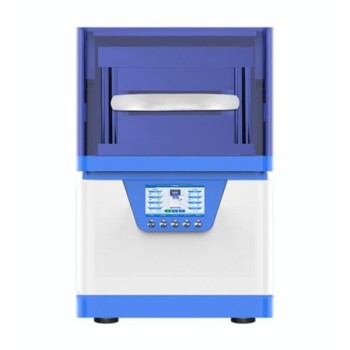
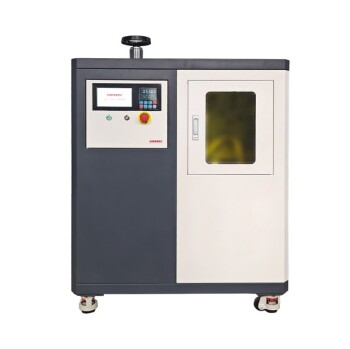
Vacuum hot pressing offers superior microstructural control over liquid infiltration primarily by enabling processing at solid or semi-solid temperatures below the melting point of aluminum. This lower-temperature approach effectively inhibits excessive chemical reactions at the interface, preventing the formation of thick, detrimental reaction layers that degrade material performance.
By maintaining strict temperature and environmental controls, vacuum hot pressing creates ideal diffusion-bonded interfaces rather than chemically reacted ones. This preserves the intrinsic properties of the SiC and Aluminum, ensuring maximum thermal conductivity and interfacial strength.
Minimizing Interface Reactions
Preventing Reaction Layers
Liquid infiltration processes inherently require temperatures exceeding the melting point of aluminum. This high heat often triggers aggressive chemical reactions between the aluminum matrix and SiC reinforcement.
Optimizing Thermal Conductivity
Vacuum hot pressing operates at lower, solid-state temperatures. This significantly limits the thickness of the interface reaction layer. A thinner, cleaner interface facilitates better phonon transfer, directly resulting in superior thermal conductivity for the composite.
Achieving Ideal Bonding
Instead of relying on chemical reaction zones for adhesion, hot pressing promotes diffusion bonding. This results in a physical bond that is strong yet avoids the brittleness associated with thick reaction products.
The Critical Role of the Vacuum Environment
Eliminating Oxidation
Aluminum alloy powders are highly susceptible to oxidation at elevated temperatures. The high vacuum environment actively prevents this oxidation during the sintering phase.
Purifying the Interface
The vacuum process removes gases and moisture adsorbed on the surface of the powder particles before consolidation occurs. This purification is essential for creating a pristine boundary between the matrix and the reinforcement.
Promoting Atomic Diffusion
By stripping away oxide layers and contaminants, the vacuum environment exposes the raw material surfaces. This facilitates atomic diffusion across the boundary, which is the foundational factor for high interface bonding strength and mechanical integrity.
Precision Control of Process Kinetics
Regulating Grain Growth
Vacuum hot pressing equipment allows for precise regulation of heating rates (e.g., 10 °C/min). This steady increase prevents abnormal grain coarsening, ensuring the microstructure remains fine and uniform.
Mitigating Thermal Stress
Rapid temperature spikes, common in less controlled processes, can cause thermal shock. The precise temperature control of a vacuum furnace ensures the composite is heated steadily, preventing structural damage to the reinforcement or the development of internal stresses.
Understanding the Trade-offs
The Necessity of Precision
While vacuum hot pressing offers superior control, it relies heavily on the precise management of parameters. The benefits of the process are contingent on maintaining the specific heating rates and vacuum levels; fluctuations or excessive speeds can negate the microstructural advantages.
Solid-State Limitations
Because the process relies on diffusion rather than liquid flow, achieving full densification requires careful optimization of pressure and time. Unlike liquid infiltration, which fills voids easily, hot pressing demands rigorous control to eliminate porosity without melting the matrix.
Making the Right Choice for Your Goal
When selecting a processing method for SiC/Al composites, consider your specific performance requirements:
- If your primary focus is Thermal Conductivity: Choose vacuum hot pressing to minimize interface reaction layers and maximize heat transfer efficiency.
- If your primary focus is Mechanical Strength: Rely on the vacuum environment to remove oxides and impurities, ensuring the strongest possible atomic bond between the matrix and reinforcement.
- If your primary focus is Microstructural Uniformity: Leverage the precise heating rate controls of hot pressing to prevent grain coarsening and thermal stress.
Vacuum hot pressing transforms the processing of SiC/Al composites from a reactive struggle into a controlled precision operation, ensuring the final material meets the highest standards of purity and performance.
Summary Table:
| Feature | Vacuum Hot Pressing | Liquid Infiltration |
|---|---|---|
| Processing State | Solid or Semi-solid (Below melting point) | Liquid (Above melting point) |
| Interface Reaction | Minimal; promotes diffusion bonding | High; risk of thick reaction layers |
| Thermal Conductivity | Superior; due to cleaner interfaces | Lower; hindered by reaction products |
| Oxidation Control | High; vacuum prevents oxide formation | Variable; higher risk at liquid state |
| Microstructure | Fine and uniform via precise kinetics | Risk of grain coarsening |
| Bonding Type | Atomic diffusion | Chemical reaction / Mechanical interlocking |
Elevate Your Material Research with KINTEK Precision
Unlock the full potential of your SiC/Al composites with KINTEK’s advanced vacuum hot pressing systems. As specialists in high-performance laboratory equipment, we provide the precise temperature and pressure control necessary to eliminate interface reactions and maximize thermal conductivity.
Beyond our industry-leading hydraulic hot presses and vacuum furnaces, KINTEK offers a comprehensive range of solutions for material science, including:
- Crushing, milling, and sieving systems for powder preparation.
- High-temperature furnaces (tube, muffle, CVD) for specialized heat treatments.
- Consumables such as high-purity ceramics, crucibles, and PTFE products.
Ready to achieve superior microstructural integrity in your lab? Contact KINTEK today to discuss your specific application and discover how our equipment can transform your research outcomes.
Related Products
- Vacuum Hot Press Furnace Machine for Lamination and Heating
- Electric Heated Hydraulic Vacuum Heat Press for Lab
- Touchscreen Automatic Vacuum Heat Press
- Automatic Laboratory Heat Press Machine
- Vacuum Hot Press Furnace Machine Heated Vacuum Press
People Also Ask
- What advantages does a vacuum hot press furnace provide for LSLBO ceramic electrolytes? Achieve 94% Relative Density
- Why is it necessary to maintain a high-vacuum environment within a vacuum hot press furnace? Optimize Cu-SiC Sintering
- What are the advantages of using a vacuum hot press furnace for sintering CNT/Cu composites? Superior Density & Bonding
- What are the advantages of a vacuum hot press furnace for W-50%Cu? Achieve 99.6% Density at Lower Temperatures
- What role does mechanical pressure play during the vacuum diffusion bonding of tungsten and copper? Keys to Solid Bonding