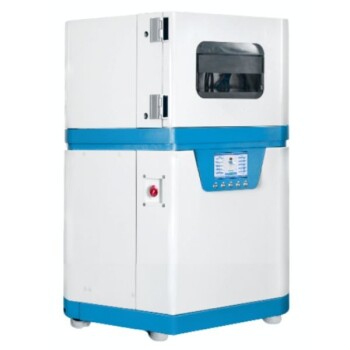
The primary function of a vacuum hot press is to consolidate chemically active copper nanopowders into a dense solid while strictly preserving their nanostructure. By synergizing a high vacuum, a precise heating field, and extreme uniaxial pressure, the system ensures the material achieves full density without oxidizing or losing its critical grain properties through overheating.
The vacuum hot press solves the fundamental challenge of sintering nanometals: achieving high density without high heat. By applying immense pressure (up to 1.0 GPa) in an oxygen-free environment, it allows for strong particle bonding at temperatures as low as 250°C, effectively locking in the nanostructure.
The Synergistic Mechanisms of Consolidation
To understand the utility of a vacuum hot press, you must view it as a system of three interacting forces—pressure, heat, and atmosphere—working together to overcome the limitations of standard sintering.
The Role of Extreme Pressure
The hydraulic system applies uniaxial pressure, reaching levels as high as 1.0 GPa.
Achieving High Densification
This mechanical force physically crushes the powder aggregates together. It reduces porosity and forces particles into intimate contact, ensuring the final material is solid and structurally sound.
Inhibiting Grain Growth
This is the most critical function for nanostructured materials. High pressure allows for consolidation without excessive heat. By relying on pressure rather than temperature to drive density, you prevent the copper grains from growing larger, preserving the unique "nano" properties of the material.
Environmental Control Functions
Beyond mechanical force, the vacuum hot press manages the chemical environment to ensure purity and bond strength.
Preventing Oxidation
Copper nanopowders are highly active and prone to rapid oxidation. The vacuum environment eliminates oxygen during the process, preserving the purity of the copper matrix.
Removing Volatiles for Better Bonding
The vacuum facilitates the removal of adsorbed gases and volatiles trapped between powder particles. Removing these impurities cleans the particle surfaces, which significantly enhances the strength of the interfacial bonds and the final mechanical properties of the material.
Facilitating Low-Temperature Bonding
The heating system promotes diffusion and bonding between particles at relatively low temperatures, such as 250°C. Because the pressure is doing the heavy lifting for densification, the thermal load can be kept low to avoid degrading the material structure.
Understanding the Trade-offs
While effective, vacuum hot pressing introduces specific constraints that must be managed.
Geometry Limitations
Because the pressure is uniaxial (applied in one direction), this method is generally limited to producing simple geometries, such as flat plates, discs, or cylinders. Complex shapes often require post-processing.
Process Efficiency
This is inherently a batch process. The requirement to establish a high vacuum and ramp up temperature and pressure for each cycle can make it slower and more costly than continuous sintering methods.
Making the Right Choice for Your Goal
When configuring a vacuum hot press for nanostructured copper, your settings should reflect your specific material targets.
- If your primary focus is keeping grains as small as possible: Prioritize maximizing uniaxial pressure (up to 1.0 GPa) while keeping the temperature at the lowest threshold (near 250°C) that still allows bonding.
- If your primary focus is material purity and bond strength: Ensure your vacuum levels are maximized prior to heating to fully degas the highly active powder surface and prevent oxide layers from forming.
Success lies in balancing mechanical force against thermal input to achieve a dense solid that acts like a bulk metal but retains the superior physics of a nanomaterial.
Summary Table:
| Feature | Function in Nano-Copper Preparation | Impact on Material Quality |
|---|---|---|
| Extreme Uniaxial Pressure | Up to 1.0 GPa applied to crush powder aggregates | Achieves high density while inhibiting grain growth |
| High Vacuum Environment | Removes oxygen and adsorbed volatiles | Prevents oxidation and ensures high-purity interfacial bonding |
| Precise Low-Temperature Heating | Provides thermal energy at ~250°C | Facilitates particle diffusion without degrading nanostructures |
| Batch Processing | Controlled cycling of pressure and temperature | Ensures uniform mechanical properties across simple geometries |
Elevate your materials research with KINTEK’s precision engineering. Whether you are consolidating active nanopowders or developing advanced ceramics, our vacuum hot presses and hydraulic pellet presses deliver the extreme pressure and environmental control necessary for superior results. KINTEK specializes in laboratory equipment and consumables, offering a comprehensive range of high-temperature furnaces, crushing systems, and high-temperature high-pressure reactors. From battery research tools to specialized crucibles, we provide the technical expertise and high-performance solutions your lab deserves. Contact KINTEK today to find the perfect system for your application!
Related Products
- Vacuum Hot Press Furnace Machine Heated Vacuum Press
- Vacuum Hot Press Furnace Machine for Lamination and Heating
- Vacuum Hot Press Furnace Heated Vacuum Press Machine Tube Furnace
- 600T Vacuum Induction Hot Press Furnace for Heat Treat and Sintering
- Touchscreen Automatic Vacuum Heat Press
People Also Ask
- What advantages does a vacuum hot press furnace provide for LSLBO ceramic electrolytes? Achieve 94% Relative Density
- What role does a Vacuum Hot Press (VHP) furnace play in the densification of austenitic stainless steel 316 composites?
- What are the advantages of using a vacuum hot pressing furnace? Superior Densification for 2024Al/Gr/SiC Composites
- Why is it necessary to maintain a high-vacuum environment within a vacuum hot press furnace? Optimize Cu-SiC Sintering
- What core challenges does a vacuum hot press furnace address? Achieve Superior WCp/Cu FGM Structural Integrity