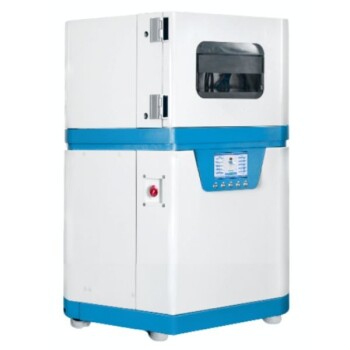
Vacuum hot pressing facilitates the preparation of high-density Nb-22.5Cr-5Si alloy bulks by synergizing a high-temperature environment (1250°C) with substantial mechanical pressure (45 MPa). This process physically forces the alloy powder particles together to close internal voids via plastic flow, while the vacuum environment eliminates oxygen to prevent chemical degradation, ultimately achieving relative densities of 97% to 99%.
Core Takeaway Achieving near-theoretical density in reactive alloys requires more than just heat; it requires the mechanical elimination of porosity. The vacuum hot pressing furnace solves this by applying uniaxial pressure to crush voids while simultaneously maintaining a pristine, oxygen-free atmosphere to ensure the material remains chemically pure and structurally uniform.
Preserving Material Purity via Vacuum
To create a high-performance Nb-22.5Cr-5Si alloy, you must first ensure the constituent elements do not degrade during the heating process.
Preventing Oxidation
At elevated temperatures, metal powders—particularly reactive ones like Niobium and Silicon—are highly susceptible to oxidation. The furnace maintains a high vacuum environment that effectively isolates the powders from oxygen and nitrogen.
This exclusion is critical because oxide inclusions act as contaminants. If allowed to form, these oxides would create brittle phases within the alloy, severely compromising its mechanical integrity and performance.
Removing Volatile Impurities
Beyond preventing new oxidation, the vacuum plays an active role in cleaning the powder. It facilitates the exhaust of adsorbed gases and volatile impurities trapped in the gaps between powder particles.
By removing these contaminants, the process minimizes porosity and ensures high bonding strength between the particles, leading to a "cleaner" and more uniform microstructure.
Mechanisms of Densification
While the vacuum protects the chemistry, the combination of heat and pressure drives the physical transformation from loose powder to solid bulk.
Facilitating Plastic Flow
The application of 45 MPa of mechanical pressure forces the powder particles to rearrange and deform. This is known as plastic flow.
Unlike pressureless sintering, where particles fuse solely due to heat, the external pressure mechanically closes large pores and forces particles into intimate contact, accelerating the densification process significantly.
Enhancing Atomic Diffusion
The furnace operates at 1250°C, providing the thermal energy necessary for atomic diffusion.
When combined with pressure, this heat promotes diffusion creep. Atoms migrate across particle boundaries to fill the remaining microscopic voids. This dual action is what drives the relative density from lower starting points up to 97%–99%, creating a bulk material that is nearly free of residual porosity.
Understanding the Trade-offs
While vacuum hot pressing is highly effective for densification, it introduces specific constraints that must be managed.
Geometry Limitations
The pressure applied is typically uniaxial (from one direction). This generally limits the production capabilities to simple shapes, such as plates, disks, or cylinders. Creating complex, net-shape components often requires additional machining or alternative methods like Hot Isostatic Pressing (HIP).
Throughput vs. Quality
This is a batch process that can be slower and more expensive than continuous sintering methods. The high cost is justified only when the application demands superior density and microstructural uniformity that cheaper methods cannot provide.
Making the Right Choice for Your Goal
When deciding if this process aligns with your manufacturing requirements, consider your specific targets for the Nb-22.5Cr-5Si alloy.
- If your primary focus is mechanical strength: Prioritize the pressure parameters (45 MPa) to maximize plastic flow and eliminate the porosity that leads to structural failure.
- If your primary focus is material purity: Ensure the vacuum levels are strictly maintained to prevent oxide formations that could alter the alloy's intended phase composition.
By leveraging the vacuum hot pressing furnace, you convert loose alloy powder into a dense, robust, and chemically pure bulk material ready for high-performance applications.
Summary Table:
| Feature | Parameter/Function | Benefit for Nb-22.5Cr-5Si Alloy |
|---|---|---|
| Sintering Temperature | 1250°C | Enhances atomic diffusion and diffusion creep |
| Mechanical Pressure | 45 MPa (Uniaxial) | Drives plastic flow to close internal voids |
| Atmosphere | High Vacuum | Prevents oxidation and removes volatile impurities |
| Relative Density | 97% to 99% | Produces near-theoretical density for superior strength |
| Microstructure | Uniform & Clean | Ensures structural integrity and high bonding strength |
Elevate Your Material Research with KINTEK Precision
Achieving near-theoretical density in reactive alloys like Nb-22.5Cr-5Si requires the perfect synergy of thermal control and mechanical pressure. KINTEK specializes in advanced laboratory solutions, offering a comprehensive range of vacuum hot pressing furnaces, hot isostatic presses (HIP), and high-temperature vacuum furnaces designed for the most demanding material science applications.
Whether you are developing high-performance alloys, ceramics, or composites, our expert team provides the tools you need for success—from crushing and milling systems for powder preparation to high-temperature high-pressure reactors for specialized synthesis.
Ready to eliminate porosity and ensure material purity? Contact KINTEK today to find the perfect furnace solution for your lab!
Related Products
- Vacuum Hot Press Furnace Heated Vacuum Press Machine Tube Furnace
- 600T Vacuum Induction Hot Press Furnace for Heat Treat and Sintering
- Vacuum Hot Press Furnace Machine Heated Vacuum Press
- Vacuum Hot Press Furnace Machine for Lamination and Heating
- Vacuum Heat Treat and Pressure Sintering Furnace for High Temperature Applications
People Also Ask
- What advantages does a vacuum hot press furnace provide for LSLBO ceramic electrolytes? Achieve 94% Relative Density
- What role does a Vacuum Hot Press (VHP) furnace play in the densification of austenitic stainless steel 316 composites?
- What are the advantages of using a vacuum hot pressing furnace? Superior Densification for 2024Al/Gr/SiC Composites
- What are the advantages of a vacuum hot press furnace for LTPO solid electrolytes? Boost Density and Conductivity
- What core processing conditions does a vacuum hot press furnace provide? Achieve High-Density Cu-SiC/Diamond Composites