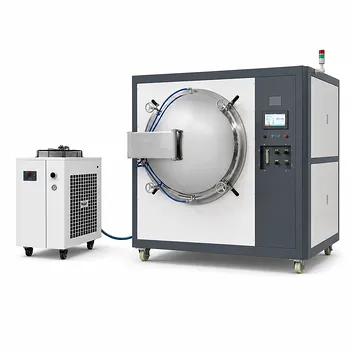
Vacuum Hot Pressing (VHP) is the preferred consolidation method for particle-reinforced aluminum matrix composites because it simultaneously applies high mechanical pressure and a high-vacuum environment to sinter materials at temperatures below the aluminum melting point. This process effectively removes interstitial gases, prevents the oxidation of highly reactive aluminum powder, and forces plastic deformation to achieve full density.
The Core Takeaway VHP solves the two biggest challenges in processing aluminum composites: oxidation and porosity. By sintering in a solid state under vacuum and high pressure, it creates robust, oxide-free interfacial bonds and fully dense structures without the chemical instability associated with liquid-phase processing.
Overcoming the Oxidation Barrier
The Challenge of Aluminum Reactivity
Aluminum powder is highly active and prone to rapid oxidation, creating a barrier that inhibits bonding.
The Vacuum Solution
VHP operates in a high-vacuum environment, typically around $10^{-5}$ Torr. This environment serves two critical functions: it prevents the surface oxidation of the aluminum matrix during heating and facilitates the desorption of adsorbed gases.
Enabling Metal-to-Metal Bonding
By maintaining clean particle surfaces, the process allows the matrix to break through existing oxide films. This direct contact enables the formation of robust metal-to-metal or metal-to-intermetallic bonds, which are the primary determinants of the composite's final mechanical properties.
Achieving Density Through Solid-State Sintering
Processing Below the Melting Point
Unlike stir casting, VHP utilizes solid-state sintering, often at temperatures such as 550°C. This is below the melting point of aluminum, which prevents the uncontrollable liquid-phase reactions that can degrade material properties.
Eliminating Porosity
The vacuum environment exhausts gases trapped between particles that would otherwise create voids. Simultaneously, the absence of a liquid phase prevents the segregation of reinforcement particles, resulting in a more uniform microstructure.
The Role of Mechanical Pressure
Promoting Plastic Deformation
VHP applies significant mechanical pressure, typically ranging from 175 to 245 MPa.
Rearrangement and Densification
This pressure promotes particle rearrangement and induces plastic deformation in the aluminum powder. This physical force is necessary to close voids and achieve full material densification that thermal energy alone cannot provide.
Breaking Oxide Layers
The combination of pressure and "clean" vacuum conditions helps mechanically fracture any remaining oxide layers. This exposes fresh metal surfaces, ensuring high-quality bonding interfaces between the aluminum matrix and reinforcements like titanium or diamond.
Understanding the Trade-offs
Equipment Complexity and Control
Achieving these results requires precise control over three variables simultaneously: temperature, pressure, and vacuum level.
The Cost of Quality
Maintaining a vacuum level of $10^{-5}$ Torr or 0.005 Pa is energy-intensive and requires specialized equipment. While this yields superior mechanical properties compared to casting, it generally involves higher operational costs and lower production throughput.
Making the Right Choice for Your Goal
When deciding if VHP is the right consolidation method for your aluminum matrix composite, consider your specific performance requirements:
- If your primary focus is interfacial strength: VHP is essential for preventing oxidation and ensuring direct metal-to-reinforcement bonding, minimizing thermal resistance.
- If your primary focus is microstructure uniformity: VHP is preferred for its ability to densify material in the solid state, avoiding particle segregation common in liquid processing.
VHP transforms the consolidation process from a simple heating step into a precision engineering operation that guarantees the structural integrity of the composite.
Summary Table:
| Feature | Vacuum Hot Pressing (VHP) | Conventional Sintering/Casting |
|---|---|---|
| Atmosphere | High Vacuum ($10^{-5}$ Torr) | Ambient or Inert Gas |
| Oxidation Control | Prevents oxide formation & removes gases | High risk of surface oxidation |
| Sintering State | Solid-state (below melting point) | Often liquid-phase |
| Pressure Application | High Mechanical Pressure (175-245 MPa) | Low or No Pressure |
| Microstructure | Uniform with no particle segregation | Potential for voids and segregation |
| Bonding Quality | Strong metal-to-metal interfacial bonds | Weakened by oxide films and porosity |
Elevate Your Advanced Material Research with KINTEK
Precision engineering of particle-reinforced aluminum matrix composites requires the perfect balance of temperature, pressure, and vacuum. KINTEK specializes in high-performance laboratory equipment designed to meet these rigorous standards. Our comprehensive range of Vacuum Hot Pressing (VHP) systems, alongside our muffle, tube, and vacuum furnaces, provides the control you need to eliminate oxidation and achieve full material densification.
Whether you are working on aerospace alloys or advanced battery research, KINTEK offers the crushing, milling, and hydraulic press solutions (including pellet and isostatic presses) to streamline your workflow.
Ready to achieve superior structural integrity in your composites?
Contact a KINTEK Specialist Today to find the ideal thermal and mechanical solution for your lab!
Related Products
- Vacuum Hot Press Furnace Heated Vacuum Press Machine Tube Furnace
- 600T Vacuum Induction Hot Press Furnace for Heat Treat and Sintering
- Vacuum Hot Press Furnace Machine Heated Vacuum Press
- Vacuum Hot Press Furnace Machine for Lamination and Heating
- Vacuum Heat Treat and Pressure Sintering Furnace for High Temperature Applications
People Also Ask
- What advantages does a vacuum hot press furnace provide for LSLBO ceramic electrolytes? Achieve 94% Relative Density
- What role does a Vacuum Hot Press (VHP) furnace play in the densification of austenitic stainless steel 316 composites?
- What are the advantages of using a vacuum hot pressing furnace? Superior Densification for 2024Al/Gr/SiC Composites
- What are the advantages of a vacuum hot press furnace for LTPO solid electrolytes? Boost Density and Conductivity
- What core processing conditions does a vacuum hot press furnace provide? Achieve High-Density Cu-SiC/Diamond Composites