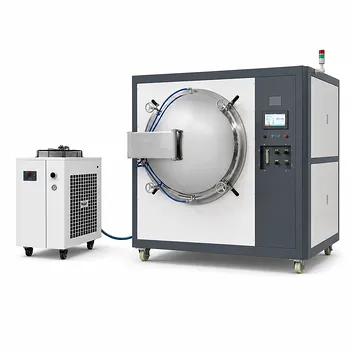
The primary function of a vacuum hot pressing furnace is to facilitate the diffusion bonding of the matrix and fibers into a dense, monolithic composite.
By creating a high-vacuum environment (typically $10^{-3}$ Pa), the furnace prevents the oxidation of the reactive titanium matrix. Simultaneously, it applies synchronized high temperatures and precise mechanical pressure to induce plastic deformation in the metal, forcing it to fill the voids between the Silicon Carbide (SiC) fibers.
The core value of this equipment lies in its ability to achieve "near-full" density through atomic diffusion without damaging the reinforcing fibers. It is not just about heating and squeezing; it is about managing the delicate chemical reaction at the fiber-matrix interface to ensure strength rather than brittleness.
The Mechanics of Densification
The fabrication process relies on transforming separate components—metal foils/powders and ceramic fibers—into a single structural entity.
Inducing Plastic Flow
The furnace applies a continuous mechanical pressure, often around 30 MPa, while the material is heated.
At these elevated temperatures, the titanium matrix softens significantly. The external force causes the metal to undergo plastic deformation, flowing effectively into the microscopic gaps between the rigid SiC fibers.
Eliminating Porosity
A primary goal is the complete removal of residual pores.
As the matrix flows, it expels internal gases and closes voids. This results in a material that approaches its theoretical maximum density, which is essential for high-performance aerospace or structural applications.
Facilitating Atomic Diffusion
Once the physical gaps are closed, the furnace maintains thermal energy to drive atomic diffusion.
This process allows atoms to migrate across the boundary between the titanium and the SiC fibers, creating a solid metallurgical bond that is far stronger than a simple mechanical grip.
Environmental and Chemical Control
Beyond physical shaping, the furnace acts as a precision chemical reactor.
Preventing Matrix Oxidation
Titanium is highly reactive and will readily form oxides if exposed to air at high temperatures.
The furnace’s high-vacuum capability (maintaining pressures as low as $10^{-3}$ Pa or lower) creates a "clean" environment. This ensures the titanium remains pure, allowing for proper wetting of the fibers and preventing weak oxide layers from forming within the composite.
Controlling the Interface Reaction
This is the most critical subtle function of the furnace.
At high temperatures, Titanium and Silicon Carbide react to form Titanium Carbide (TiC). A thin layer of this reaction is necessary for bonding, but a thick layer degrades the material.
Regulating Layer Thickness
The furnace creates a specific temperature profile (e.g., maintaining 840°C with high precision) to limit the growth of this brittle interface layer.
By strictly controlling the thermal cycle, the furnace ensures the reaction layer remains below a critical threshold (typically 2 micrometers), preserving the mechanical properties of the composite.
Understanding the Trade-offs
While the vacuum hot press is essential, the process involves a conflict between densification and degradation.
The Pressure-Damage Balance
High pressure accelerates densification and closes pores quickly.
However, excessive pressure can mechanically damage or fracture the brittle SiC fibers. The furnace controls must apply force only when the matrix is sufficiently soft to accommodate the fibers without crushing them.
The Temperature-Reaction Paradox
Higher temperatures promote faster diffusion and stronger initial bonding.
However, excessive heat (or prolonged exposure) accelerates the chemical reaction between the fiber and matrix. This results in a thick, brittle reaction layer that acts as a crack initiation site, significantly reducing the composite's overall strength.
Making the Right Choice for Your Goal
The operation of the furnace must be tuned to the specific requirements of the final component.
- If your primary focus is Maximum Density: Prioritize the duration of the pressure hold phase to ensure plastic flow completely fills all void spaces.
- If your primary focus is Fiber Integrity: Prioritize precise temperature regulation to keep the interface reaction layer strictly below 2 micrometers.
The vacuum hot pressing furnace is the gatekeeper of quality, translating raw materials into high-performance composites by balancing the physics of pressure against the chemistry of atomic bonding.
Summary Table:
| Feature | Function in SiC/Ti Fabrication | Benefit to Material Performance |
|---|---|---|
| High Vacuum ($10^{-3}$ Pa) | Prevents oxidation of reactive Titanium | Ensures clean metallurgical bonds and pure matrix |
| High Temperature Control | Manages interface reaction layer growth | Prevents brittleness by keeping reaction layers < 2μm |
| Mechanical Pressure | Induces plastic flow of the metal matrix | Eliminates porosity and achieves near-theoretical density |
| Diffusion Bonding | Facilitates atomic migration across interfaces | Creates high-strength structural integrity |
Elevate Your Material Science with KINTEK Precision
Unlock the full potential of high-performance composites with KINTEK’s advanced thermal solutions. As specialists in laboratory equipment, we provide the cutting-edge vacuum hot pressing furnaces, high-temperature furnaces (vacuum, CVD, atmosphere), and hydraulic presses essential for achieving superior densification and fiber integrity in aerospace and industrial applications.
From high-pressure reactors to advanced crushing and milling systems, KINTEK delivers the reliability and precision your research demands. Our experts are ready to help you optimize your fabrication process for maximum strength and efficiency.
Ready to transform your material research? Contact KINTEK Today to find the perfect solution for your lab.
Related Products
- 600T Vacuum Induction Hot Press Furnace for Heat Treat and Sintering
- Vacuum Hot Press Furnace Heated Vacuum Press Machine Tube Furnace
- Vacuum Hot Press Furnace Machine for Lamination and Heating
- Vacuum Hot Press Furnace Machine Heated Vacuum Press
- Vacuum Heat Treat and Pressure Sintering Furnace for High Temperature Applications
People Also Ask
- What role does an induction vacuum hot pressing furnace play in sintering? Achieve 98% Density in Carbide Blocks
- What advantages does a vacuum hot press furnace provide for LSLBO ceramic electrolytes? Achieve 94% Relative Density
- What role does a Vacuum Hot Press (VHP) furnace play in the densification of austenitic stainless steel 316 composites?
- What are the advantages of a vacuum hot press furnace for W-50%Cu? Achieve 99.6% Density at Lower Temperatures
- What role does mechanical pressure play during the vacuum diffusion bonding of tungsten and copper? Keys to Solid Bonding