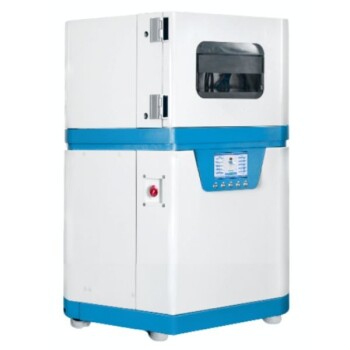
During the solid-solid diffusion stage of Ti-Al3Ti sintering, the mechanical pressure applied by the vacuum hot press serves as the primary driver for physical densification and reaction kinetics. By forcing the titanium and aluminum layers into intimate contact, this pressure minimizes interfacial gaps and accelerates the atomic diffusion necessary to form the Al3Ti intermetallic compound.
The application of continuous axial pressure transforms the sintering process from passive heating to active consolidation. It ensures the atomic proximity required to create solid solutions, compensating for the lack of densification drive found in standard pressureless sintering.
The Mechanics of Contact and Diffusion
Overcoming Surface Irregularities
In a laminated composite structure, microscopic roughness exists on the surface of both titanium and aluminum foils. Without external force, these irregularities create voids that separate the materials.
The hydraulic system of the furnace applies continuous pressure (often around 4 MPa in this specific context) to flatten these irregularities. This facilitates the plastic flow of the softer aluminum against the titanium, ensuring the layers physically touch across their entire surface area.
Accelerating Atomic Migration
Solid-solid diffusion relies entirely on the movement of atoms across the interface between the two metals. This process is heavily dependent on the distance atoms must travel.
By eliminating physical gaps, the applied pressure significantly shortens the diffusion path. This allows Titanium and Aluminum atoms to migrate rapidly across the boundary, initiating the chemical reactions required to form the composite.
Microstructural Evolution
Promoting Phase Formation
The ultimate goal of this stage (typically occurring between 600-650°C) is the generation of specific metallurgical phases. The pressure drives the formation of Ti(Al) solid solutions.
Furthermore, this tight contact is a prerequisite for the synthesis of the intermetallic compound Al3Ti. The pressure ensures this compound forms as a uniformly thick, continuous diffusion layer rather than isolated patches.
Defect Reduction
The pressure serves a critical structural function by mitigating defects. It actively compresses the material to prevent the formation of porosity.
This results in a "crack-free" and "pore-free" microstructure. The mechanical force consolidates the material, ensuring high relative density and strong interfacial bonding that thermal energy alone cannot achieve.
Understanding the Trade-offs
Pressure vs. Pressureless Sintering
It is important to recognize why this complexity is added. In pressureless sintering, the driving force for densification is often insufficient for these materials.
Without the axial pressure provided by the hot press, the material relies solely on capillary forces or surface energy to close pores. In Ti-Al systems, this often leads to incomplete densification and residual porosity, which severely compromises mechanical strength.
The Balance of Environment
While pressure drives density, it must be balanced with the vacuum environment. Pressure closes the gaps, but the high vacuum (e.g., 1.5 x 10^-2 Pa) is required simultaneously to remove trapped gases.
If pressure is applied without a sufficient vacuum, gases may be trapped inside the closing pores, leading to internal oxidation or embrittlement. The success of the process depends on the synergy between the mechanical force and the vacuum atmosphere.
Making the Right Choice for Your Goal
The use of a vacuum hot press is a strategic decision to prioritize material integrity over processing speed or cost.
- If your primary focus is Structural Integrity: Utilize the applied pressure to maximize particle rearrangement and plastic flow, ensuring a pore-free, high-density composite.
- If your primary focus is Reaction Kinetics: Rely on the pressure to maximize the contact area between layers, which is the limiting factor for how fast the Al3Ti phase can form.
- If your primary focus is Phase Purity: Ensure the pressure is applied in conjunction with a high vacuum to prevent the entrapment of oxides between the tightly compressed layers.
The pressure applied during solid-solid diffusion is the mechanical bridge that turns raw elemental layers into a unified, high-performance composite.
Summary Table:
| Mechanism | Impact on Sintering | Key Benefit |
|---|---|---|
| Surface Contact | Flattens microscopic irregularities | Eliminates voids and interfacial gaps |
| Atomic Migration | Shortens atomic travel distance | Accelerates diffusion and Al3Ti phase formation |
| Plastic Flow | Drives material consolidation | Achieves high relative density without pores |
| Defect Mitigation | Compresses internal structures | Prevents porosity and ensures crack-free results |
Achieve superior structural integrity in your advanced material research with KINTEK. Whether you are developing Ti-Al composites or high-performance ceramics, our precision-engineered vacuum hot press furnaces, high-temperature furnaces, and hydraulic presses provide the exact pressure and thermal control required for pore-free consolidation. From isostatic presses for uniform densification to specialized milling systems and PTFE consumables, KINTEK empowers laboratory professionals with the tools needed for metallurgical excellence. Contact our specialists today to optimize your sintering process and enhance your material performance!
Related Products
- Vacuum Hot Press Furnace Heated Vacuum Press Machine Tube Furnace
- 600T Vacuum Induction Hot Press Furnace for Heat Treat and Sintering
- Vacuum Hot Press Furnace Machine Heated Vacuum Press
- Vacuum Hot Press Furnace Machine for Lamination and Heating
- Vacuum Heat Treat and Pressure Sintering Furnace for High Temperature Applications
People Also Ask
- What advantages does a vacuum hot press furnace provide for LSLBO ceramic electrolytes? Achieve 94% Relative Density
- What role does a Vacuum Hot Press (VHP) furnace play in the densification of austenitic stainless steel 316 composites?
- What are the advantages of using a vacuum hot pressing furnace? Superior Densification for 2024Al/Gr/SiC Composites
- What are the advantages of a vacuum hot press furnace for LTPO solid electrolytes? Boost Density and Conductivity
- What core processing conditions does a vacuum hot press furnace provide? Achieve High-Density Cu-SiC/Diamond Composites