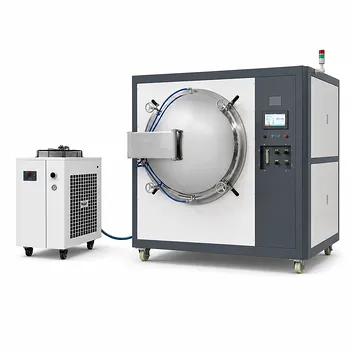
A high-vacuum environment significantly refines the microstructure of Molybdenum-Sodium (Mo-Na) alloys by creating a fine and uniformly distributed grain structure. By maintaining a vacuum level around 5x10⁻³ Pa, the furnace actively removes air and adsorbed gases from the gaps between powder particles before sintering fully initiates. This elimination of contaminants prevents the oxidation of the chemically active Molybdenum and Sodium elements, ensuring the final alloy is dense, pure, and metallurgically sound.
Core Takeaway The vacuum environment is not just about pressure; it is a purification tool. By stripping away oxygen and adsorbed gases, it enables direct metallurgical bonding between particles, resulting in a cleaner, denser alloy with high grain boundary integrity.
The Mechanism of Microstructural Refinement
Prevention of Oxidation
Molybdenum and Sodium are high-activity elements, meaning they react readily with oxygen at elevated temperatures.
Without a vacuum, these elements would form oxide layers on the surface of the powder particles.
The high-vacuum environment (5x10⁻³ Pa) effectively lowers the oxygen content in the furnace, preventing these detrimental oxides from forming and preserving the elemental purity of the alloy.
Purification of Grain Boundaries
For an alloy to be strong, the boundaries between its grains must be clean.
The vacuum process facilitates degassing, which strips away volatile impurities and gases physically adsorbed onto the powder surfaces.
This results in "purified" grain boundaries, eliminating the microscopic barriers that typically hinder particle adhesion.
Enhanced Metallurgical Bonding
Once the surfaces are stripped of oxides and gases, the metal particles can interact directly.
This promotes strong metallurgical bonding during the hot-press phase.
The result is a microstructure where particles have fused completely, leading to a fine and uniform distribution rather than a cluster of loosely connected, oxidized grains.
Density and Composition Control
Minimizing Trapped Gases
In non-vacuum environments, gases can become trapped inside the pores of the material as it densifies.
The vacuum environment ensures these gases are evacuated before the pores close.
This leads to a cleaner internal structure with significantly fewer pore-related defects, improving the overall density of the final Mo-Na target.
Preserving Sodium Content
Sodium has a low melting point (97.7°C) and is prone to evaporation loss.
Vacuum hot-pressing allows for densification at temperatures lower than the melting point of Molybdenum (solid-phase or liquid-phase sintering).
This controlled environment reduces the excessive evaporation of Sodium, ensuring the final microstructure retains the precise chemical composition required for the alloy's performance.
Understanding the Trade-offs
The Risk of Sodium Volatility
While the vacuum prevents oxidation, it can theoretically encourage evaporation of volatile elements like Sodium if not managed correctly.
However, in this specific application, the vacuum enables sintering at lower temperatures, which acts as a counter-balance to reduce evaporation loss compared to traditional melting.
Vacuum Level Sensitivity
The quality of the microstructure is directly tied to the quality of the vacuum.
If the vacuum level fluctuates or fails to reach the 5x10⁻³ Pa threshold, oxidation will occur immediately.
Even minor oxide inclusions can scatter electrons and reduce thermal conductivity, compromising the alloy's utility as a sputtering target or heat conductor.
Making the Right Choice for Your Goal
To optimize your Mo-Na alloy production, align your process controls with your specific material requirements:
- If your primary focus is Structural Integrity: Ensure your vacuum system can reliably maintain 5x10⁻³ Pa to maximize grain boundary purification and bonding strength.
- If your primary focus is Compositional Accuracy: Prioritize vacuum hot-pressing to sinter at lower temperatures, minimizing the evaporation loss of the volatile Sodium component.
Ultimately, the high-vacuum environment is the critical "cleaning agent" that transforms loose powder into a high-performance, oxidation-free solid.
Summary Table:
| Feature | Impact on Mo-Na Microstructure | Benefit to Final Alloy |
|---|---|---|
| Vacuum Level (5x10⁻³ Pa) | Removes adsorbed gases and prevents oxide formation | High purity and elemental integrity |
| Degassing Mechanism | Purifies grain boundaries by stripping volatile impurities | Stronger metallurgical bonding |
| Pore Management | Minimizes trapped gases during densification | High density with fewer structural defects |
| Thermal Control | Enables lower temperature sintering | Preserves volatile Sodium (Na) content |
Elevate Your Advanced Material Research with KINTEK
Precise control over vacuum and temperature is non-negotiable for high-performance alloys like Molybdenum-Sodium. KINTEK specializes in cutting-edge laboratory equipment designed for the most demanding sintering processes.
Our extensive portfolio includes:
- High-Temperature Vacuum & Atmosphere Furnaces (Muffle, Tube, Rotary, and CVD/PECVD systems)
- Precision Hydraulic Presses (Pellet, Hot, and Isostatic) for maximum densification
- Crushing, Milling, and Sieving Systems for perfect powder preparation
- Essential Consumables including high-purity ceramics, crucibles, and PTFE products
Whether you are developing sputtering targets or advanced battery components, KINTEK provides the tools to ensure grain boundary integrity and compositional accuracy.
Ready to optimize your alloy production? Contact our technical experts today to find the perfect furnace or press solution for your laboratory.
Related Products
- 600T Vacuum Induction Hot Press Furnace for Heat Treat and Sintering
- Vacuum Heat Treat and Pressure Sintering Furnace for High Temperature Applications
- Laboratory High Pressure Vacuum Tube Furnace
- Vacuum Hot Press Furnace Heated Vacuum Press Machine Tube Furnace
- Vacuum Heat Treat and Sintering Furnace with 9MPa Air Pressure
People Also Ask
- What role does an induction vacuum hot pressing furnace play in sintering? Achieve 98% Density in Carbide Blocks
- What advantages does a vacuum hot press furnace provide for LSLBO ceramic electrolytes? Achieve 94% Relative Density
- What role does a Vacuum Hot Press (VHP) furnace play in the densification of austenitic stainless steel 316 composites?
- What role does mechanical pressure play during the vacuum diffusion bonding of tungsten and copper? Keys to Solid Bonding
- What are the advantages of a vacuum hot press furnace for W-50%Cu? Achieve 99.6% Density at Lower Temperatures