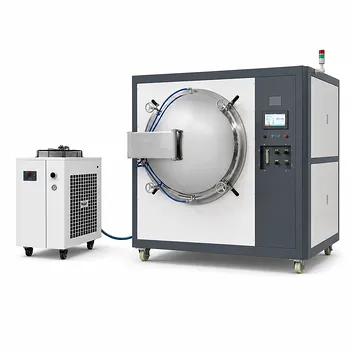
A vacuum hot-pressing furnace serves as a unified processing environment that simultaneously applies high temperature, mechanical pressure, and vacuum conditions to raw powder mixtures. For Fe-Cu-Ni-Sn-VN composites specifically, this equipment acts as a catalyst for rapid densification, driving grain rearrangement and atomic diffusion to produce a material with superior mechanical properties.
Core Takeaway The furnace functions not merely as a heater, but as a kinetic accelerator. By combining 30 MPa of pressure with temperatures up to 1000°C in a vacuum, it forces the precipitation of nano-scale vanadium nitride particles within the iron matrix, directly transforming the composite's hardness and wear resistance.
The Mechanisms of Densification
Simultaneous Application of Heat and Pressure
The primary function of the furnace is to create a synergy between thermal energy and mechanical force. While temperatures between 800°C and 1000°C soften the metallic components and activate sintering, the simultaneous application of 30 MPa of pressure physically forces the particles together.
Grain Rearrangement and Flow
In a pressureless environment, particles rely solely on diffusion to bond. In this furnace, the applied pressure mechanically rearranges the powder grains, filling voids and accelerating material flow. This results in rapid densification that would be difficult to achieve through heat alone.
Enhanced Atomic Diffusion
The mechanical pressure increases the contact area between powder particles. Tighter contact points effectively shorten the diffusion distance for atoms, allowing them to migrate across grain boundaries more efficiently. This creates a denser, more cohesive solid structure in less time.
Microstructural Control and Chemistry
Oxidation Prevention via Vacuum
The vacuum environment is critical for the integrity of metallic components like Iron (Fe) and Copper (Cu). By removing oxygen from the chamber, the furnace prevents the formation of oxide layers on the particle surfaces. This ensures that the bonds formed are purely metallic, which is essential for high strength.
Nano-Scale Precipitation
For this specific composite (Fe-Cu-Ni-Sn-VN), the furnace environment plays a distinct metallurgical role. The processing conditions encourage the precipitation of nano-scale vanadium nitride (VN) particles distributed within the alpha-Fe (iron) matrix.
Impact on Wear Resistance
This specific microstructure—hard VN nanoparticles reinforced within a soft iron matrix—is the key to the material's performance. The furnace allows this structure to form uniformly, significantly improving the composite's overall hardness and resistance to wear.
Understanding the Trade-offs
The Cost of Precision
While vacuum hot pressing offers superior material properties, it is a batch process that is generally slower and more expensive than continuous sintering methods. It is best reserved for high-performance applications where material density and purity are non-negotiable.
Parameter Sensitivity
The synergy of the system relies on precise balance. Excessive heating rates can cause thermal stress or abnormal grain growth, while insufficient pressure may leave residual porosity. The equipment requires exact control over the heating rate and pressure ramp-up to avoid structural defects.
Making the Right Choice for Your Goal
To maximize the utility of a vacuum hot-pressing furnace for these composites, consider your specific performance targets:
- If your primary focus is Wear Resistance: Ensure your process parameters (800-1000°C) are strictly maintained to maximize the precipitation of nano-scale vanadium nitride particles.
- If your primary focus is Structural Integrity: Prioritize the vacuum level and pressure application (30 MPa) to eliminate porosity and prevent oxidation of the Fe and Cu components.
The vacuum hot-pressing furnace is the definitive tool for converting loose alloy powder into a dense, high-performance composite capable of withstanding extreme mechanical stress.
Summary Table:
| Feature | Parameter | Impact on Fe-Cu-Ni-Sn-VN Composite |
|---|---|---|
| Temperature | 800°C - 1000°C | Softens metal components and activates sintering process. |
| Pressure | 30 MPa | Drives grain rearrangement and eliminates residual porosity. |
| Environment | Vacuum | Prevents oxidation of Fe/Cu and ensures strong metallic bonding. |
| Microstructure | Nano-Precipitation | Promotes VN nanoparticle distribution for extreme wear resistance. |
Elevate Your Material Science with KINTEK Precision
Unlock the full potential of your Fe-Cu-Ni-Sn-VN composites with KINTEK’s industry-leading vacuum hot-pressing furnaces. As specialists in high-performance laboratory equipment, we provide the precise thermal and mechanical control necessary to achieve near-theoretical density and optimal nano-scale precipitation.
Our extensive portfolio supports every stage of your research and production, featuring:
- Advanced Furnaces: Muffle, tube, vacuum, and specialized CVD/PECVD systems.
- Sample Preparation: Precision crushing, milling, sieving, and hydraulic presses (pellet, hot, isostatic).
- Specialized Lab Tools: High-temperature high-pressure reactors, autoclaves, and electrolytic cells.
- Essential Consumables: High-purity ceramics, crucibles, and PTFE products.
Ready to achieve superior mechanical properties? Contact KINTEK today to consult with our experts on the perfect solution for your lab’s unique requirements.
Related Products
- Vacuum Hot Press Furnace Heated Vacuum Press Machine Tube Furnace
- 600T Vacuum Induction Hot Press Furnace for Heat Treat and Sintering
- Vacuum Hot Press Furnace Machine Heated Vacuum Press
- Vacuum Hot Press Furnace Machine for Lamination and Heating
- Vacuum Heat Treat and Pressure Sintering Furnace for High Temperature Applications
People Also Ask
- What advantages does a vacuum hot press furnace provide for LSLBO ceramic electrolytes? Achieve 94% Relative Density
- What role does a Vacuum Hot Press (VHP) furnace play in the densification of austenitic stainless steel 316 composites?
- What are the advantages of using a vacuum hot pressing furnace? Superior Densification for 2024Al/Gr/SiC Composites
- What are the advantages of a vacuum hot press furnace for LTPO solid electrolytes? Boost Density and Conductivity
- What core processing conditions does a vacuum hot press furnace provide? Achieve High-Density Cu-SiC/Diamond Composites