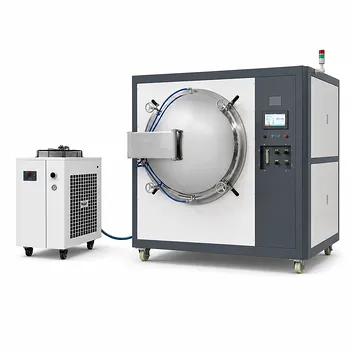
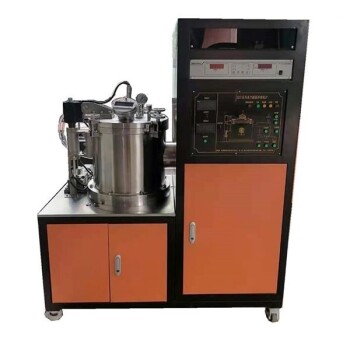
A vacuum hot pressing furnace is essential for sintering Ni-Mn-Sn-In alloys because it simultaneously applies high thermal energy and uniaxial mechanical pressure within a strictly controlled vacuum environment. This specific combination is required to forcibly promote atomic diffusion and bonding, ensuring a dense structure while completely preventing the oxidation of reactive elements.
Core Takeaway Standard sintering methods cannot achieve the density or purity required for Ni-Mn-Sn-In alloys. Vacuum hot pressing creates a "synergistic effect" of heat and pressure that physically eliminates internal pores and oxides, resulting in a mechanically superior, fine-grained microstructure.
The Synergistic Role of Pressure and Heat
Accelerating Atomic Diffusion
In a standard furnace, particles bond slowly through thermal energy alone. A hot pressing furnace adds uniaxial high pressure to this equation.
This mechanical force pushes powder particles into intimate contact. This significantly accelerates the diffusion process, causing atoms to bond across particle boundaries much faster than heat could achieve on its own.
Eliminating Internal Pores
One of the primary failure points in sintered alloys is porosity—microscopic gaps left between particles.
The simultaneous application of pressure and heat effectively squeezes these voids shut. The furnace produces a high-density microstructure by mechanically forcing the material to consolidate, virtually eliminating internal pores that would weaken the final component.
Controlling Grain Structure
Achieving the right grain size is critical for the alloy's performance.
Vacuum hot pressing promotes densification without allowing the grains to grow too large. The process typically yields a fine-grained microstructure with an average grain size of 10–12 micrometers, balancing strength with ductility.
The Critical Importance of the Vacuum Environment
Protecting Reactive Elements
Ni-Mn-Sn-In alloys contain Manganese (Mn) and Tin (Sn), both of which are highly prone to oxidation at sintering temperatures.
If oxygen were present, these elements would form oxides, degrading the material's purity. The vacuum environment ensures these elements remain in their metallic state, preserving the accuracy of the alloy's chemical composition.
Removing Trapped Gases
Powder metallurgy naturally involves gaps filled with gas between particles.
The vacuum actively removes these trapped gases before and during the compaction process. This removal is vital; if gas remained trapped during densification, it would create pressurized pockets that inhibit bonding and lower the mechanical properties of the alloy.
Understanding the Trade-offs
Equipment Complexity vs. Material Quality
Vacuum hot pressing is significantly more complex and resource-intensive than pressureless sintering.
However, for Ni-Mn-Sn-In alloys, this complexity is a necessary trade-off. Attempting to sinter these specific alloys without the vacuum or pressure usually results in porous, oxidized samples that fail to meet performance standards.
The Need for Post-Sintering Treatment
While this process creates a dense, pore-free material, it introduces internal stresses due to the high mechanical pressure.
Users should be aware that a dense "as-sintered" sample often requires a subsequent annealing step (typically between 873 K and 1073 K). This secondary heat treatment relieves internal stress and homogenizes the composition, optimizing the material's martensitic transformation properties.
Achieving Optimal Alloy Properties
To successfully fabricate Ni-Mn-Sn-In alloys, you must prioritize the specific mechanisms that drive densification and purity.
- If your primary focus is Chemical Purity: Rely on the high-vacuum capability to prevent the oxidation of Manganese and Tin, ensuring the alloy matches your precise compositional targets.
- If your primary focus is Mechanical Density: Leverage the uniaxial pressure to mechanically eliminate porosity and achieve a fine grain size (10-12 $\mu$m) that thermal sintering alone cannot produce.
By utilizing a vacuum hot pressing furnace, you transition from simple particle adhesion to true structural consolidation, ensuring the final alloy achieves its maximum potential performance.
Summary Table:
| Feature | Vacuum Hot Pressing Impact on Ni-Mn-Sn-In Alloys |
|---|---|
| Atmosphere Control | High vacuum prevents oxidation of reactive Mn and Sn elements. |
| Densification | Uniaxial pressure eliminates internal pores for a high-density structure. |
| Grain Size | Maintains a fine-grained microstructure (approx. 10–12 μm). |
| Atomic Diffusion | Simultaneous heat and pressure accelerate bonding across particle boundaries. |
| Mechanical Integrity | Produces superior strength and ductility compared to pressureless sintering. |
Maximize Your Material Performance with KINTEK
Precision engineering of Ni-Mn-Sn-In alloys requires the perfect balance of heat, pressure, and vacuum. KINTEK specializes in advanced laboratory equipment, including state-of-the-art vacuum hot pressing furnaces, high-temperature muffle and tube furnaces, and hydraulic presses designed for the most demanding research applications.
Whether you are focusing on battery research, metallurgical sintering, or advanced material synthesis, our comprehensive portfolio—from high-pressure reactors and homogenizers to precision ceramics and crucibles—ensures your lab achieves consistent, high-purity results.
Ready to elevate your sintering process? Contact KINTEK experts today for a tailored solution!
Related Products
- Vacuum Hot Press Furnace Machine for Lamination and Heating
- 600T Vacuum Induction Hot Press Furnace for Heat Treat and Sintering
- Vacuum Hot Press Furnace Heated Vacuum Press Machine Tube Furnace
- Vacuum Hot Press Furnace Machine Heated Vacuum Press
- Vacuum Heat Treat and Pressure Sintering Furnace for High Temperature Applications
People Also Ask
- What advantages does a vacuum hot press furnace provide for LSLBO ceramic electrolytes? Achieve 94% Relative Density
- Why is it necessary to maintain a high-vacuum environment within a vacuum hot press furnace? Optimize Cu-SiC Sintering
- What are the advantages of using a vacuum hot press furnace for sintering CNT/Cu composites? Superior Density & Bonding
- What are the advantages of a vacuum hot press furnace for W-50%Cu? Achieve 99.6% Density at Lower Temperatures
- What role does mechanical pressure play during the vacuum diffusion bonding of tungsten and copper? Keys to Solid Bonding