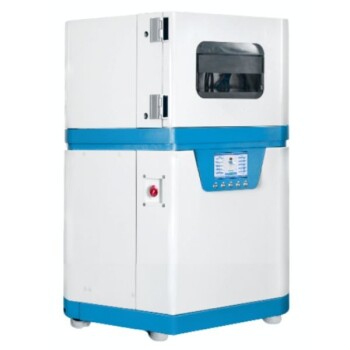
The critical role of a vacuum hot press furnace is to facilitate liquid-phase sintering within a strictly controlled, oxidation-free environment.
By maintaining a high vacuum while strictly controlling temperatures around 1430°C, the furnace enables the steel matrix to enter a liquid phase without degrading. This process promotes deep atomic diffusion and wetting between the steel and the titanium carbide (TiC) particles, allowing the composite to achieve a relative density exceeding 99 percent.
Core Takeaway Achieving structural integrity in TiC-reinforced steel matrix composites requires more than just heat; it requires the elimination of atmospheric interference. The vacuum hot press furnace acts as a hermetic chamber that prevents oxidation, ensuring the steel matrix can liquefy and fully wet the ceramic particles to form a near-perfectly dense material.
Creating the Optimal Conditions for Densification
The densification of composite materials is a delicate balance of thermodynamics and mechanics. A vacuum hot press furnace manages this balance by controlling three critical variables simultaneously.
The Necessity of a High-Vacuum Environment
At elevated temperatures, metal matrices and ceramic reinforcements are highly reactive to oxygen. The vacuum hot press evacuates air to create a clean environment.
This prevents the oxidation of both the steel matrix and the TiC particles. Without this vacuum, oxide layers would form on the particle surfaces, inhibiting the bonding process and compromising the final material properties.
Precision High-Temperature Control
To achieve high density, the steel matrix must undergo a specific phase change. The furnace provides precise temperature control, specifically targeting ranges such as 1430°C.
This temperature is sufficient to induce liquid-phase sintering in the steel matrix. The precise regulation ensures the metal melts sufficiently to flow around the reinforcement without overheating, which could lead to excessive grain growth or degradation.
The Role of Mechanical Pressure
While the primary reference highlights liquid-phase sintering, the "press" aspect of the furnace adds a mechanical advantage. External pressure is applied to the material while it is in a softened or liquid state.
This mechanical force physically collapses voids and pores that surface tension alone might not eliminate. It forces the matrix material into the interstitial spaces between TiC particles, ensuring near-full density.
Mechanisms of Microstructure Formation
The furnace does not simply compact the powder; it fundamentally alters the microstructure through chemical and physical interactions.
Facilitating Liquid-Phase Sintering
The core mechanism for this specific composite is liquid-phase sintering. The furnace holds the material at a temperature where the steel matrix becomes liquid.
In this state, the liquid steel rearranges itself, filling gaps between the solid TiC particles. This is the primary driver for increasing the relative density from a porous "green" state to a solid component.
Promoting Atomic Diffusion and Wetting
For a composite to act as a single material, the matrix and reinforcement must bond at the atomic level. The vacuum environment is critical here, as it ensures chemically clean surfaces.
These clean surfaces allow the liquid steel to "wet" the TiC particles effectively. This wetting facilitates atomic diffusion across the interface, creating a strong metallurgical bond rather than a simple mechanical interlock.
Controlled Cooling and Crystallization
The process concludes with a controlled cooling phase, often referred to as furnace cooling.
This gradual reduction in temperature allows the microstructure to develop uniformly. It prevents the formation of thermal stress cracks and ensures the steel matrix crystallizes in a stable, consistent pattern around the TiC reinforcement.
Understanding the Trade-offs
While vacuum hot pressing is the gold standard for density, it is not without operational challenges.
Process Complexity and Cycle Time
The requirement to pump a chamber down to a high vacuum and then heat it to 1430°C results in long cycle times.
This process involves slow heating rates to maintain uniformity and slow cooling rates to control microstructure. It is significantly slower than continuous sintering methods, making it less ideal for high-volume mass production.
Size and Geometry Limitations
The application of uniaxial mechanical pressure typically limits the geometry of the parts produced.
Vacuum hot press furnaces are generally best suited for simple shapes, such as plates or discs. Producing complex, near-net-shape components often requires additional machining or alternative processing methods.
Making the Right Choice for Your Goal
When deciding if a vacuum hot press furnace is the correct tool for your manufacturing process, consider your specific performance targets.
- If your primary focus is maximum density: This is the definitive solution for achieving >99% relative density and eliminating residual porosity.
- If your primary focus is interfacial strength: The vacuum environment is non-negotiable for preventing oxidation and ensuring proper wetting between the steel matrix and TiC particles.
- If your primary focus is throughput: Be aware that the batch nature and long cycle times of this equipment may require a trade-off between production speed and material quality.
Ultimately, the vacuum hot press furnace is the bridge between loose composite powders and a high-performance, structural material capable of withstanding extreme conditions.
Summary Table:
| Key Feature | Role in TiC-Steel Densification | Impact on Material Quality |
|---|---|---|
| High Vacuum | Prevents oxidation of steel matrix and TiC particles | Ensures clean surfaces for strong atomic bonding |
| 1430°C Control | Facilitates liquid-phase sintering | Enables matrix flow into interstitial spaces |
| Mechanical Pressure | Physically collapses voids and pores | Eliminates residual porosity for >99% density |
| Controlled Cooling | Uniform crystallization of the matrix | Prevents thermal stress cracks and improves stability |
Elevate Your Material Science with KINTEK
Unlock the full potential of your composite research and manufacturing with KINTEK’s high-performance vacuum hot press furnaces. Whether you are developing TiC-reinforced steel matrix composites or advanced ceramics, our equipment provides the extreme vacuum environments and precision temperature control required for near-perfect densification.
Beyond hot pressing, KINTEK specializes in a comprehensive range of laboratory solutions, including:
- Advanced Furnaces: Muffle, tube, rotary, CVD, and induction melting systems.
- Sample Preparation: Crushing, milling, sieving, and hydraulic pellet presses.
- Specialized Reactors: High-temperature high-pressure reactors and autoclaves.
- Electrochemistry: Electrolytic cells, electrodes, and battery research tools.
- Lab Essentials: ULT freezers, freeze dryers, and high-quality PTFE/ceramic consumables.
Ready to achieve >99% relative density in your materials? Contact our technical experts today to find the perfect furnace or laboratory system tailored to your specific application.
Related Products
- Vacuum Hot Press Furnace Heated Vacuum Press Machine Tube Furnace
- 600T Vacuum Induction Hot Press Furnace for Heat Treat and Sintering
- Vacuum Hot Press Furnace Machine Heated Vacuum Press
- Vacuum Hot Press Furnace Machine for Lamination and Heating
- Vacuum Heat Treat and Pressure Sintering Furnace for High Temperature Applications
People Also Ask
- What advantages does a vacuum hot press furnace provide for LSLBO ceramic electrolytes? Achieve 94% Relative Density
- What role does a Vacuum Hot Press (VHP) furnace play in the densification of austenitic stainless steel 316 composites?
- What are the advantages of using a vacuum hot pressing furnace? Superior Densification for 2024Al/Gr/SiC Composites
- What are the advantages of a vacuum hot press furnace for LTPO solid electrolytes? Boost Density and Conductivity
- What core processing conditions does a vacuum hot press furnace provide? Achieve High-Density Cu-SiC/Diamond Composites