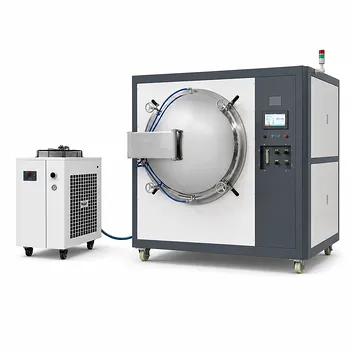
Vacuum Hot-Pressing (VHP) fundamentally outperforms traditional sintering for Ti-6Al-4V alloy preparation by applying mechanical pressure and thermal energy simultaneously.
While traditional equipment often relies solely on thermal diffusion, leading to residual porosity, VHP utilizes uniaxial pressure (typically 30 MPa) alongside high temperatures (900-1300°C). This dual-action approach forces material consolidation, achieving densities up to 98% of the theoretical maximum, resulting in mechanical properties comparable to forged metals.
Core Takeaway The defining advantage of a Vacuum Hot-Pressing Furnace is its ability to eliminate the residual porosity inherent in pressureless sintering. By driving consolidation through plastic deformation and diffusion creep, VHP produces Ti-6Al-4V components with superior density, finer grain structures, and exceptional chemical purity.
Achieving Superior Density and Strength
Overcoming Porosity Limits
Traditional pressureless sintering depends on time and temperature to bond particles, often leaving microscopic voids (pores) in the material. VHP introduces an external mechanical force that physically collapses these voids.
Mechanisms of Consolidation
The application of 30 MPa of pressure activates plastic deformation and diffusion creep. These mechanisms physically move material to fill gaps that thermal energy alone cannot resolve, ensuring the alloy forms a solid, cohesive mass.
Forged-Like Mechanical Properties
Because the material reaches near-theoretical density (98%), the resulting Ti-6Al-4V blocks exhibit strength and durability similar to forged materials. This is a significant upgrade over the lower-density structures often produced by conventional sintering.
Optimizing Microstructure
Lowering Processing Temperatures
The addition of mechanical pressure significantly reduces the activation energy required for sintering. This allows densification to occur at lower temperatures than those required for full melting or conventional sintering.
Inhibiting Grain Growth
High temperatures held for long periods typically cause grains to grow large, which weakens the metal. By sintering at lower temperatures and for shorter durations (often 10–15 minutes), VHP effectively inhibits excessive grain growth.
Resulting Material Properties
The process yields a fine-grained, uniform microstructure. For Ti-6Al-4V, this microstructural refinement directly translates to enhanced hardness and superior tensile strength.
Ensuring Chemical Purity (The Vacuum Advantage)
Preventing Embrittlement
Titanium alloys have a high chemical affinity for oxygen and nitrogen at elevated temperatures. The vacuum environment is critical because it prevents oxidation and nitriding, reactions that typically make titanium brittle and unusable.
Controlling Interstitial Elements
By maintaining a stable high vacuum, VHP strictly controls the content of interstitial elements. This ensures the material maintains its intended ductility and fracture toughness rather than succumbing to contamination-induced failure.
Active Degassing
The vacuum process actively facilitates the escape of gaseous byproducts and removes gases dissolved within the metal powder. This cleaning action occurs before the liquid phase appears, improving wettability and further enhancing the internal integrity of the alloy.
Understanding the Trade-offs
Process Constraints
While VHP produces superior material properties, it is generally a batch process bounded by the size of the die. Unlike continuous sintering furnaces, VHP is often limited to simpler geometries (blocks or cylinders) that may require subsequent machining.
Cost vs. Performance
The equipment and cycle times for VHP can be more intensive than simple atmospheric furnaces. However, for high-performance applications, this cost is often offset by the elimination of secondary processing steps (like Hot Isostatic Pressing) and the reduction of scrap rates due to material defects.
Making the Right Choice for Your Goal
To determine if VHP is the correct equipment for your specific Ti-6Al-4V application, consider your performance requirements:
- If your primary focus is maximum mechanical strength: Choose VHP to achieve near-100% density and forged-like properties through pressure-assisted consolidation.
- If your primary focus is microstructural control: Use VHP to leverage lower sintering temperatures, which prevent grain coarsening and ensure high hardness.
- If your primary focus is material purity: Rely on VHP's vacuum environment to prevent oxygen contamination and brittleness, which is non-negotiable for aerospace or medical titanium applications.
Summary: Use Vacuum Hot-Pressing when the goal is to produce a dense, fine-grained, and chemically pure Ti-6Al-4V component that demands the structural integrity of a forged part.
Summary Table:
| Feature | Traditional Sintering | Vacuum Hot-Pressing (VHP) |
|---|---|---|
| Mechanism | Thermal diffusion only | Thermal energy + Uniaxial pressure |
| Final Density | Residual porosity likely | Up to 98% (Near-theoretical) |
| Grain Structure | Prone to grain growth | Fine-grained (low temp/fast cycle) |
| Purity Control | Limited atmosphere control | High vacuum (no oxidation/nitriding) |
| Material Properties | Standard sintered quality | Comparable to forged metals |
Elevate Your Material Research with KINTEK Precision
Unlock the full potential of your Ti-6Al-4V alloys with KINTEK’s advanced Vacuum Hot-Pressing furnaces. Our technology ensures superior densification, microstructural refinement, and unmatched chemical purity for high-performance applications in aerospace, medical, and defense industries.
As a global leader in laboratory solutions, KINTEK offers a comprehensive range of high-temperature equipment, including:
- Thermal Systems: Muffle, tube, rotary, vacuum, and atmosphere furnaces.
- Advanced Processing: CVD, PECVD, MPCVD, and induction melting systems.
- Pressure & Consolidation: Hydraulic presses (pellet, hot, isostatic) and high-pressure reactors.
- Lab Essentials: Crushing and milling systems, cooling solutions (ULT freezers), and high-quality PTFE or ceramic consumables.
Ready to achieve forged-like integrity in your sintered components? Contact our technical experts today to find the perfect solution for your lab's specific needs.
Related Products
- Vacuum Hot Press Furnace Heated Vacuum Press Machine Tube Furnace
- 600T Vacuum Induction Hot Press Furnace for Heat Treat and Sintering
- Vacuum Hot Press Furnace Machine Heated Vacuum Press
- Vacuum Hot Press Furnace Machine for Lamination and Heating
- Vacuum Heat Treat and Pressure Sintering Furnace for High Temperature Applications
People Also Ask
- What advantages does a vacuum hot press furnace provide for LSLBO ceramic electrolytes? Achieve 94% Relative Density
- What role does a Vacuum Hot Press (VHP) furnace play in the densification of austenitic stainless steel 316 composites?
- What are the advantages of using a vacuum hot pressing furnace? Superior Densification for 2024Al/Gr/SiC Composites
- What are the advantages of a vacuum hot press furnace for LTPO solid electrolytes? Boost Density and Conductivity
- What core processing conditions does a vacuum hot press furnace provide? Achieve High-Density Cu-SiC/Diamond Composites