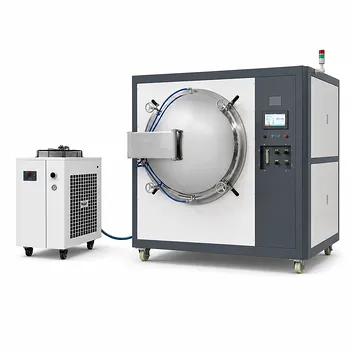
The core function of a vacuum hot press sintering furnace is to consolidate Silicon Carbide whisker (SiCw) reinforced 2024 aluminum composite powders into a high-density solid without melting the metal matrix.
By simultaneously applying mechanical pressure, high temperature, and a high vacuum, the furnace drives rapid densification through atomic diffusion and plastic flow. This specific environment is engineered to remove adsorbed gases and, most critically, inhibit the chemical reactions that create brittle phases like Aluminum Carbide (Al4C3).
Core Takeaway The vacuum hot press does not merely "heat" the material; it mechanically forces the solid particles to bond while chemically purifying the environment. This achieves near 100% theoretical density and prevents the formation of brittle interfacial compounds that would otherwise compromise the composite's structural integrity.
The Mechanics of Solid-State Densification
Driving Plastic Flow
The furnace operates at temperatures below the melting point of the 2024 aluminum alloy.
Instead of melting the metal to fill voids, the equipment utilizes mechanical pressure to force the aluminum particles to deform plastically.
This physical deformation fills the gaps between the hard Silicon Carbide whiskers and the aluminum powder, eliminating internal porosity.
Facilitating Atomic Diffusion
Simultaneously, the high thermal energy activates the atoms within the metal matrix.
This triggers atomic diffusion, where atoms migrate across the boundaries of the touching particles.
This process welds the particles together at a molecular level, creating a continuous, solid matrix around the reinforcement whiskers.
The Critical Role of the Vacuum
Eliminating Adsorbed Gases
Aluminum powder has a high surface area and naturally holds onto gases and moisture.
The vacuum environment extracts these volatile impurities and adsorbed gases from the gaps between powder particles before the material seals shut.
Without this degassing step, trapped gases would form pores or voids in the final product, drastically reducing mechanical strength.
Preventing Oxidation and Brittle Phases
Aluminum is highly reactive with oxygen. The vacuum minimizes the oxygen partial pressure, preventing the aluminum matrix from oxidizing during the heating cycle.
More importantly, the vacuum helps control the chemical interaction between the Aluminum matrix and the Silicon Carbide whiskers.
By strictly controlling the environment, the furnace inhibits the formation of Aluminum Carbide (Al4C3). This is a brittle reaction product that forms at the interface; if allowed to grow, it acts as a crack initiation site and weakens the material.
Enhancing Wettability
The removal of surface oxide layers and impurities significantly improves wettability.
This ensures that the aluminum matrix bonds tightly to the surface of the Silicon Carbide whiskers, resulting in superior metallurgical bonding strength.
Understanding the Trade-offs
While vacuum hot pressing is effective, it requires a delicate balance of processing parameters.
The Risk of Overheating
If the temperature is too high, even in a vacuum, the reaction kinetics accelerate.
This can lead to excessive interfacial reactions, creating thick layers of brittle Aluminum Carbide (Al4C3) that degrade the composite's ductility.
The Limitation of Geometry
Hot pressing relies on a uniaxial force (pressure applied in one direction).
This limits the process effectively to simple geometries, such as plates or discs. It is generally not suitable for creating complex, near-net-shape components without significant post-process machining.
Making the Right Choice for Your Goal
To maximize the performance of SiCw/2024Al composites, you must tune the furnace parameters to your specific performance requirements.
- If your primary focus is Maximum Density: Prioritize higher mechanical pressure to force plastic flow and eliminate residual pores, ensuring the material reaches near 100% theoretical density.
- If your primary focus is Fracture Toughness: Prioritize strict temperature control and high vacuum levels to minimize the formation of brittle Al4C3 phases at the fiber-matrix interface.
Success in this process relies on achieving a solid metallurgical bond while suppressing the chemical reactions that lead to brittleness.
Summary Table:
| Feature | Function in SiCw/2024Al Consolidation | Benefit to Composite Quality |
|---|---|---|
| Mechanical Pressure | Drives plastic flow and particle deformation | Eliminates porosity and reaches near-theoretical density |
| High Temperature | Activates atomic diffusion across boundaries | Creates a continuous solid matrix and molecular welding |
| High Vacuum | Extracts adsorbed gases and volatile impurities | Prevents internal voids and ensures material purity |
| Atmosphere Control | Inhibits Aluminum Carbide (Al4C3) formation | Prevents interfacial brittleness and crack initiation |
| Oxide Removal | Enhances wettability between Al and SiC | Ensures superior metallurgical bonding strength |
Elevate Your Material Performance with KINTEK
Precision is paramount when consolidating advanced composites like SiCw-reinforced aluminum. KINTEK specializes in high-performance laboratory equipment, offering state-of-the-art vacuum hot press sintering furnaces designed to provide the exact temperature and pressure control required to prevent brittle phases and maximize density.
Beyond sintering, our portfolio supports every stage of your research with:
- Crushing, milling, and sieving systems for powder preparation.
- High-temperature high-pressure reactors and autoclaves for advanced synthesis.
- Precision hydraulic presses and essential ceramic/crucible consumables.
Ready to achieve near 100% theoretical density in your next project? Contact our technical experts today to find the ideal solution for your laboratory needs.
Related Products
- 600T Vacuum Induction Hot Press Furnace for Heat Treat and Sintering
- Vacuum Heat Treat and Sintering Furnace with 9MPa Air Pressure
- Vacuum Heat Treat and Pressure Sintering Furnace for High Temperature Applications
- 2200 ℃ Tungsten Vacuum Heat Treat and Sintering Furnace
- Vacuum Hot Press Furnace Heated Vacuum Press Machine Tube Furnace
People Also Ask
- What role does an induction vacuum hot pressing furnace play in sintering? Achieve 98% Density in Carbide Blocks
- What advantages does a vacuum hot press furnace provide for LSLBO ceramic electrolytes? Achieve 94% Relative Density
- What role does a Vacuum Hot Press (VHP) furnace play in the densification of austenitic stainless steel 316 composites?
- What role does mechanical pressure play during the vacuum diffusion bonding of tungsten and copper? Keys to Solid Bonding
- What are the advantages of a vacuum hot press furnace for W-50%Cu? Achieve 99.6% Density at Lower Temperatures