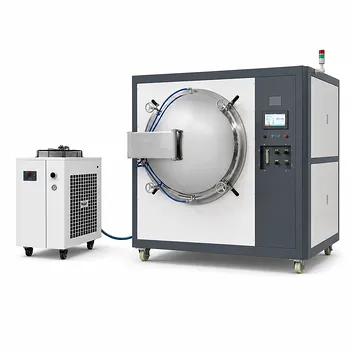
A Vacuum Hot Press (VHP) furnace functions as a synergistic processing tool that simultaneously applies thermal energy, mechanical force, and atmospheric control to synthesize aluminum and high-entropy alloy (EHEA) composites. Specifically, it creates a precise environment characterized by temperatures of 600-640°C, high vacuum levels of $10^{-3}$ Pa, and mechanical pressure of 50 MPa.
Core Takeaway The VHP furnace is not merely a heating device; it is a consolidation system that overcomes the natural barriers between aluminum and EHEA materials. By synchronizing high pressure with high temperature in a vacuum, it forces atomic diffusion and pore elimination while strictly preventing the oxidation that would otherwise compromise the composite's structural integrity.
The Three Pillars of the VHP Process
To understand how the furnace fabricates these composites, we must break down the three distinct physical conditions it imposes on the material.
Precise Thermal Activation
The furnace maintains a processing temperature range of 600-640°C.
This temperature is critical because it softens the aluminum matrix without melting the EHEA skeleton.
It provides the necessary thermal energy to activate atomic mobility, a prerequisite for bonding dissimilar metals.
High-Pressure Mechanical Consolidation
The system applies a significant uniaxial pressure of 50 MPa.
This mechanical force is required to overcome the physical resistance of the solid materials.
It forces the softer aluminum into the microscopic gaps within the EHEA structure, ensuring intimate contact at the interface.
Vacuum Atmosphere Control
The furnace operates at a high vacuum of $10^{-3}$ Pa.
This removes air and volatile contaminants from the processing chamber.
It is the primary defense mechanism against chemical degradation during the heating cycle.
Critical Functions During Fabrication
The combination of heat, pressure, and vacuum performs three specific metallurgical functions required to create a viable Al/EHEA composite.
1. Promoting Atomic Diffusion
The primary function of the VHP is to facilitate metallurgical bonding.
Mere physical contact between aluminum and EHEA is insufficient for load transfer; the atoms must intermingle.
The combination of 600-640°C heat and 50 MPa pressure drives atoms to diffuse across the boundary between the aluminum matrix and the EHEA skeleton, creating a robust, unified interface.
2. Eliminating Internal Porosity
The furnace is responsible for achieving full densification of the composite.
Porosity (voids) acts as a crack initiation point, severely weakening the final material.
The applied pressure mechanically collapses voids and forces material flow, effectively squeezing out empty space to create a solid, non-porous part.
3. Preventing Oxidation
The vacuum environment functions as a chemical shield.
Aluminum is highly reactive and forms oxides instantly when exposed to oxygen, especially at elevated temperatures.
By maintaining a vacuum of $10^{-3}$ Pa, the furnace prevents the formation of brittle oxide layers that would otherwise inhibit bonding and degrade the mechanical properties of the EHEA composite.
Understanding the Trade-offs
While VHP is essential for high-performance composites, it introduces specific constraints that must be managed.
Geometric Limitations
The uniaxial pressure (pressure applied in one direction) limits part complexity.
VHP is generally restricted to producing simple shapes, such as plates, pucks, or cylinders.
Complex geometries often require secondary machining after the hot pressing process is complete.
Cycle Efficiency
The process is inherently batch-based and time-intensive.
Achieving high vacuum and ramping temperatures up and down safely requires significant cycle time compared to continuous casting methods.
This makes VHP excellent for high-value material synthesis but less suited for high-volume mass production.
Making the Right Choice for Your Goal
To maximize the utility of a Vacuum Hot Press for Al/EHEA composites, align your process parameters with your specific performance targets.
- If your primary focus is Maximum Strength: Prioritize the pressure parameter (50 MPa) to ensure absolute elimination of porosity, as even micro-voids will reduce tensile strength.
- If your primary focus is Interface Quality: Prioritize the vacuum level ($10^{-3}$ Pa) and strict temperature control to prevent oxidation and ensure pure atomic diffusion between the matrix and the skeleton.
Success in fabricating Al/EHEA composites relies on the precise synchronization of heat to activate the metal, pressure to densify it, and vacuum to protect it.
Summary Table:
| VHP Function | Process Parameter | Impact on Al/EHEA Composite |
|---|---|---|
| Thermal Activation | 600 - 640°C | Softens Al matrix & activates atomic mobility for bonding. |
| Mechanical Consolidation | 50 MPa (Uniaxial) | Collapses internal porosity & forces material densification. |
| Atmosphere Control | $10^{-3}$ Pa Vacuum | Prevents oxidation and brittle layer formation at high temps. |
| Interface Synthesis | Combined Heat/Pressure | Facilitates metallurgical bonding through atomic diffusion. |
Elevate Your Advanced Material Synthesis with KINTEK
Precise control over temperature, pressure, and atmosphere is non-negotiable when fabricating high-performance Al/EHEA composites. KINTEK specializes in high-precision laboratory equipment designed for rigorous research environments. From our advanced vacuum hot presses and isostatic hydraulic presses to high-temperature vacuum and CVD furnaces, we provide the tools necessary to eliminate porosity and ensure superior metallurgical bonding.
Whether you are developing next-generation high-entropy alloys or optimizing battery research, our comprehensive portfolio—including high-temperature high-pressure reactors, crushing systems, and specialized ceramics—is engineered to meet your exact specifications.
Ready to achieve full densification in your composites? Contact our technical experts today to find the perfect system for your laboratory.
Related Products
- Vacuum Hot Press Furnace Heated Vacuum Press Machine Tube Furnace
- 600T Vacuum Induction Hot Press Furnace for Heat Treat and Sintering
- Vacuum Hot Press Furnace Machine Heated Vacuum Press
- Vacuum Hot Press Furnace Machine for Lamination and Heating
- Vacuum Heat Treat and Pressure Sintering Furnace for High Temperature Applications
People Also Ask
- What advantages does a vacuum hot press furnace provide for LSLBO ceramic electrolytes? Achieve 94% Relative Density
- What role does a Vacuum Hot Press (VHP) furnace play in the densification of austenitic stainless steel 316 composites?
- What are the advantages of using a vacuum hot pressing furnace? Superior Densification for 2024Al/Gr/SiC Composites
- What are the advantages of a vacuum hot press furnace for LTPO solid electrolytes? Boost Density and Conductivity
- What core processing conditions does a vacuum hot press furnace provide? Achieve High-Density Cu-SiC/Diamond Composites