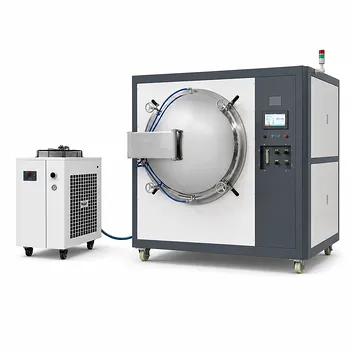
The primary role of a vacuum hot press furnace in the preparation of Cd2SnO4 targets is to facilitate pressure-assisted sintering. By applying axial pressure simultaneously with high temperature, the furnace forces the powder to densify more efficiently than thermal energy alone could achieve.
The vacuum hot press furnace acts as a catalyst for structural integrity, utilizing mechanical pressure to achieve high density and fine grain structures at significantly lower temperatures and faster speeds than traditional pressureless methods.
The Mechanics of Pressure-Assisted Sintering
Simultaneous Heat and Pressure
The defining characteristic of this furnace is its ability to create an environment where high temperature and axial pressure are applied at the same time.
While traditional sintering relies solely on heat to fuse particles, the addition of mechanical pressure drastically alters the kinetics of the process.
Particle Rearrangement and Flow
The applied pressure actively drives the rearrangement of powder particles.
As the material heats up, the pressure induces plastic flow and diffusion, physically forcing the Cd2SnO4 particles to slide into void spaces and bond together.
Advantages Over Traditional Methods
Lower Thermal Budget
Because mechanical pressure aids the densification process, the furnace can operate at lower temperatures than pressureless sintering requires.
This is critical for materials that might degrade or suffer from excessive grain growth at higher thermal thresholds.
Accelerated Processing
The combination of forces results in a much shorter sintering duration.
The external pressure accelerates the diffusion mechanisms, allowing the target to reach its final state rapidly without the long soak times typical of standard furnaces.
Impact on Target Quality
Maximizing Density
The primary output goal is the production of high-density Cd2SnO4 targets.
By mechanically eliminating pores during the sintering phase, the furnace ensures the final target is solid and robust, which is essential for consistent sputtering performance.
Fine Grain Structure
The process promotes a fine grain structure within the target.
Because the process is faster and occurs at lower temperatures, the individual grains do not have time to grow excessively large, preserving the material's desired microstructural properties.
Understanding the Trade-offs
Equipment Complexity
While effective, vacuum hot pressing is inherently more complex than pressureless sintering.
It requires precise synchronization of vacuum levels, thermal ramps, and hydraulic pressure systems, making the process parameters more critical to manage than in a standard oven.
Geometry Limitations
The application of uniaxial pressure generally limits the geometry of the target.
This method is ideal for flat, disc-like shapes (targets) but is less suitable for complex, non-symmetrical 3D components compared to pressureless sintering or isostatic pressing.
Making the Right Choice for Your Goal
When selecting a preparation method for transparent conductive targets, consider your specific performance requirements.
- If your primary focus is target longevity and performance: Prioritize this method to achieve the high density required to prevent arcing and ensure uniform erosion during sputtering.
- If your primary focus is process efficiency: Leverage vacuum hot pressing to reduce the thermal cycle time and energy consumption compared to conventional sintering.
The vacuum hot press furnace transforms the challenge of densifying Cd2SnO4 from a purely thermal process into a mechanical one, ensuring superior structural quality with greater efficiency.
Summary Table:
| Feature | Vacuum Hot Press Sintering | Traditional Pressureless Sintering |
|---|---|---|
| Mechanism | Simultaneous Heat + Axial Pressure | Thermal Energy Only |
| Densification | High (Enhanced particle rearrangement) | Moderate (Limited by diffusion) |
| Grain Size | Fine (Reduced grain growth) | Coarse (Due to high heat/time) |
| Sintering Temp | Lower (Reduces thermal degradation) | Higher (Required for bonding) |
| Process Speed | Accelerated / Shorter Duration | Slow / Long Soak Times |
Elevate Your Material Research with KINTEK Precision Solutions
Are you looking to achieve superior density and structural integrity for your Cd2SnO4 targets or advanced ceramics? KINTEK specializes in high-performance vacuum hot press furnaces and hydraulic presses (pellet, hot, isostatic) designed to meet the rigorous demands of laboratory and industrial research.
Beyond sintering, our comprehensive portfolio includes high-temperature furnaces (muffle, tube, vacuum, CVD), crushing and milling systems, and battery research tools, ensuring you have the right equipment for every stage of your material development. Partner with KINTEK to benefit from our expertise in precision thermal processing and robust laboratory consumables.
Ready to optimize your thin-film target production? Contact KINTEK today for a custom consultation!
Related Products
- Vacuum Hot Press Furnace Heated Vacuum Press Machine Tube Furnace
- 600T Vacuum Induction Hot Press Furnace for Heat Treat and Sintering
- Vacuum Hot Press Furnace Machine for Lamination and Heating
- Vacuum Hot Press Furnace Machine Heated Vacuum Press
- Vacuum Heat Treat and Pressure Sintering Furnace for High Temperature Applications
People Also Ask
- What advantages does a vacuum hot press furnace provide for LSLBO ceramic electrolytes? Achieve 94% Relative Density
- What role does a Vacuum Hot Press (VHP) furnace play in the densification of austenitic stainless steel 316 composites?
- What are the advantages of using a vacuum hot pressing furnace? Superior Densification for 2024Al/Gr/SiC Composites
- What are the advantages of a vacuum hot press furnace for LTPO solid electrolytes? Boost Density and Conductivity
- What core processing conditions does a vacuum hot press furnace provide? Achieve High-Density Cu-SiC/Diamond Composites