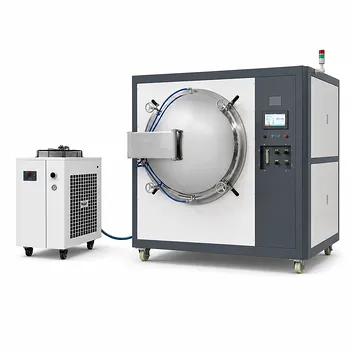
High-precision pressure control is the critical variable that governs both the material quality of Aluminum Nitride (AlN) and the structural integrity of the furnace equipment. By rigorously regulating the mechanical force applied during particle rearrangement and plastic deformation, you ensure the material reaches full density without subjecting the graphite molds to destructive stress.
Core Insight: While temperature provides the thermal energy for sintering, precise pressure control acts as the mechanical driver that forces densification at lower temperatures. It is the only mechanism that guarantees sintering additives effectively fill microscopic pores without crushing the mold due to excessive force.
The Role of Pressure in Microstructural Evolution
To understand why precision is non-negotiable, you must look at what happens inside the material during the sintering cycle.
Facilitating Particle Rearrangement
During the initial stages of sintering, AlN particles are loosely packed.
Precise pressure application forces these particles to physically move and rotate into a tighter configuration.
This mechanical particle rearrangement eliminates large voids early in the process, setting the stage for a defect-free final product.
Enhancing Liquid Phase Distribution
Sintering AlN often involves additives that create a liquid phase at high temperatures.
Consistent, stable pressure drives this liquid phase into the interstitial spaces between solid grains.
This accelerates the dense arrangement of grains, ensuring that the liquid acts as a binder that fills pores rather than pooling in isolated pockets.
Driving Plastic Deformation
As the process continues, simple rearrangement is no longer sufficient to remove remaining porosity.
Controlled pressure induces plastic flow and diffusion creep within the material.
This forces the solid material to deform and close any remaining gaps, achieving high density at temperatures (e.g., 1550°C) significantly lower than what pressureless sintering would require.
Operational Risks and Equipment Safety
Beyond material quality, pressure control is a primary safety and maintenance concern.
Preventing Mold Damage
The molds used in vacuum hot pressing, typically graphite, have finite strength limits.
If pressure control is imprecise or fluctuates upward, the force can easily exceed the mold's mechanical limits.
Excessive force leads to cracked molds, halted production, and expensive equipment repairs.
Avoiding Incomplete Densification
Conversely, if the pressure drops below the required threshold, the mechanical driving force is lost.
Insufficient pressure results in a porous ceramic that lacks the thermal conductivity and mechanical strength required of high-grade AlN.
Without the "push" of external pressure, the material cannot overcome the internal resistance to densification.
Understanding the Trade-offs
Achieving the perfect sinter requires balancing competing physical limitations.
The Balance of Force and Temperature
High pressure allows for lower sintering temperatures, which is beneficial for grain size control.
However, relying too heavily on pressure creates a narrow operating window where a slight calibration error can destroy the mold.
Reaction Control
While pressure drives density, it must be synchronized with temperature limits.
Supplementary data suggests that checking temperature is vital to prevent brittle interfacial products (like WAl12).
Therefore, pressure must be maintained precisely to allow densification before the system reaches temperatures where these adverse chemical reactions degrade the matrix.
Making the Right Choice for Your Goal
To apply this to your specific manufacturing context, consider your primary objective:
- If your primary focus is Maximum Density: Prioritize stability during the liquid phase generation to ensure additives completely fill all microscopic pores.
- If your primary focus is Equipment Longevity: Implement strict upper-limit pressure caps to prevent momentary force spikes that cause mold cracking during the plastic deformation stage.
Summary: High-precision pressure control turns a volatile manufacturing process into a repeatable science, allowing you to achieve maximum density at lower temperatures while protecting your tooling from catastrophic failure.
Summary Table:
| Stage of Sintering | Mechanical Effect | Benefit to Aluminum Nitride |
|---|---|---|
| Initial Stage | Particle Rearrangement | Eliminates large voids and optimizes grain packing |
| Intermediate Stage | Liquid Phase Distribution | Drives additives into interstitial spaces for pore filling |
| Final Stage | Plastic Deformation | Forces diffusion creep to achieve theoretical density |
| Equipment Safety | Limit Regulation | Prevents graphite mold cracking and costly downtime |
Elevate Your Advanced Ceramics Production with KINTEK
Precision is the difference between a high-performance ceramic and a failed mold. KINTEK specializes in cutting-edge laboratory equipment, including high-precision vacuum hot pressing furnaces, atmosphere furnaces, and a comprehensive range of high-temperature furnaces (muffle, tube, rotary).
Our systems are designed for researchers and manufacturers who demand absolute control over density and microstructural integrity. Whether you are working on battery research, crushing and milling, or complex high-pressure reactor applications, KINTEK provides the tools, consumables (crucibles, ceramics, and PTFE), and technical expertise to ensure your success.
Ready to optimize your sintering cycle? Contact our engineering experts today to find the perfect furnace solution for your specific material requirements.
Related Products
- 600T Vacuum Induction Hot Press Furnace for Heat Treat and Sintering
- Vacuum Heat Treat and Sintering Furnace with 9MPa Air Pressure
- Vacuum Heat Treat and Pressure Sintering Furnace for High Temperature Applications
- Vacuum Heat Treat Sintering Brazing Furnace
- Vacuum Heat Treat and Molybdenum Wire Sintering Furnace for Vacuum Sintering
People Also Ask
- What role does an induction vacuum hot pressing furnace play in sintering? Achieve 98% Density in Carbide Blocks
- What advantages does a vacuum hot press furnace provide for LSLBO ceramic electrolytes? Achieve 94% Relative Density
- What role does a Vacuum Hot Press (VHP) furnace play in the densification of austenitic stainless steel 316 composites?
- What are the advantages of a vacuum hot press furnace for W-50%Cu? Achieve 99.6% Density at Lower Temperatures
- What role does mechanical pressure play during the vacuum diffusion bonding of tungsten and copper? Keys to Solid Bonding