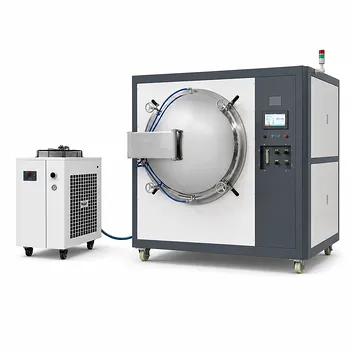
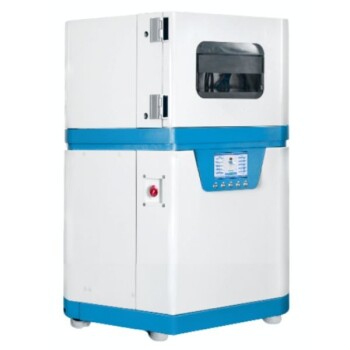
A vacuum hot pressing furnace facilitates densification by subjecting Eu:Y2O3 powder to a synergistic combination of high temperature (up to 1580°C) and uniaxial mechanical pressure (40 MPa) within a vacuum environment. This process actively forces particle diffusion and rearrangement while a specific programmed, multi-step pressurization strategy targets and eliminates gas pores at grain boundaries, ensuring the material achieves the high optical transparency required for scintillator applications.
Core Takeaway While standard sintering relies solely on thermal energy to close pores, vacuum hot pressing introduces an external mechanical driving force (pressure). This effectively "squeezes" the material to near-theoretical density, eliminating the microscopic voids that otherwise destroy optical clarity in scintillator ceramics.
The Mechanics of Pressure-Assisted Sintering
The Role of Uniaxial Pressure
The primary driver for densification in this process is the application of 40 MPa of uniaxial mechanical pressure.
Instead of relying passively on atomic diffusion, this external force physically pushes particles together. This induces particle rearrangement and plastic flow, significantly accelerating the closing of voids between grains.
Thermal Activation
Simultaneously, the furnace heats the material to approximately 1580°C.
This thermal energy increases the mobility of atoms, facilitating the diffusion necessary for particles to bond. By combining this heat with mechanical pressure, the ceramic can reach high density more efficiently than with heat alone.
Achieving Optical Transparency in Eu:Y2O3
Eliminating Gas Pores
For scintillator ceramics like Eu:Y2O3, density alone is not enough; the material must be optically transparent. The primary obstacle to transparency is residual gas trapped within the material's pores.
The vacuum hot pressing furnace addresses this through programmed, multi-step pressurization. By applying pressure in specific stages rather than all at once, the system allows trapped gases to escape before the pores seal off completely.
The Vacuum Environment
Conducting this process in a vacuum serves a dual purpose.
First, it creates a clean environment that prevents oxidation of the ceramic powder and the graphite mold. Second, it lowers the vapor pressure, aiding in the removal of volatile impurities and preventing the formation of gas pockets that would scatter light.
Understanding the Trade-offs
Geometry Limitations
Because the pressure is uniaxial (applied from the top and bottom), this method is generally limited to simple shapes, such as flat disks or plates. Complex geometries are difficult to press uniformly without creating density gradients.
Throughput and Cost
Vacuum hot pressing is a batch process. It requires heating up, pressing, and cooling down the entire furnace for each run. This makes it slower and more expensive compared to continuous pressureless sintering, though the superior optical quality often justifies the cost for high-performance scintillators.
Making the Right Choice for Your Goal
To maximize the effectiveness of vacuum hot pressing for your specific application:
- If your primary focus is Optical Clarity: Prioritize the multi-step pressurization profile to ensure all gas is evacuated before maximum density is reached.
- If your primary focus is Grain Size Control: Utilize the mechanical pressure to achieve density at slightly lower temperatures or faster rates, which inhibits excessive grain growth.
The synergy of heat, pressure, and vacuum is not just about making the material hard; it is the specific mechanism required to make Eu:Y2O3 transparent.
Summary Table:
| Feature | Parameter/Function | Benefit to Eu:Y2O3 Scintillators |
|---|---|---|
| Sintering Temp | Up to 1580°C | Increases atomic mobility and facilitates particle bonding |
| Uniaxial Pressure | 40 MPa | Forces particle rearrangement and eliminates microscopic voids |
| Environment | Vacuum (< 10^-3 Pa) | Prevents oxidation and aids in the removal of trapped gases |
| Pressurization | Multi-step Program | Targets pore elimination to ensure optical transparency |
| Process Type | Batch Processing | Produces high-performance, disk-shaped ceramic plates |
Elevate Your Advanced Material Research with KINTEK
Precision densification is the key to achieving optical excellence in scintillator ceramics. At KINTEK, we specialize in high-performance laboratory equipment designed to meet the rigorous demands of material science. Our comprehensive range of vacuum hot pressing furnaces, hydraulic presses (isostatic and pellet), and high-temperature furnaces (muffle, tube, and vacuum) provides the precise control over heat and pressure necessary for your most sensitive applications.
Whether you are developing next-generation scintillators, high-pressure reactors, or battery research tools, KINTEK offers the technical expertise and durable consumables—from graphite molds and crucibles to PTFE and ceramic products—to ensure your lab's success.
Ready to achieve theoretical density in your materials? Contact our technical specialists today to find the perfect furnace solution!
Related Products
- Vacuum Hot Press Furnace Heated Vacuum Press Machine Tube Furnace
- 600T Vacuum Induction Hot Press Furnace for Heat Treat and Sintering
- Vacuum Hot Press Furnace Machine Heated Vacuum Press
- Vacuum Hot Press Furnace Machine for Lamination and Heating
- Vacuum Heat Treat and Pressure Sintering Furnace for High Temperature Applications
People Also Ask
- What advantages does a vacuum hot press furnace provide for LSLBO ceramic electrolytes? Achieve 94% Relative Density
- What role does a Vacuum Hot Press (VHP) furnace play in the densification of austenitic stainless steel 316 composites?
- What are the advantages of using a vacuum hot pressing furnace? Superior Densification for 2024Al/Gr/SiC Composites
- What are the advantages of a vacuum hot press furnace for LTPO solid electrolytes? Boost Density and Conductivity
- What core processing conditions does a vacuum hot press furnace provide? Achieve High-Density Cu-SiC/Diamond Composites